
BERT: Ushering in the Era of Deep Bidirectional Language Understanding
BERT: Pre-training of deep bidirectional transformers for language understanding
BERT (Bidirectional Encoder Representations from Transformers) is a groundbreaking language representation model that pre-trains deep bidirectional representations from unlabeled text. By jointly conditioning on both left and right context across all layers, it achieved SOTA results on 11 NLP tasks, including a GLUE score of 80.5% and SQuAD v1.1 F1 of 93.2.
Executive Summary
TL;DR: BERT (Bidirectional Encoder Representations from Transformers) fundamentally changed NLP by proving that bidirectional pre-training is superior to the traditional left-to-right approach. By using a "Masked Language Model" objective, BERT allows the model to "see" the entire sentence at once, leading to massive jumps in performance—most notably a 7.7% absolute gain on the GLUE benchmark.
Background: Before BERT, models like OpenAI GPT were restricted by unidirectionality, while others like ELMo only combined separate directional models at the output. BERT is the first deeply bidirectional, unsupervised representation model that works across almost all NLP tasks.
The Problem: The Unidirectionality Constraint
Existing models were "bottlenecked" by their architecture. Traditional LMs are trained to predict the next word given the previous ones. While this works for generation, it is sub-optimal for understanding.
- OpenAI GPT: Uses a Transformer but can only look left.
- ELMo: Uses LSTMs to look both ways but only merges them at the very end, missing the interaction between contexts in middle layers.
The authors argued that for tasks like SQuAD (Question Answering), understanding the relationship between the question and the passage requires looking both ways simultaneously.
Methodology: How BERT "Sees" in Both Directions
The core innovation lies in two pre-training tasks that move away from "predicting the next word."
1. Masked Language Model (MLM)
Instead of predicting the next token, BERT masks 15% of the input tokens at random (the "Cloze" task). The model must use the surrounding context (both left and right) to guess the identity of the hidden word. This forces the Transformer to build a deep, bidirectional representation.
2. Next Sentence Prediction (NSP)
To handle sentence-level relationships (like Entailment or QA), BERT is trained to predict whether Sentence B actually follows Sentence A.
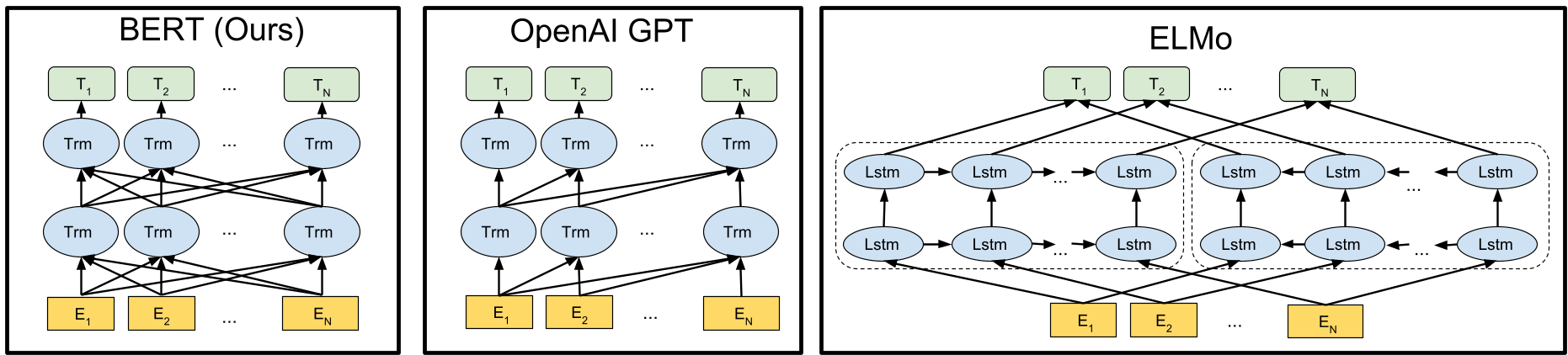 Figure: Comparison of BERT (Bidirectional), GPT (Left-to-Right), and ELMo (Shallow Bidirectional).
The Unified Architecture
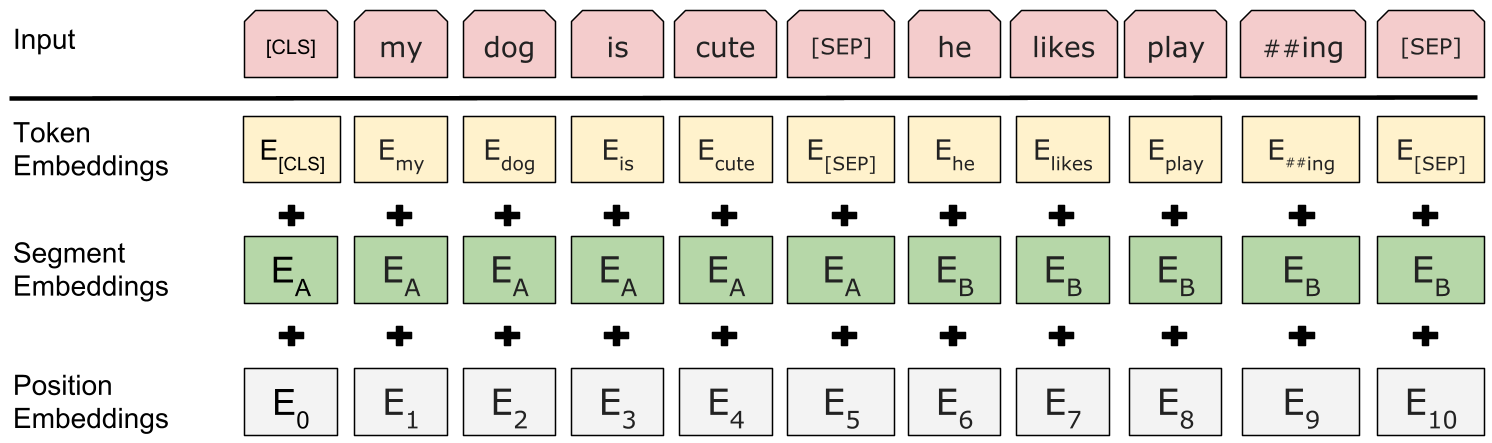
BERT uses the Transformer Encoder. It introduces a special [CLS] token at the start of every sequence for classification tasks and [SEP] tokens to separate sentence pairs. The input is a sum of Token, Segment, and Position embeddings.
Experiments and SOTA Results
BERT was tested on 11 tasks and achieved SOTA on all of them.
| Task | BERT-Base | BERT-Large | Prior SOTA |
|---|---|---|---|
| GLUE Average | 79.6 | 82.1 | 74.0 |
| SQuAD v1.1 F1 | 88.5 | 90.9 | 85.8 |
| MNLI Accuracy | 84.6 | 86.7 | 80.6 |
The Power of Scale
A key finding in the ablation studies was that model size matters immensely. Even on very small datasets like MRPC (3.6k examples), moving from the 110M parameter Base model to the 340M parameter Large model yielded significant accuracy gains. This suggests that massive pre-training allows even small downstream tasks to "inherit" high-level linguistic knowledge.
Deep Insight: Why it Works
In Section 5.1, the authors removed the NSP task and found a significant drop in performance for QA and NLI. Furthermore, they proved that a "No NSP" bidirectional model still beats a "Left-to-Right" model significantly. This confirms that deep bidirectionality is the most critical factor in BERT's success—it creates a more robust, "aware" representation of language than any previous method.
Conclusion and Takeaways
BERT marked a paradigm shift in NLP. It proved that:
- Bidirectionality is essential for language representation.
- Fine-tuning a large, pre-trained model is more effective and efficient than building task-specific architectures.
- Scalability in pre-training continues to unlock performance even for small tasks.
Limitations: BERT is computationally expensive to pre-train (4 days on 64 TPU chips for the Large version) and the "Mask" token creates a slight mismatch between pre-training and fine-tuning (though the authors mitigated this with a 80-10-10 masking strategy).
Future Outlook: The success of BERT paved the way for models that are even larger and more optimized, shifting the focus of the AI community toward "Foundation Models."