
The "Best Current Friend": Identifying Your Most Critical Links via PageRank
My Best Current Friend in a Social Network
This paper introduces the concept of the "Best Current Friend" (BCF) in Social Networks (SNs), a novel user classification based on the PageRank algorithm. The BCF is defined as the specific neighbor whose removal from a user's network would cause the maximum decrease in that user's PageRank centrality.
TL;DR
In any social network, not all friends are equal. While some contribute to your social "prestige" more than others, this paper defines the Best Current Friend (BCF): the single person whose departure would hurt your visibility the most. By applying PageRank sensitivity analysis, the authors provide a mathematical framework to identify which relationships are essential to maintain for personal or brand influence.
Background & Motivation: Moving Beyond Popularity
Standard social network analysis usually focuses on identifying "Leaders" or "Influencers" using centrality measures like Betweenness or PageRank. However, these measures are often ego-centric or global.
The authors argue that from a strategic perspective—whether you are a sales executive or a social media influencer—the critical question is not just "How important am I?" but "Whose friendship is keeping me important?"
Traditional SOTA methods identify potential friends you should have, but they often ignore the fragility of current influence. This gap led to the birth of the BCF metric.
Methodology: The Math of Social Dependency
The core of the study relies on the Google Matrix (G), which balances direct links with a "random walk" probability (damping factor ).
The BCF Algorithm
The BCF is found through a process of elimination:
- Identify In-links: Find all nodes that point to user .
- Iterative Simulation: For each neighbor , temporarily "delete" the edge .
- Impact Assessment: Recompute the PageRank for user in this modified graph.
- The BCF Selection: The neighbor whose absence results in the lowest PageRank for user is crowned the BCF.
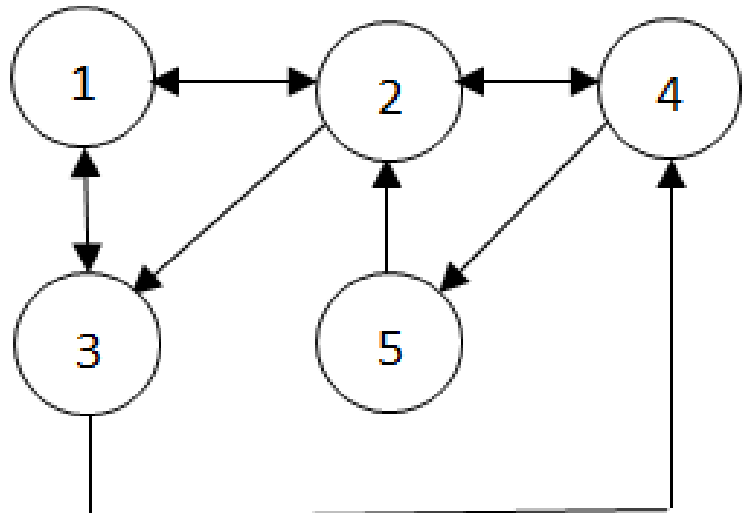 Figure 1: A directed graph representation of a social network used to calculate influence scores.
Experiments: Measuring the Loss
The paper demonstrates this using a 5-node network. While Node 2 is the "VIP" of the network with a PageRank of 0.2944, the authors analyzed what happens if its friends leave.
| Node to Disconnect | Residual PageRank of Node 2 |
|---|---|
| Node 1 | 0.2149 (BCF) |
| Node 4 | 0.2654 |
As shown, losing the connection from Node 1 causes a much steeper decline in influence than losing Node 4. Therefore, Node 1 is the BCF of Node 2.
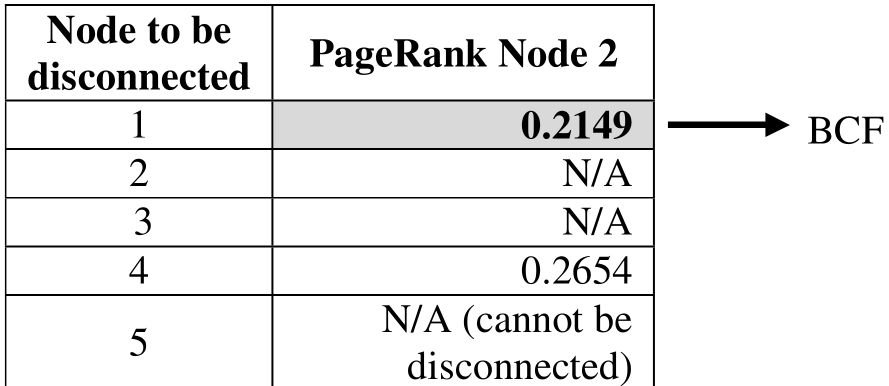 Table 2: Quantifying the impact of disconnection on the primary user's prestige.
Critical Insight & Conclusion
The BCF isn't necessarily the person with the most friends; it is the person who provides the most "authoritative" link to you.
Takeaways for the Future:
- Customer Retention: Companies can use BCF to identify which customers provide the most "referral value" or prestige to their brand's network and offer them customized services to prevent them from leaving.
- Limitations: The current method requires recomputing PageRank multiple times, which could be computationally expensive for massive networks like Twitter or Facebook without optimization (e.g., using incremental PageRank updates).
- Closing Thought: This research shifts the focus from "finding new friends" to "not losing the vital ones." In a world of fleeting digital connections, knowing your BCF might be the key to staying relevant.