
Optimized Learning Paths: Leveraging Blue-Red Trees and Rule-Space Models for Adaptive E-Learning
The Best Learning Order Inference Based on Blue-Red Trees of Rule-Space Model for Social Network -- Case in ITE Course
This paper proposes an intelligent adaptive learning framework using the Rule-Space Model and Blue-Red Trees to infer optimal learning orders for social network-based e-learning. Applied to an Information Technology Expert (ITE) course, the method utilizes the "Relation Weight" and "Confidence Level" metrics to determine the most effective sequence of learning objects.
TL;DR
In the era of networked learning, "what to learn next" is as critical as the content itself. This paper introduces a sophisticated framework using the Rule-Space Model and Blue-Red Trees to infer the optimal learning order for students. By quantifying the relationship between learning objects through Relation Weights and Confidence Levels, the researchers demonstrate a way to mathematically pinpoint the most efficient path through complex course materials, specifically validated using an ITE (Information Technology Expert) curriculum.
Background & Motivation: Beyond Static Concept Maps
Concept maps have been a staple of educational psychology since Novak, serving as visual representations of how knowledge is organized. However, static maps often fail to adapt to the diverse "learning states" of individuals. The Rule-Space Model, originally proposed by Tatsuoka, offers a way to analyze misconceptions and knowledge gaps by mapping item responses to cognitive attributes.
The core challenge this paper addresses is that while we can identify what a student knows (the learning effect), it is much harder to prescribe the order in which they should tackle new sub-concepts to minimize cognitive load and maximize retention.
Methodology: The Mechanics of Inference
The authors break down the learning process into a hierarchical structure represented by Blue-Red Trees, where "Blue" nodes signify mastered concepts and "Red" nodes signify areas requiring improvement.
1. Social Network Grouping
Learners are categorized into nine distinct groups (G1-G9) based on the distribution of their blue/red nodes. For instance:
- G1: Full mastery (All Blue).
- G3: Mastery of left-subtree nodes, failure in right-subtree nodes.
- G7/G8: Imbalanced mastery across sub-trees.
2. The Rule-Space Matrix Workflow
The process follows a rigorous mathematical progression:
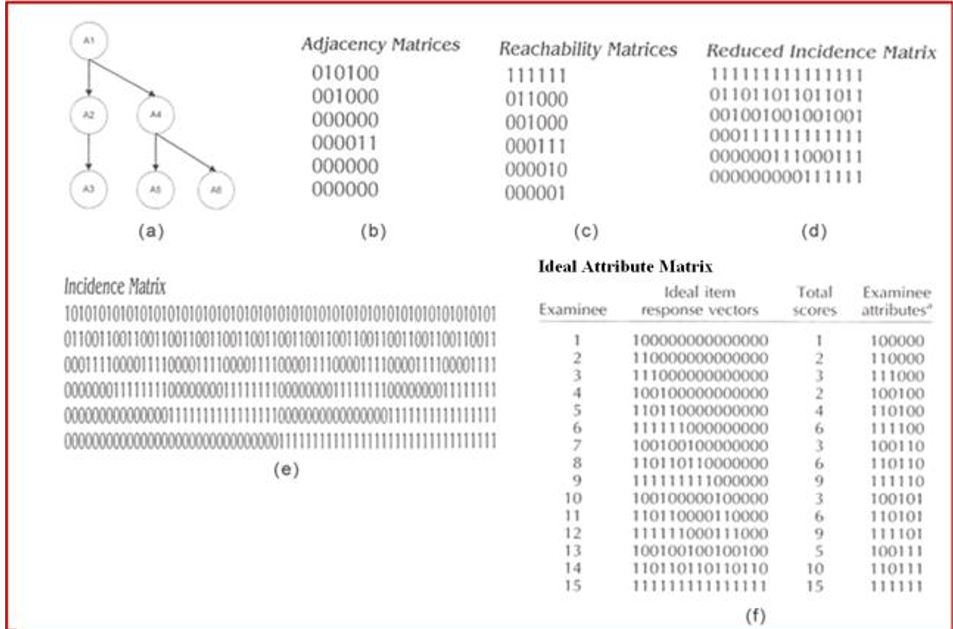
- Adjacency Matrix: Defining direct connections between nodes.
- Reachability Matrix: Identifying all possible downstream connections.
- Incidence Matrix: Mapping paths through the learning tree.
3. Quantifying the "Best" Order: Relation Weight & Confidence Level
The breakthrough of this paper lies in two specific metrics:
- Relation Weight (RW): An matrix that defines how much a concept relies on other concepts.
- Confidence Level (CL): A cross-product of weights between two adjacent learning objects.
The fundamental logic is that if the transition from to has a higher CL, the cognitive bridge between these concepts is stronger, making it a "better" learning sequence.
Experimental Case Study: The ITE Course
The researchers applied this to an ITE course involving 8 attributes, including Internet History, OSI Model, and Wireless LAN.
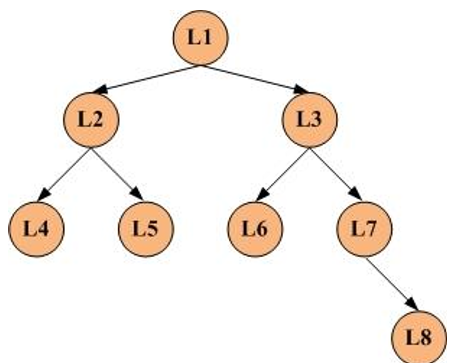
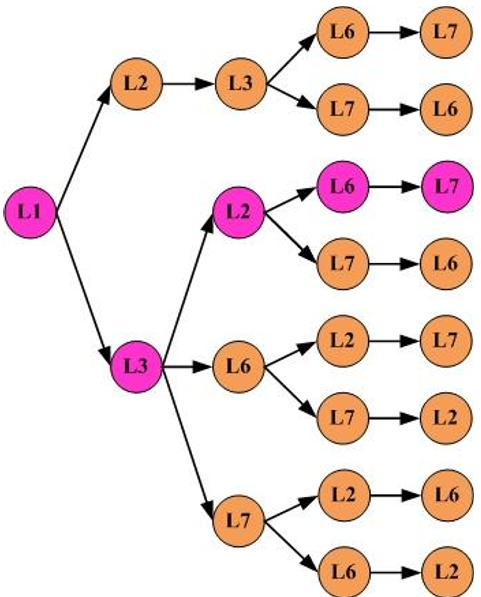
Through a 4-step calculation process, they analyzed various learning paths. For a specific sub-tree of 5 nodes, they calculated the CL for every possible transition:
- Step 1: vs. . Winner: L3.
- Step 2: Starting from L3, , outperforming L6 and L7.
- Step 3 & 4: Further iterations determined the full sequence.
The final inferred optimal order was: L1 (History) → L3 (Computing Models) → L2 (Comm. Tech) → L6 (Topologies) → L7 (LAN Standards).
Critical Insight & Practical Value
The significance of this work is its shift from descriptive analytics (what went wrong) to prescriptive analytics (what to do next). By treating a curriculum as a tree structure and applying social network grouping, the system can provide tailored "GPS-like" navigation for students.
Limitations: The model currently assumes a binary mastery state (Passed/Not Passed). Future iterations could benefit from incorporating "Partial Mastery" (Fuzzy Logic) and real-time inference as a student moves through the sub-trees.
Conclusion
This paper provides a robust mathematical foundation for adaptive learning systems. By integrating the Rule-Space Model with hierarchical tree analysis, it moves us closer to AI tutors that can truly understand the prerequisite landscape of complex technical subjects.