
EDA: Optimizing Mobile Social Networks through External Density and Random Walks
Finding Best Matching Community for Common Nodes in Mobile Social Networks
The paper introduces the External Density Algorithm (EDA), a novel community detection method for Mobile Social Networks (MSNs) that effectively handles "common nodes" situated between clusters. By utilizing random walk dynamics and lumped Markov chains, EDA achieves better partition fairness and higher modularity than traditional hierarchical methods.
TL;DR
Mobile Social Networks (MSNs) are the backbone of modern data offloading. However, identifying the right clusters is difficult when "common nodes" act as bridges between groups. This paper introduces the External Density Algorithm (EDA), which uses random walk dynamics and lumped Markov chains to assign these nodes to their best-matching community, significantly improving network modularity and partition fairness.
Problem & Motivation: The Bridge Node Dilemma
In a mobile social network, users aren't just isolated points; they are nodes in a dynamic graph connected by Bluetooth, WiFi, or cellular links. Traditional clustering methods (like k-Means or hierarchical clustering) often stumble when they encounter Common Nodes—users who interact almost equally with two different social circles.
If a common node is assigned to the wrong community, the internal strength of that cluster weakens, and "traffic leakage" (communication outside the group) increases. The authors argue that existing algorithms do not make "fair" partitions, often leading to skewed communities that fail to represent the real-world ground truth.
Methodology: Seeing Networks as Random Walks
The core innovation of this paper is the move from static link counting to dynamic probability modeling.
1. Dynamic Social Features
The authors don't just look at whether a connection exists; they predict meeting probabilities at based on encounter history. This creates a directed-weighted graph that captures the temporal strength of human relationships.
2. External Density () and the Lumped Markov Chain
By modeling a "random walker" moving through the network, the authors define a transition matrix . To understand communities, they aggregate this into a Lumped Markov Chain (), where the diagonal entries represent the probability that a walker stays within a community. The External Density () is defined as:
otin G_e} \pi_i D_{ij}}{\sum_{i \in G_e} \pi_i}$$ This measures the "escaping probability." A lower $\varepsilon$ means a better, more self-contained community. ### 3. Assigning the Common Node When a node $i$ has equal jumping probabilities to two groups, EDA assigns it based on the external densities of those groups. By moving a node into a "higher density" environment, the algorithm balances the network's overall modularity. 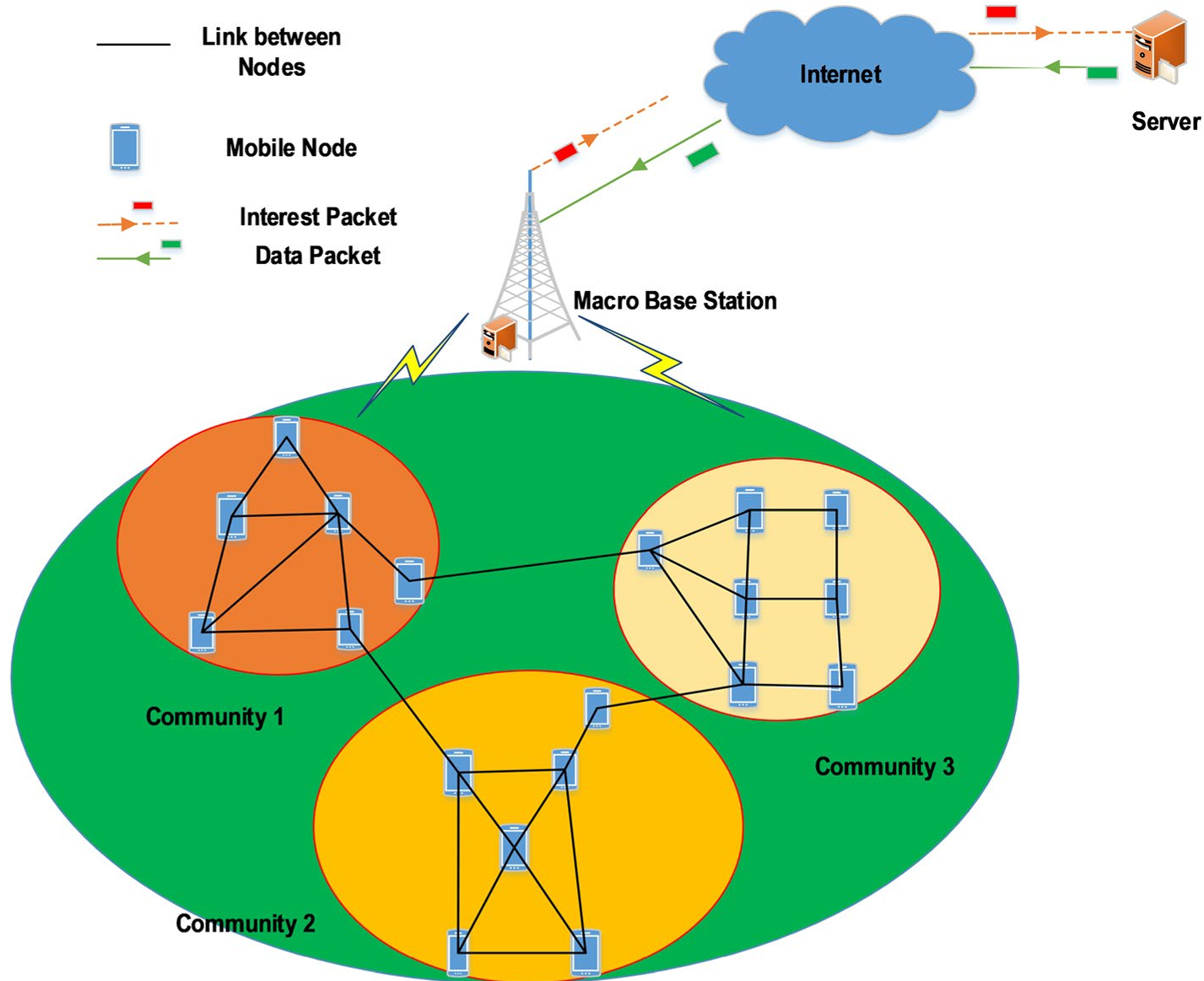 *Figure 1: The system architecture showing MBS (Macro Base Station) performing centralized community detection to facilitate D2D content sharing.* ## Experiments & Results The authors validated EDA using four classic datasets: the Zachary Karate Club, the American Football network, an Airport connection network, and a real Bluetooth proximity dataset from the University of Calabria. ### Performance Benchmarks * **Zachary Karate Club**: EDA achieved 100% agreement with the ground truth division, successfully identifying the split between the "Mr. Hi" and "Mr. Johan" factions. * **Modularity (Q)**: In the American Football network, EDA matched the performance of the Louvain algorithm (Q=0.6) and outperformed the Fastgreedy method (Q=0.55). * **Partition Fairness ($ heta$)**: In a test network, EDA reduced the difference between maximum and minimum community densities ($ heta$) to 0.010, indicating a much fairer distribution than traditional baselines. 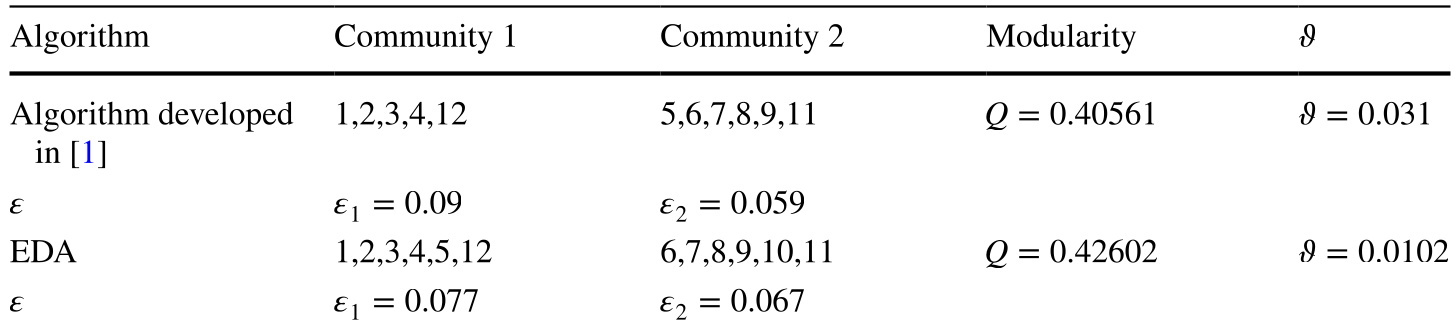 *Table 1: Quantitative comparison of EDA against traditional algorithms, highlighting the boost in Modularity (Q) and improvement in fairness (θ).* 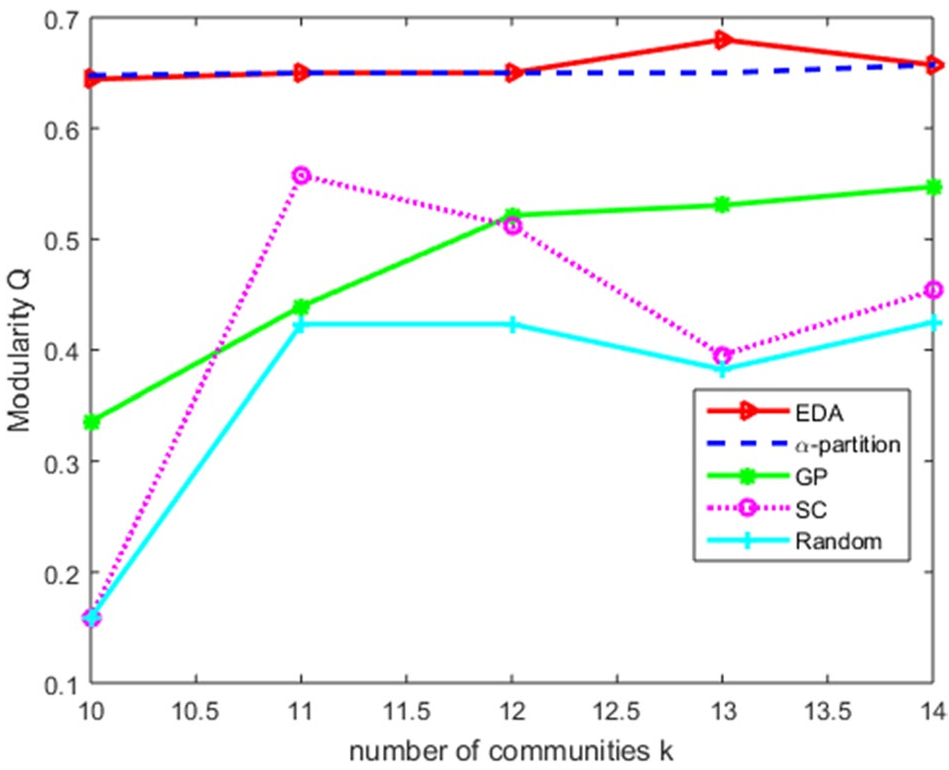 *Figure 2: Modularity scores across different days in the Bluetooth proximity dataset. EDA consistently stays at the SOTA frontier.* ## Critical Analysis & Conclusion ### The Takeaway The External Density Algorithm proves that **fairness in partitioning** is just as important as **modularity maximization**. By explicitly handling common nodes using "escaping probabilities," EDA provides a more nuanced view of social structures than edge-removal techniques like Girvan-Newman. ### Limitations & Future Work While EDA performs well, the authors acknowledge that it is currently a centralized approach managed by a Macro Base Station (MBS). Future iterations could explore: 1. **Distributed EDA**: Enabling nodes to determine their communities locally without a central coordinator. 2. **Influential Seeds**: The authors plan to use EDA as a foundation for selecting "Influential Nodes" to act as local caches, offloading even more traffic from the main cellular network. This paper is a significant step toward making Mobile Social Networks more efficient and reflective of the complex human interactions they support.