
Elevating Truth in the Crowd: Best Practices for QoE Crowdtesting
2584_Best Practices for QoE Crowdtesting QoE Assessment With Crowdsourcing.
The paper establishes a comprehensive framework and "Best Practices" for Quality of Experience (QoE) crowdtesting, specifically for video applications. It introduces a robust two-stage test design and statistical screening methods to ensure data reliability in uncontrolled, remote crowdsourcing environments.
TL;DR
Quality of Experience (QoE) is the holy grail of multimedia optimization, yet measuring it has historically required stagnant, expensive lab settings. This paper provides the definitive roadmap for "Crowdtesting"—migrating these tests to the global internet. By leveraging a two-stage experimental design and behavioral monitoring, the authors demonstrate how to filter out "random clickers" and "cheaters" to achieve lab-grade data quality at a fraction of the cost.
Problem & Motivation: The Fragility of the "Mean"
In a controlled laboratory, a supervisor ensures the participant is actually watching the video. In the "Virtual Laboratory" of the internet, participants often try to maximize payment while minimizing effort.
The authors demonstrate a terrifying reality: unreliable user ratings tend to follow a discrete uniform distribution. When even 25% of your crowd provides random scores, your Mean Opinion Score (MOS) is forcefully pulled toward the center (3.0 on a 5-point scale), effectively masking the true impact of system impairments like video stalling or packet loss.
Methodology: The Two-Stage Shield
The core contribution is a shift from reactive filtering to proactive design. Instead of just deleting "bad" data after the fact, the authors propose a structured workflow:
1. The Two-Stage Design
- Stage 1 (Screening): A fast, low-pay ($0.10) task that tests the user's hardware (e.g., "Can you see these grey steps?") and reliability. This builds a "pseudo-reliable" panel.
- Stage 2 (Actual Test): Only the proven reliable workers from Stage 1 are invited to the high-stakes QoE evaluation. This pre-screening reduced total campaign costs and improved efficiency by 60%.
2. ARM vs. URS (The "Why" it Works)
The paper makes a critical distinction between:
- URS (User Rating Based Screening): Mathematically identifying outliers (like ITU-R BT.500 or CrowdMOS).
- ARM (Additional Reliability Mechanisms): Behavioral checks like Gold Standard data (asking if a video stalled when it objectively didn't) and Application-layer monitoring (tracking if the browser tab remained in focus).
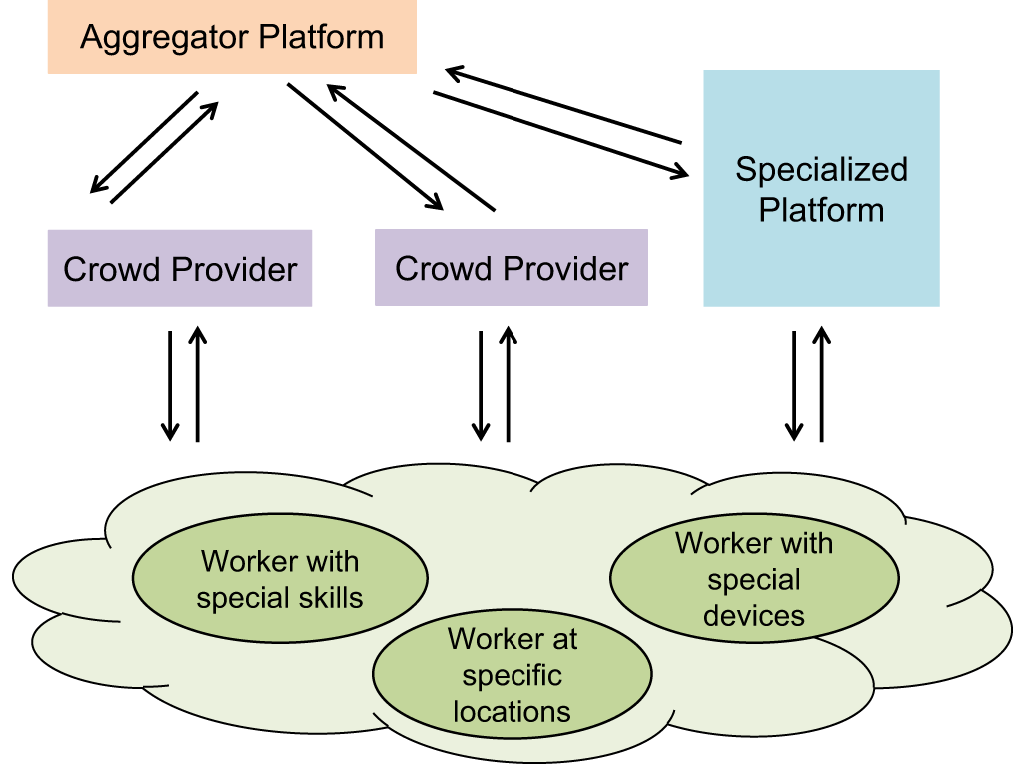 Figure 1: High-level overview of Crowdsourcing Platform interactions.
Experimental Evidence & Results
Using YouTube stalling and H.264 video quality as case studies, the authors compared lab results with crowd results.
The data revealed that standard statistical tests (like the test in ITU-R BT.500) are often insufficient for the crowd. They tend to accept a large ratio of unreliable users while accidentally rejecting honest users who have different sensitivities. In contrast, using a "Warning Message" for users who didn't watch the full video duration (Focus Time) doubled the number of reliable ratings.
 Table 1: Comparison of YouTube and H.264/AVC Experimental Settings.
The SOS Hypothesis
To further validate findings, the authors applied the SOS Hypothesis, which postulates a square relationship between the variance (Standard deviation of Opinion Scores) and the MOS. If a data set doesn't follow this curve, it’s a red flag for hidden influence factors or cheating.
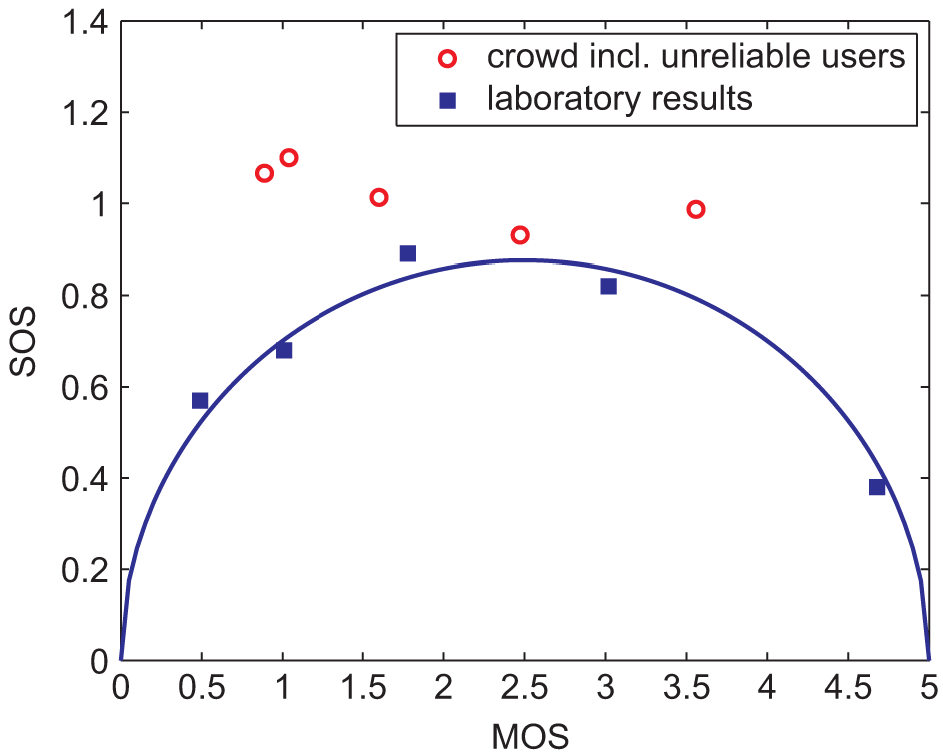 Figure 2: SOS-MOS relationship comparing Lab (stable) vs. Crowd (noisy before filtering).
Deep Insight: Beyond the Technical
The most profound takeaway is that Environment is Metadata. In QoE crowdtesting, the user's screen resolution, background noise, and even their country of origin (which dictates their quality expectations) act as "hidden variables."
The paper concludes that while Crowdsourcing is a powerful tool for rapid, diverse validation of multimedia algorithms, it requires a "Trust but Verify" architecture. Future work will likely look toward Gamification to keep workers focused naturally, rather than through punitive monitoring.
Summary (Takeaways)
- Don't rely on stats alone: Use behavioral cues (Focus time, Gold data) to screen users.
- Filter early: Use a two-stage design to save costs.
- Report clearly: Always state inter-rater and intra-rater reliability metrics (Spearman/Krippendorff’s ) in your publications.