
Personalized Career Guidance: An Improved Fuzzy Evaluation Model for Summer Job Selection
The Choice of Best Summer Job Based on Improved Fuzzy Comprehensive Evaluation
The paper introduces a personalized evaluation model for summer job selection among high school students, utilizing an Improved Fuzzy Comprehensive Evaluation (FCE) framework. It integrates social media analysis for factor mining and Analytic Hierarchy Process (AHP) to generate individual-specific weightings for job criteria.
TL;DR
Choosing a summer job is a complex "multi-criteria decision-making" (MCDM) problem, especially for teenagers with varying priorities. This paper proposes a decision-support model that combines Analytic Hierarchy Process (AHP) with Fuzzy Comprehensive Evaluation (FCE). By prioritizing individual user input over "expert" generalizations, the model achieves a personalized ranking of potential jobs across six key dimensions: Salary, Traffic, Time, Extra Gain, Exertion, and Safety.
Problem & Motivation: Beyond the "One-Size-Fits-All" Recommendation
High school student employment has seen a significant decline since the late 1970s. While economic factors play a role, the authors identify a modern friction point: the paralysis of choice. Students are faced with diverse options—from remote data entry to manual labor—but lack the tools to evaluate which job aligns with their unique constraints and psychological profiles (e.g., Holland's career themes).
Prior work often uses expert systems that assign fixed weights to factors like "Salary." However, for a student with high academic pressure, "Time flexibility" might be infinitely more valuable than a higher hourly rate. The motivation here is to build a system where the user's subjective intuition is the primary engine of the model.
Methodology: The Fusion of Quantitative Logic and Fuzzy Intuition
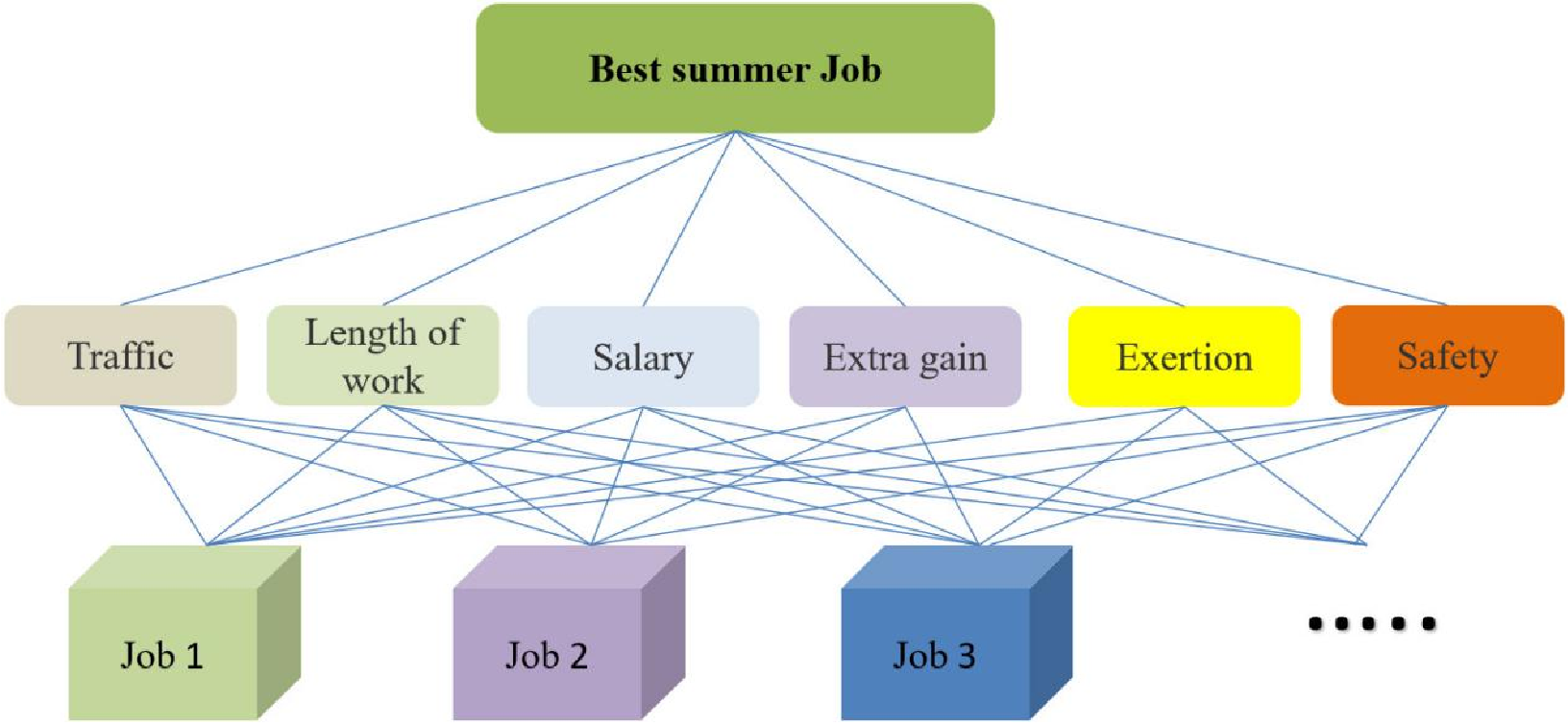
The model operates in three distinct phases: factor mining, weight determination, and fuzzy scoring.
1. The Multi-Dimensional Hierarchy
The authors identified six core factors, split into two categories:
- Quantitative: Salary (normalized via ), Traffic (based on commuting time), and Time (using a specialized piecewise function).
- Qualitative: Extra Gain, Exertion, and Safety.
2. Personalized Weighting (Improved AHP)
Traditional AHP uses expert judgment to compare the importance of factors. This paper innovatively uses a User Questionnaire to build the comparison matrix . If a user values "Safety" over "Salary," the AHP matrix reflects that specific priority, calculating a unique weight vector for that individual.
3. The Time Sensitivity Function
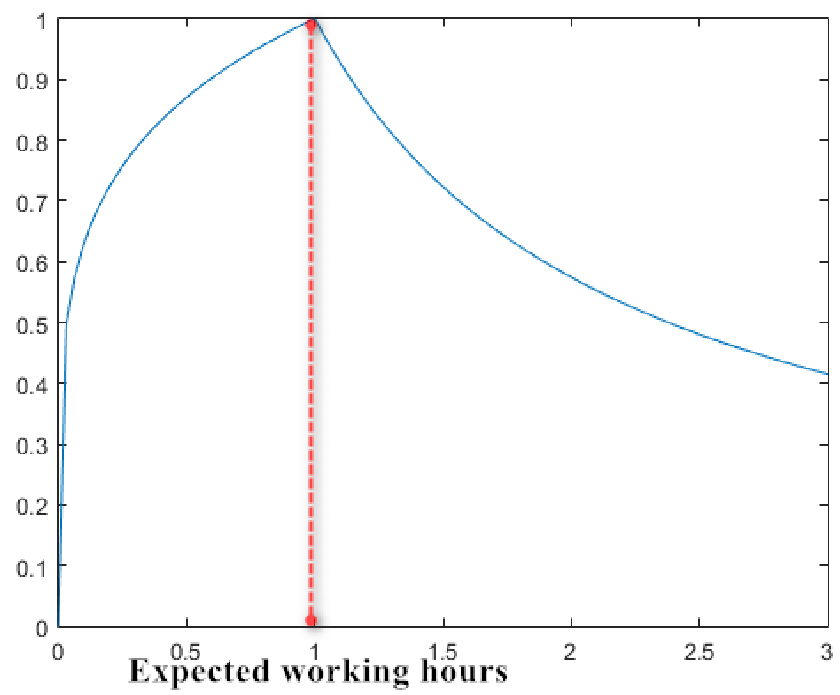
A standout feature of the methodology is the non-linear treatment of working hours. The authors recognize that students have an "expected time" (). Working less than the expectation is generally fine, but exceeding it carries a heavy psychological penalty. They modeled this using a piecewise power function: With , the score drops precipitously once the threshold is crossed, capturing the "work-life balance" intuition perfectly.
Experiments & Results
The authors used a Gaussian membership function to map qualitative labels (Better, Good, General, Bad, Worse) to a continuous space.
| Qualitative Category | Membership Score |
|---|---|
| Better | 1.0 |
| Good | 0.846 |
| General | 0.513 |
| Bad | 0.223 |
| Worse | 0.069 |
By multiplying the Score Matrix (C) by the Weight Vector (W), the final suitability score is produced. The model was tested against virtual users created based on Holland's career theory (Realistic, Investigative, Artistic, Social, Enterprising, and Conventional). The results demonstrated that the model could successfully differentiate between a "Social" profile (who might prioritize extra gain/networking) and a "Realistic" profile (who might prioritize salary or exertion).
Critical Analysis & Conclusion
Takeaway
The paper’s core strength lies in its hybrid nature. It treats objective data (Google Navigation for traffic) and subjective feelings (safety) with equal mathematical rigor using Fuzzy Sets. This is a significant step toward "Human-Centric AI."
Limitations
- Indicator Depth: As noted by the authors, only six factors were used. In reality, factors like "Future Resume Value" or "Peer Prevalence" might be equally important.
- Data Sparsity: The model relies on the user to provide data for the alternative jobs. If a user doesn't know the "Safety score" of a warehouse job, the model's accuracy degrades.
Future Outlook
This framework could be extended by integrating Large Language Models (LLMs) to automatically extract "Qualitative" scores from online company reviews (Glassdoor/Reddit), thereby reducing the "user input burden" mentioned in the conclusion.
Author Affiliations: Tianai Yue (Tianjin Nankai High School), Ziyi Cheng (Xi’an Tie Yi High School), et al. Publication: ICAIIS 2021.