
Beta-Cooperative CBR: Navigating Business Strategy through Neural Manifolds
A Beta-Cooperative CBR System for Constructing a Business Management Model
This paper introduces a Beta-Cooperative Case-Based Reasoning (CBR) system designed for strategic knowledge management in business. It integrates a novel neural architecture, Beta-Cooperative Learning, to cluster and retrieve organizational knowledge needs, facilitating SOTA-level identifying of critical business situations.
TL;DR
The paper presents a sophisticated hybrid system that merges Case-Based Reasoning (CBR) with a novel neural architecture called Beta-Cooperative Learning. By utilizing sparse lateral connections and flexible Beta-distribution cost functions, the system can categorize complex organizational knowledge needs into strategic action zones—ranging from "Growth Strategy" to "Critical Situation"—providing a data-driven compass for corporate management.
Background & Motivation: The Knowledge Paradox
In the modern business landscape, knowledge is the ultimate strategic asset. However, most firms suffer from a "knowledge paradox": they possess vast amounts of data but lack the mechanism to identify which specific knowledge is missing, obsolete, or underutilized.
The authors argue that existing management models are too rigid. Prior work using standard tools like Principal Component Analysis (PCA) often misses the subtle, non-linear relationships in how knowledge behaves within different departments. The motivation here was to build a system that doesn't just store "cases" (experiences), but understands the manifold structure of organizational needs.
Methodology: The Beta-Cooperative Edge
The core innovation lies in the Beta-Cooperative Learning model, which improves the "Retrieval" phase of the CBR cycle.
1. Beyond Hebbian Learning: The Beta Cost Function
Unlike standard neural networks that assume a Gaussian error distribution, this model uses a Beta distribution probability density function. By optimizing the learning rule (derived via gradient ascent on the likelihood function), the network becomes significantly more robust to varied data distributions typical in social and business sectors.
2. Cooperative Sparsity via Rectified Gaussians
To prevent the network from merely finding a generic subspace, the authors added lateral connections derived from the Rectified Gaussian Distribution. This enforces two critical properties:
- Non-negativity: Ensuring outputs stay within logical bounds.
- Global Ordering: Forcing the neurons to "cooperate" or "compete," resulting in sparse representations that clearly separate different types of business risks.
 The learning rule integrates the residual error (e) with the Beta distribution parameters to achieve precise weight updates.
Experiments & Strategic Mapping
The system was tested on a real-world dataset of 277 registries from a multinational automotive leader. The Beta-Cooperative model processed these "knowledge necessities" and projected them into a 2D space.
The Strategic Map
The results were not just mathematical clusters, but "Strategic Zones":
- CHAOS (Bottom Left): Urgent needs for wide-level knowledge acquisition.
- GROWTH STRATEGY (Bottom Right): Low urgency but high importance—indicating potential for expansion.
- CRITICAL SITUATION (Top Left): High urgency for basic knowledge, suggesting a dependency on external clients or imminent projects.
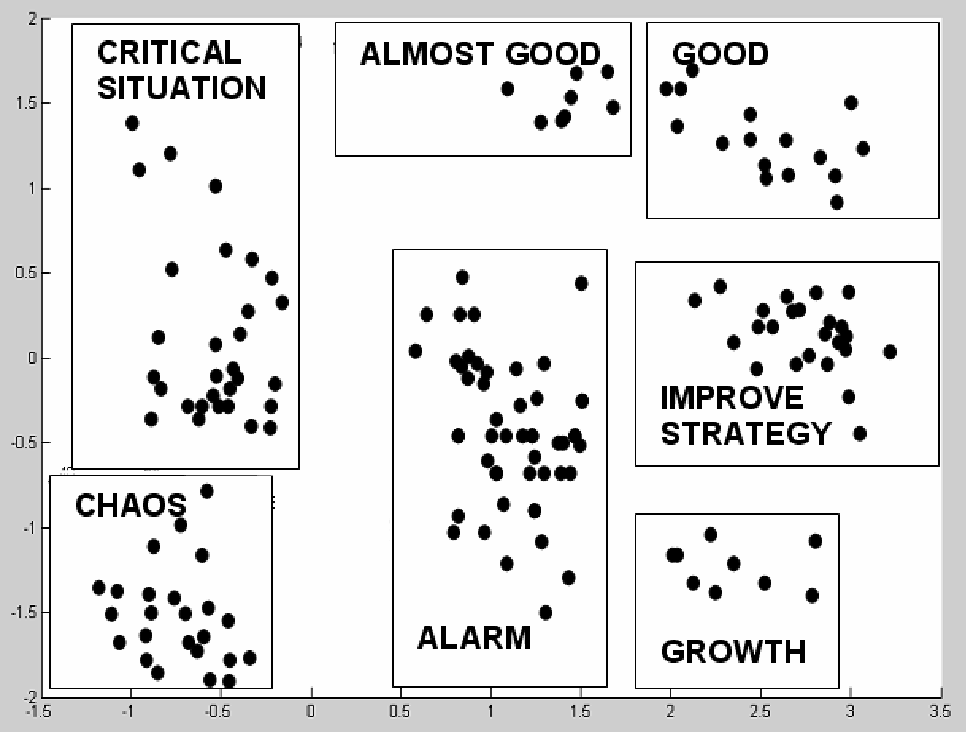 The 2D projection clearly demonstrates the clustering of different risk profiles within the firm.
Critical Insight & Conclusion
Wait, why does this matter for the future of AI in business? Most current LLM-based solutions for management are "black boxes." This paper demonstrates a symbolic-connectionist hybrid approach: the CBR system provides a logical framework (Retrieve, Reuse, Revise, Retain), while the Beta-Cooperative neural net provides the "intuition" for similarity and clustering.
Takeaways
- Inductive Bias Matters: By moving away from Gaussian assumptions to Beta distributions, we better model human/business data.
- Sparsity is Clarity: Lateral connections provide the sparsity needed to make business "clusters" interpretable.
Limitations: While the retrieval is automated and sophisticated, the "Revision" stage remains manual, requiring human experts to validate the AI's suggestions—a classic "human-in-the-loop" requirement that remains a bottleneck for total automation.