
Decoupling Size and Speed: A New Theory for Job Redundancy
A Better Model for Job Redundancy: Decoupling Server Slowdown and Job Size
The paper introduces the S&X model, a realistic framework for job redundancy in computer systems that decouples inherent job size () from server-side slowdown (). It proposes a new dispatching policy, Redundant-to-Idle-Queue (RIQ), which achieves superior stability and performance compared to traditional redundancy models.
TL;DR
To reduce latency, modern systems often send multiple copies of the same request to different servers (redundancy). However, theoretical models often fail because they assume a job can "magically" become smaller on a different server. This paper introduces the S&X model, which separates the job's actual size from the server's jitter. It proves that while common redundancy policies can crash a system, the newly proposed Redundant-to-Idle-Queue (RIQ) policy provides a robust, stable, and analytically predictable way to kill tail latency.
The "Independence" Fallacy
In classical queueing theory, the Independent Runtimes (IR) model is the gold standard. It assumes that if you replicate a job, each copy gets a brand-new, independent service time.
The Problem: In the real world, a 1GB data processing job is 1GB everywhere. If the job is inherently large, it will be large on every server. The IR model ignores this, leading theorists to believe that adding more replicas always improves performance. Practitioners know better: too many replicas of a large job will clog every queue in the cluster, leading to instability.
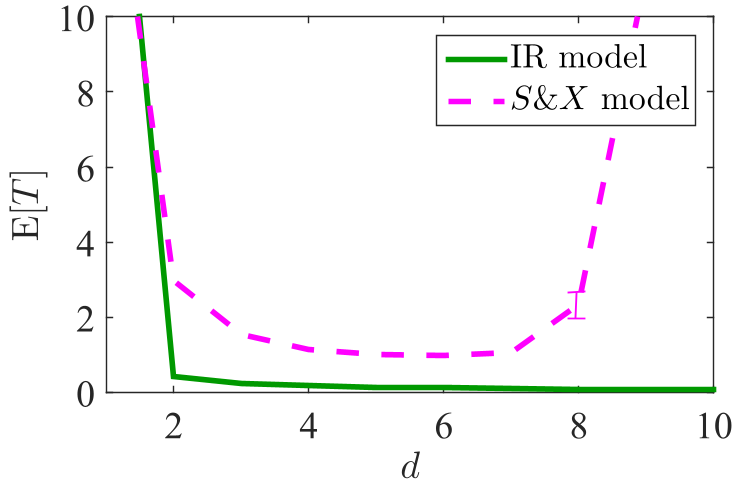 Figure: Under the IR model, more redundancy (d) is always better. In the realistic S&X model, too much redundancy leads to infinite response times (instability).
The S&X Model: A Dose of Realism
The authors propose a new decomposition. For any job, the runtime on server is:
- (Job Size): A random variable representing the inherent work (e.g., number of CPU cycles). This is fixed for the job across all replicas.
- (Slowdown): A random variable representing "server jitter" (e.g., background noise, GC pauses). This is unique to each server.
This decoupling changes everything. It captures the "Sad Truth": redundancy cannot save a large job from being large; it can only save a job from a temporarily slow server.
Methodology: The RIQ Policy
How do we gain the benefits of redundancy without risking a system meltdown? The authors introduce Redundant-to-Idle-Queue (RIQ).
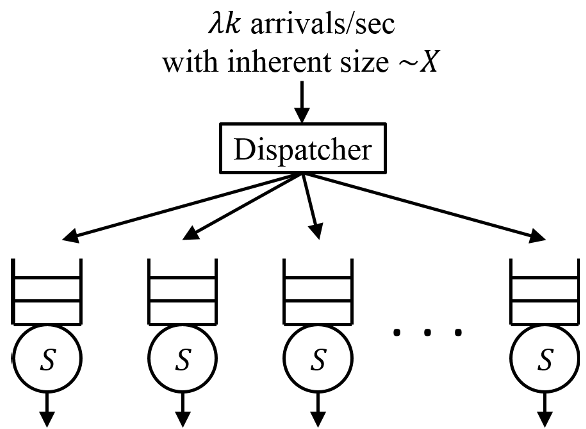
- The Logic: When a job arrives, it polls random servers.
- The Execution:
- If some servers are idle, the job runs on all of them simultaneously.
- If all are busy, the job joins only one queue at random.
This conservative approach ensures we only use "spare" capacity for redundancy.
Analytical Intuition
The authors model the system by treating each server as an M/G/1/efs* queue (Exponential arrivals, General service, with an Exceptional First Service). By using renewal-reward theory, they show that RIQ behaves like a system with "vacations"—whenever a server is idle, it "takes a vacation" to work on a redundant copy of a job.
Experiments & Results
The study utilizes traces from Facebook (Hadoop) and Microsoft (Bing) to model the slowdown .
1. Stability: The RIQ Advantage
Unlike the standard Redundancy-d policy, RIQ is provably stable. Even if you set in a 1000-server cluster, the system will not blow up. It simply plateaus in performance.
2. Tail Latency Reduction
The most impressive result is in tail latency. While the mean response time sees modest gains, the 95th percentile drops sharply. This is exactly what system architects want: a "predictable" system where outliers are eliminated.
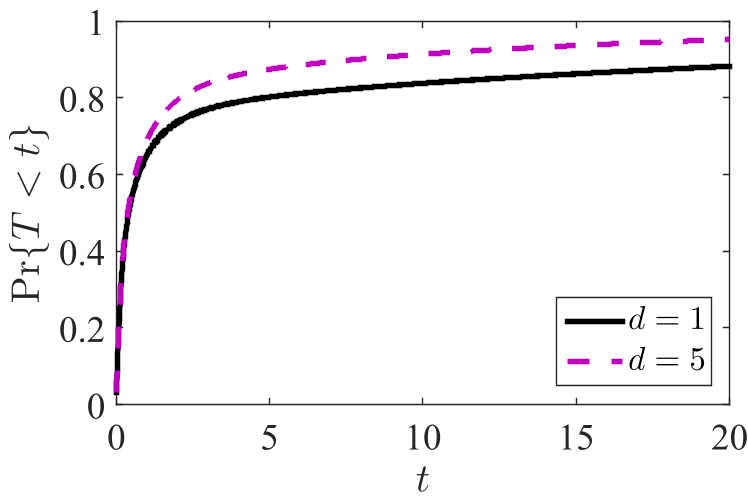 Figure: RIQ (d=5) significantly tightens the response time distribution compared to no redundancy (d=1).
Beyond RIQ: The Threshold Policy
The authors also explore a middle ground called THRESHOLD-n. Instead of only replicating to idle servers (idle = 0 jobs), it replicates to any server with jobs.
- This offers the aggressive latency reduction of Redundancy-d at small scales.
- It maintains the safety and stability of RIQ at large scales.
Strategic Insights
For tech leads and cloud architects, the takeaways are clear:
- Don't Replicate Blindly: If you don't know the job size, replicating to busy queues is a recipe for disaster.
- Load-Awareness is Key: Policies like RIQ or THRESHOLD-n provide a safety net that allows for high redundancy degrees without the risk of cascading failures.
- Decouple your Models: When simulating system performance, ensure your models account for inherent job complexity separately from infrastructure noise.
Scientific Contribution: This work bridges the gap between queueing theory and systems engineering, providing an analytically tractable yet realistic framework for the next generation of cloud load balancers.