
DefServ: Reimagining QoS through the Lens of "Mice and Elephants"
Better Service from Understanding the Social Network Behaviour in the Internet
The paper introduces Defensive Services (DefServ), a novel QoS architecture designed to protect normal network traffic by mitigating the impact of large flows (elephants). Using a specialized Mice and Elephants (MAE) queue discipline, DefServ achieves significant performance gains, including an average 7x increase in effective throughput for small flows compared to traditional DropTail during congestion.
TL;DR
The paper proposes Defensive Services (DefServ), a shift from static traffic classification to dynamic behavioral protection. By utilizing a "Mice and Elephants" (MAE) queueing discipline—which prioritizes short flows over long ones—the authors demonstrate a 7x performance boost for typical Internet traffic during congestion, all without the rigid overhead of traditional DiffServ architectures.
Problem & Motivation: The Tyranny of the Elephant
For decades, the Internet has relied on the DiffServ (Differentiated Services) model to manage Quality of Service (QoS). While effective for prioritizing specific traffic like Voice over IP, DiffServ has a fundamental flaw: it is static. Once a packet is tagged, it receives priority regardless of whether that flow is a tiny "mouse" (a DNS query) or a massive "elephant" (a 10GB file transfer).
The authors argue that the Internet follows the Pareto Principle: 20% of the flows (elephants) consume 80% of the bandwidth. In a typical congested link, these elephants "bully" the mice, leading to high latency and packet loss for the vast majority of users.
Methodology: The MAE Algorithm
The core innovation is the Mice and Elephants (MAE) queue discipline. Inspired by the Shortest-Job-First (SJF) principle in queueing theory, MAE treats short flows with the highest priority.
How it Works:
- Observation over Nomination: Unlike DiffServ, which relies on headers, DefServ observes the actual size of the flow.
- Multi-level Queuing: The system uses 8 priority queues. New flows start in the highest priority queue.
- Dynamic De-prioritization: As a flow consumes more bytes and hits specific thresholds, it is progressively demoted to lower-priority queues.
- The Intuition: Because most flows are short, they exit the system quickly, clearing the queue for others. Large flows are only penalized once they have already proven to be "elephants."
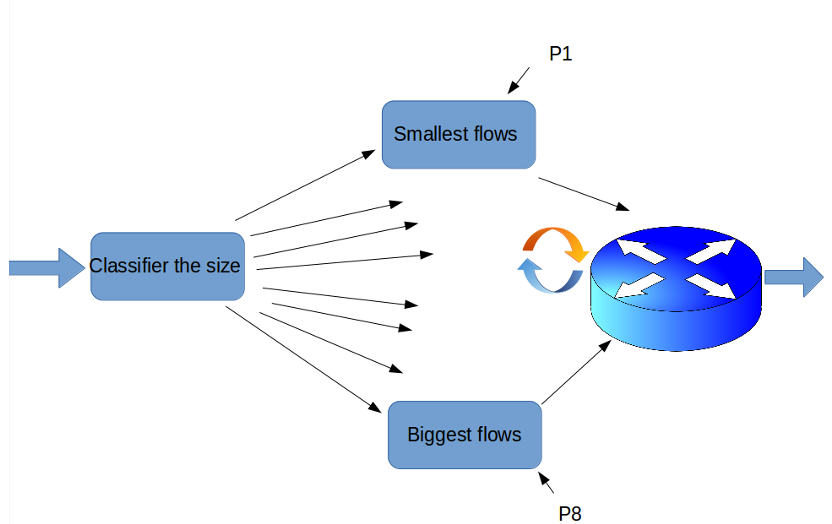 Fig 3: The priority-based logic of the MAE algorithm.
Experiments & Results
The authors conducted extensive simulations using Netml and ns-3, comparing DefServ against standard DropTail (Best Effort) and DiffServ (pFifoFast).
DefServ vs. DropTail
In non-congested scenarios, both perform similarly. However, under overload, the results are dramatic.
- Throughput: DefServ provided ~7x higher effective throughput for small flows.
- Consistency: The variance in performance was significantly lower with MAE, meaning a more predictable user experience.
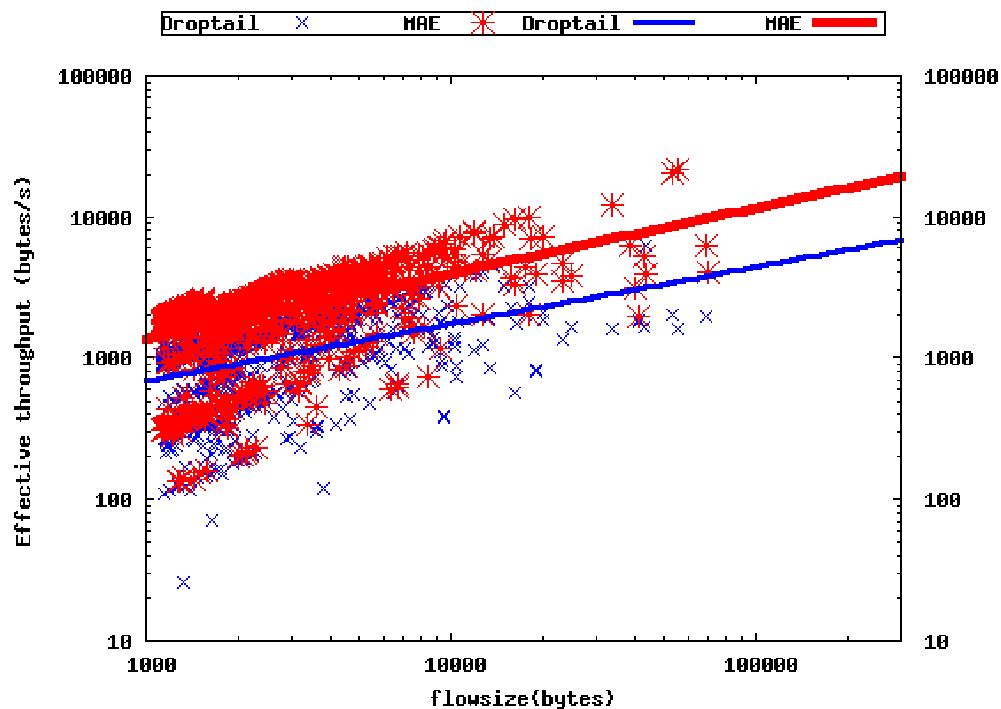 Fig 5: Under overload, DefServ (MAE) in red vastly outperforms DropTail in blue for nearly 90% of flows.
DefServ vs. DiffServ
The comparison with DiffServ revealed a critical insight: while DiffServ protects "Premium" classes, it does so by sacrificing the entire "Best Effort" class, even if that class contains small, urgent flows. DefServ, by contrast, protects the "mouse-like" behavior across all tags.
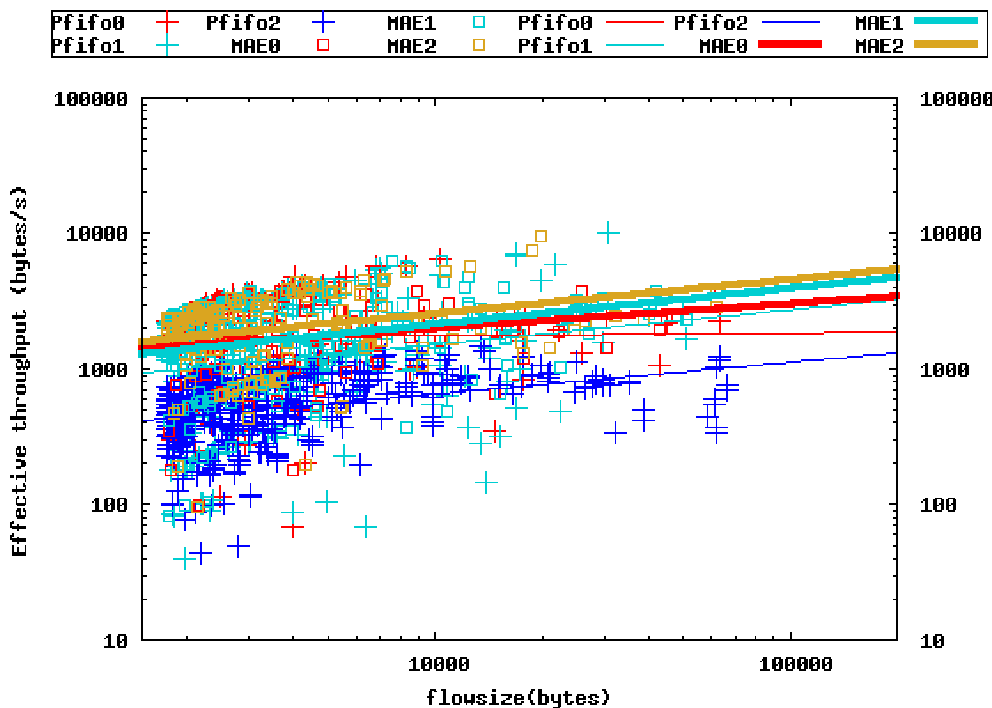 Fig 8: In overloaded conditions, DiffServ (pFifo) severely degrades the performance of the lowest class, whereas DefServ maintains quality for all mice.
Critical Insight & Conclusion
The "social network behavior" mentioned in the title refers to this Pareto distribution of human activity translated into packet flows. The "Defensive" approach is revolutionary because it assumes that congestion is a normal byproduct of human behavior, not a network failure.
Takeaway: By focusing on protecting the "normal" many from the "gourmand" few, DefServ offers a more democratic and efficient path to QoS. Future work may see DefServ merged into DiffServ as a specialized Per-Hop Behavior (PHB) for modern routers.
Limitations: The paper primarily focuses on throughput; further study on the impact of packet reordering and the overhead of tracking flow sizes in high-speed 100GbE switches would be valuable for real-world deployment.