
Cross Betweenness Centrality: Identifying the True Gatekeepers of Information in a Multi-Platform World
Measuring Betweenness Centrality in Social Internetworking Scenarios
The paper introduces Cross Betweenness Centrality (CBC), a novel metric designed for Social Internetworking Scenarios (SIS). It specifically measures a node's influence over information flows that cross boundaries between different social networks or distinct communities, outperforming traditional Betweenness Centrality in multi-platform environments.
TL;DR
In today's interconnected digital landscape, a "local celebrity" on one platform isn't necessarily the person who spreads news to another. This paper proposes Cross Betweenness Centrality (CBC), a metric that filters out the "noise" of local popularity to identify the critical bridges connecting different social networks (e.g., LinkedIn, MySpace, or Twitter).
The "Local Hero" Trap: Why Traditional Metrics Fail
Social Network Analysis (SNA) has long relied on Betweenness Centrality (BC) to find influential nodes. BC identifies nodes that sit on the shortest paths between others—essentially the "middlemen" of information.
However, the authors point out a fatal flaw in the context of a Social Internetworking Scenario (SIS):
- Uniformity Bias: Standard BC treats a path between two friends on Facebook the same way it treats a path connecting a Facebook user to a LinkedIn user.
- Visibility Gap: A user who acts as a crucial link between two professional communities might have very few local friends. Standard BC would give them a low score, while a "hub" inside a massive but isolated community would get a high score, even if that hub has zero influence on the outside world.
Methodology: The Anatomy of CBC
The authors redefine the problem by partitioning a graph into social networks and edges into two types: Friendship edges (intra-network) and Me edges (connecting accounts of the same user across platforms).
The core innovation is the CBC formula, which restricts the sum of shortest paths to those where the source () and target () belong to different networks:
eq S(t)} \frac{\sigma_{st}(u)}{\sigma_{st}}$$ ### The Decomposition Identity One of the most profound insights in the paper is that traditional Betweenness Centrality is actually a composite of three distinct roles: 1. **CBC (u, \Omega)**: Paths starting outside the target set and ending inside. 2. **CBC (u, \Omega')**: Paths starting inside and ending outside. 3. **IBC (Internal Betweenness)**: Paths that stay entirely within the same network. This math proves that a node can be a "central" figure globally (high BC) but a "nobody" for cross-platform communication (low CBC).  ## Experimental Proof: Where BC Fails The authors tested CBC against BC using synthetic SIS models. The results were stark: - **High-Degree vs. High-Bridge**: In their first test, the top 3 nodes ranked by BC were high-degree nodes (hubs) with no connection to other networks. Conversely, the top 3 CBC nodes were **bridges** or nodes directly connected to bridges. - **The Disconnected Fragment Test**: When one network was completely isolated, BC still ranked nodes within that isolated cluster very highly. CBC correctly gave them a rank of zero for inter-network flow, as they were incapable of passing information to the rest of the world. 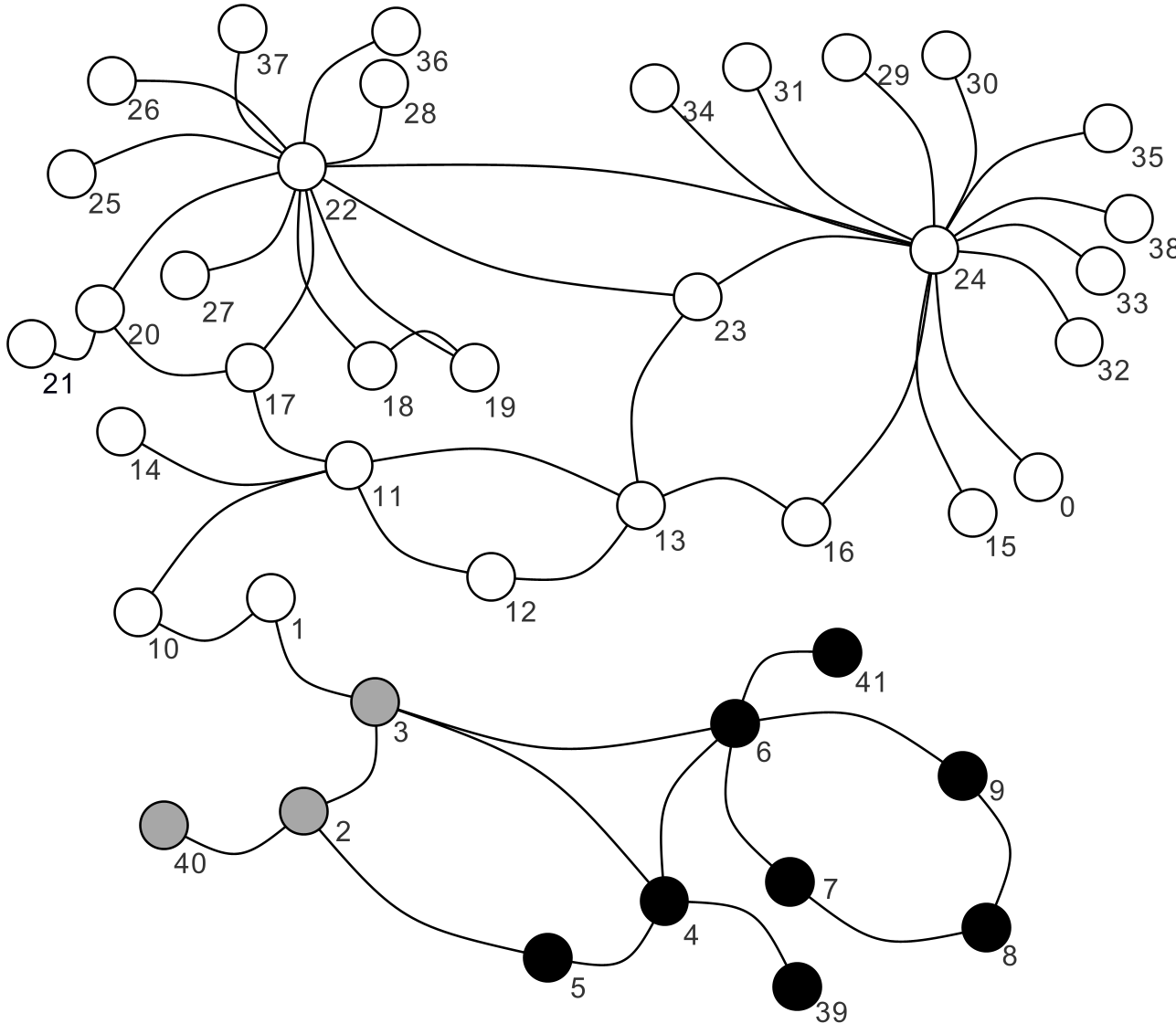 *Figure 1: Comparison between different social networks (colored black, gray, and white) showing how CBC identifies the nodes that facilitate interaction between these colors.* ## Critical Analysis & Future Outlook The paper successfully challenges the "one-size-fits-all" approach to centrality. By mathematically isolating the inter-network component, they provide a tool that is highly relevant for **Strategic Marketing** (e.g., how to make a viral campaign jump from Reddit to Twitter) and **Security** (e.g., identifying points of failure in multi-domain networks). **Limitations**: - The current study uses synthetic networks. Real-world SIS data is significantly noisier and larger. - The computation of all-pairs shortest paths for CBC remains computationally expensive ($O(N^3)$), suggesting a need for approximate algorithms in the future. **Future Prospects**: The author's mention of "Weak Ties" (Granovetter, 1973) is key. CBC provides the first formal mathematical bridge between modern Internetworking and classical "strength of weak ties" theory. We expect future iterations to apply this to **Community Detection** within single platforms, identifying the "ambassadors" between polarized echo chambers. ## Conclusion CBC isn't just a new formula; it's a shift in perspective. In a world where we are defined by multiple digital identities, the most influential people aren't just those with the most followers, but those who sit at the crossroads of our fragmented digital lives.