
Beyond the Individual: Decoding the Social DNA of Modern Matchmaking
Beyond the individual: Understanding social structures of an online player matchmaking website
This study investigates the social structures of "the100.io," a third-party matchmaking website for the game Destiny, using Social Network Analysis (SNA) and Archetypal Analysis. By mapping a network of 45,221 active users, the researchers identify how social connectivity correlates with in-game performance and player preferences, establishing a framework for understanding community-led player grouping.
TL;DR
While most game analytics focus on what players do inside the game, this study looks at the "pre-game" social structures formed on the100.io, a matchmaking giant for Destiny. By analyzing a network of over 45,000 players, researchers found that your social "centrality" (how many friends and connections you have) is a better predictor of your in-game power than almost any other metric. The paper introduces Archetypal Analysis to map out five distinct player "destinies," ranging from the altruistic "Sherpas" to the restless "Group-Hoppers."
The Motivation: Why Your Fireteam Matters
In the world of "Live Service" games, retention is everything. Developers have long known that players who play together, stay together. However, most research has a blind spot: they only see the data after the match starts.
The authors argue that by ignoring the platforms where players find each other—like the100.io—we miss the social architecture that determines whether a player becomes a "Legend" or a "Leaver." The core insight? Social connections are not just a byproduct of playing; they are the engine that drives in-game progression.
Methodology: Mapping the Social Galaxy
The researchers didn't just look at friend lists. They treated the community as a mathematical graph, calculating four types of Centrality:
- Degree: How many friends you have.
- Betweenness: How much you act as a "bridge" between different social groups.
- Eigenvector: Not just how many friends you have, but how "important" those friends are.
- Closeness: How quickly you can reach anyone else in the network.
The Community Structure
As shown in the architecture of the network, the community is split by a "Great Divide": the console platform.
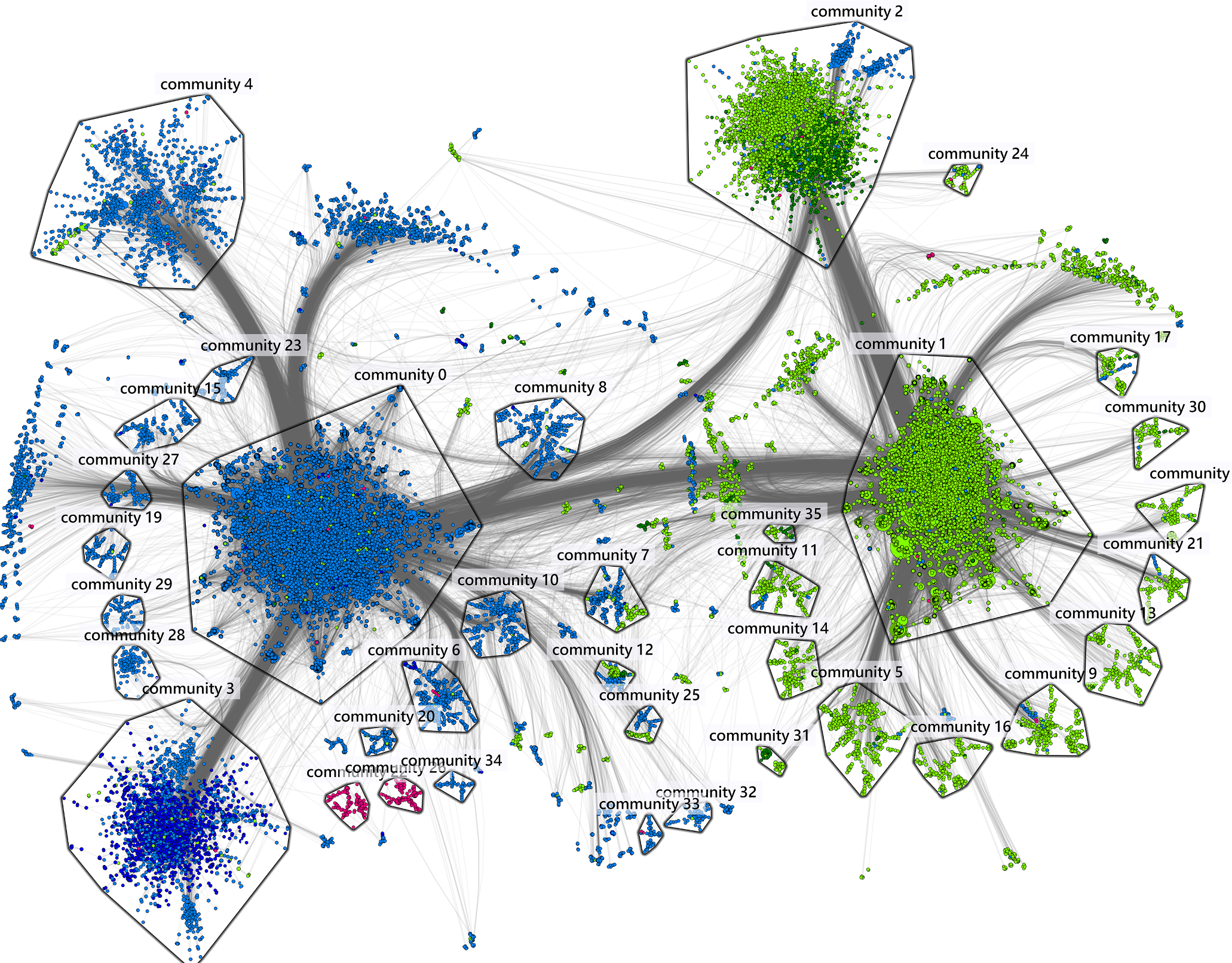 Figure: The community structure, showing a massive split between PlayStation (blue/purple) and Xbox (green/red) users, highlighting the isolation of PC players in a console-dominated era.
Core Findings: The Power of Social Capital
The study confirmed several "Academic Truths" but added a fascinating twist regarding community management:
- Social Connectivity = Power: Players with higher Degree Centrality (more friends) consistently had higher "Light Levels" and character levels. Interestingly, it’s a chicken-and-egg scenario: does playing more make you social, or does being social give you more opportunities to play?
- Karma > Professional Labels: the100.io has a "Sherpa" score (for designated teachers). However, the community-voted "Karma" score was a much stronger predictor of actual network activity. Insight for Devs: Trust your community's voting systems more than your own badge systems.
The Five Archetypes of Players
Using Archetypal Analysis, the authors identified five "extreme" versions of players that exist on a spectrum:
 Note: Image Placeholder for Archetype Profiles
- A1: The True Sherpas: High level, high karma, high mastery. They focus on helping others but stay loyal to a few small groups.
- A2: The Active Veterans: The backbone of the game. High character levels, high friendship counts, and very high activity.
- A3: The Newcomers: Low level, limited friends, still finding their footing.
- A4: The Social Butterflies: Extremely high activity and friend counts. They are the "influencers" of the matchmaking world.
- A5: The Group-Hoppers: High group count but low friend count and low activity. These players are "homeless," jumping from group to group without finding a fit—they are at the highest risk of quitting.
Critical Analysis & Industry Takeaways
This paper moves the needle from "Individual Analytics" to "Relationship Analytics."
Why it Works:
By using Archetypal Analysis instead of standard K-means clustering, the authors allow for "niche" behaviors (like the Sherpas) to emerge, rather than being buried in a statistical average.
Limitations:
The data is self-reported. While players on the100.io have an incentive to be honest (to get better matches), it’s not as "pure" as raw server logs. Furthermore, the network is limited by the platforms of the time (PS3/PS4 vs Xbox 360/One).
Industry Lessons:
- Support your Moderators: Active groups live and die by their leaders.
- Bridge the Gaps: Isolated communities (like the Australian cluster found in the study) have lower activity. Game devs should use algorithms to suggest "neighboring" groups to help these clusters stay active.
- Identify the "Hoppers": If a player is joining many groups but making zero friends (Archetype A5), they are frustrated. Direct outreach or "Sherpa" intervention here could save a subscription.
Conclusion
The study proves that in Destiny, your "Light" doesn't just come from your gear—it comes from the people you carry with you. For community managers and developers, the message is clear: Analyze the network, not just the player.