
Beyond GPS: How Your App Usage Predicts Your Life – The Rise of Soft Sensing
Beyond location check-ins: Exploring physical and soft sensing to augment social check-in apps
The paper introduces up2, a social check-in framework that expands beyond location to 48 fine-grained activities (e.g., "cooking," "waiting for bus"). It utilizes a novel combination of physical and "soft" sensors (phone usage logs) to provide activity suggestions and validate check-in authenticity.
TL;DR
Researchers from the University of Cambridge and Samsung have developed a system called up2 that predicts your current activity (like "drinking coffee" or "waiting for a bus") using your phone's usage habits—what they call "Soft Sensors." By analyzing app logs and call history instead of just GPS, they achieve 75% prediction accuracy while nearly eliminating the battery drain typical of activity-recognition apps.
The "Check-in Fatigue" Problem
We’ve all been there: you want to share a moment on social media, but by the time you've scrolled through a list of 50 nearby places, the moment has passed. This is check-in fatigue. While modern LBSNs (like Foursquare) use GPS to find your location, location is a poor proxy for activity. Being at a "Cafe" could mean "working on a laptop," "meeting a friend," or just "waiting for a bus."
Prior attempts to automate this required "Physical Sensors" (Accelerometer, Mic, GPS) to run constantly in the background. The result? A phone that dies by lunchtime.
The Insight: Your Phone Usage is Your Digital Fingerprint
The authors' core insight is that digital behavior correlates with physical reality.
- If you open a news app at 8:30 AM, you are likely "commuting."
- If your phone starts charging and the proximity sensor is covered at 11 PM, you are likely "sleeping."
- If you use a fitness tracker, you are likely "running."
By treating these logs as "Soft Sensors," the researchers found they could predict behavior at a negligible energy cost.
Methodology: The up2 Framework
The researchers deployed the up2 app to 20 users, collecting 2,700 check-ins across 48 activities. They extracted three types of features:
- Temporal: Time of day and day of the week.
- Physical: Accelerometer (motion), Mic (noise levels), and GPS (distance from home/work).
- Soft: Battery state, network type (Wi-Fi vs. Cellular), last used app category, and recent communication (calls/SMS).
Architecture and Suggestion Logic
The system uses a Naive Bayes classifier. This is a strategic choice: it’s computationally "cheap" for mobile devices and provides a probability distribution. Instead of guessing one activity, the app presents the Top 5 likely activities.
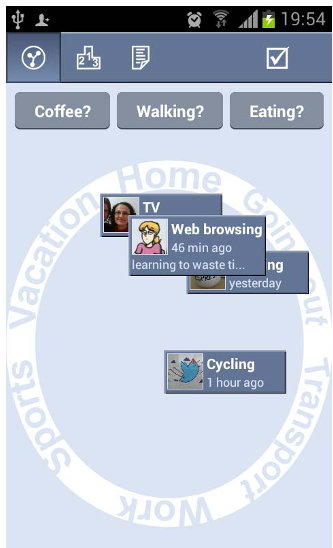 Figure 1: The up2 interface showing activity suggestions and the check-in process.
Experiments: Performance vs. Battery
The results reveal a fascinating trade-off. Physical sensors (GPS/Accel) consume roughly 561mW of power. Soft sensors consume almost zero additional power because the OS already logs this data.
Key Findings:
- User-Specific Power: A "Global" model (one-size-fits-all) only hits 60% accuracy for 5 suggestions. However, once the system learns your specific habits (after about 60-70 check-ins), accuracy jumps to 75%.
- The Soft Sensor Triumph: Using only soft sensors achieved 72% accuracy in user-specific models—nearly matching the performance of the battery-heavy physical sensors.
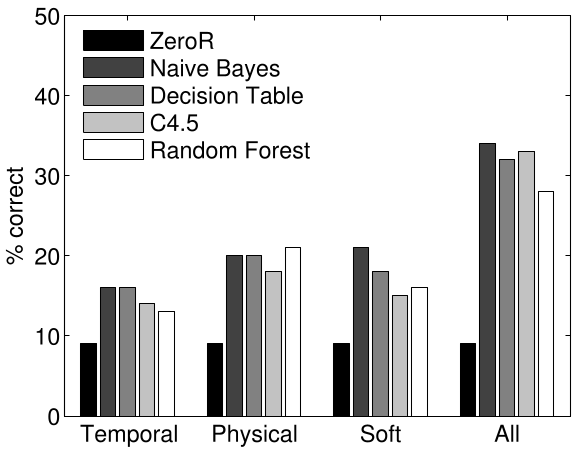 Figure 2: Prediction accuracy across various feature sets.
Verifying the Truth: Catching Fake Check-ins
LBSNs often use rewards (badges, discounts) to encourage check-ins, which invites "fake" data. The authors used the same Bayesian probabilities to spot anomalies. If a user says they are "Running" but the sensors show high Wi-Fi signal and low acceleration, the "Global Model" identifies the discrepancy. The system caught 80% of fakes with only a 3% false-alarm rate.
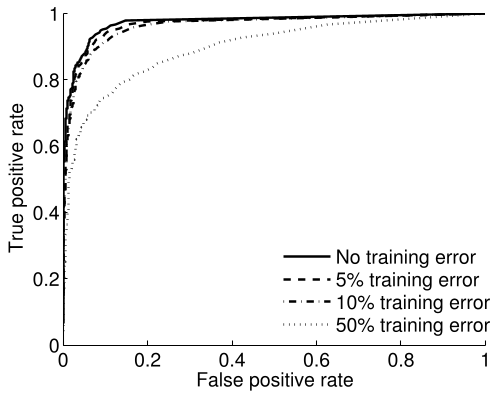 Figure 3: ROC Curve showing the high effectiveness of the verification system.
Critical Insight: The Future of Context-Aware Apps
This paper proves that metadata is often as valuable as raw data. By moving from "Sensing the World" (Physical) to "Sensing the User" (Soft), we can build social apps that are deeply contextualized without sacrificing hardware longevity.
Limitations: The model relies on the user being an "active" phone user. For someone who leaves their phone in their bag all day, soft sensors may lack the granularity to distinguish between "working" and "reading." However, for the majority of "always-on" users, this represents a massive leap forward in mobile OS intelligence.