
Beyond the Canvas: A Causal and Historical Critique of Biases in Generative Art
Biases in Generative Art -- A Causal Look from the Lens of Art History
This paper presents a critical investigation into the ethical and socio-cultural dimensions of AI generative art, specifically identifying systemic biases across the machine learning pipeline. By integrating art history with structural causal models, the authors analyze how popular architectures like CycleGAN and ArtGAN fail to capture the nuanced intent and historical context of artistic styles, leading to stereotyping and misrepresentation.
Executive Summary
While AI-generated art captures headlines with multi-million dollar auctions and viral style-swap apps, a deeper ethical rot remains largely unexamined. In "Biases in Generative Art: A Causal Look from the Lens of Art History," Srinivasan and Uchino peel back the aesthetic veneer of SOTA models like CycleGAN and ArtGAN. They argue that these models are "tourists in a foreign country"—capable of repeating phrases (visual patterns) without understanding the language (cultural intent). By applying Structural Causal Models (SCMs), the paper identifies why AI often defaults to racial stereotyping and historical erasure.
The Core Tension: Aesthetics vs. Intent
The fundamental problem in generative art today is Framing Effect Bias. Computer scientists often define "style" through a narrow computational lens—usually low-level statistics like color histograms or brushstroke frequency.
However, art history teaches us that style is inseparable from intent. For instance, Vincent van Gogh’s use of vibrant colors wasn't a random statistical preference; it was a deliberate attempt to infuse "life" into subjects to convey specific emotions. When a model like CycleGAN reproduces a Van Gogh landscape by simply shifting colors toward a yellowish-brown palette, it may technically match a "weighted average" of his work, but it fundamentally violates the artist’s emotional logic.
Methodology: The Causal Lens
The authors advocate for using Directed Acyclic Graphs (DAGs) to map the art creation process. By treating "Artist," "Genre," "Material," and "Movement" as variables, they show where AI fails.
1. Confounding Bias
If an algorithm only looks at the relationship between an Artist (X) and an Artwork (Z), it ignores confounders like the Art Movement (A) or Material (M).
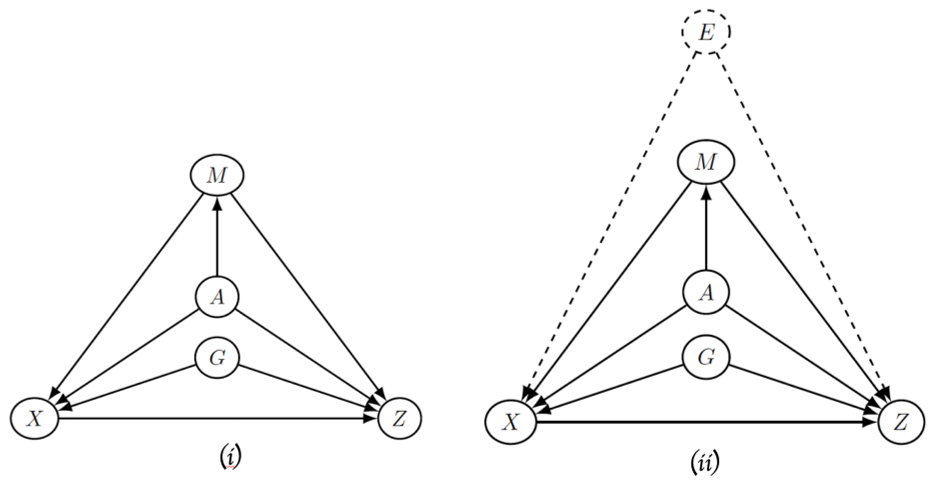 Figure: The causal complexity of art vs. the simplistic correlation used by AI.
2. Transportability Bias
This occurs when a model attempts to "transport" a style from one domain (e.g., Futurism) to another (e.g., a photo of propellers). In the paper’s case study, AI-generated "Futurist" art fails to capture kinetics. While real Futurism used fractured planes to denote speed and war, AI simply applies a texture, missing the structural essence of the movement.
Critical Failures in Modern Apps
The paper highlights several "in-the-wild" failures that showcase the real-world impact of these biases:
- Racial Bias (Selection Bias): The "AIportraits" app notoriously lightened the skin of people of color (e.g., actress Tessa Thompson). Because the training set was overwhelmingly composed of white Renaissance portraits, the model "corrected" non-white features to fit the statistical mean of the "Renaissance" label.
- Historical Stereotyping: Gender-translation tools often fail to recognize that Renaissance men frequently had long hair. By applying modern grooming standards, the AI misidentified male portraits as female, illustrating a failure in Transportability.
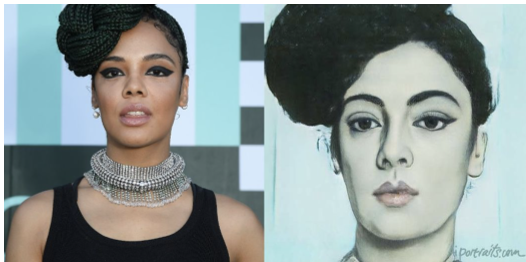 Figure: Racial bias in portrait rendition where skin color is lightened to match training data demographics.
Performance and Case Study Analysis
The authors systematically categorized 10 case studies (see Table below) to prove their point. Their analysis shows that even SOTA models fail at "Style Transfer" because they cannot account for the Inductive Bias inherent in specific art movements.
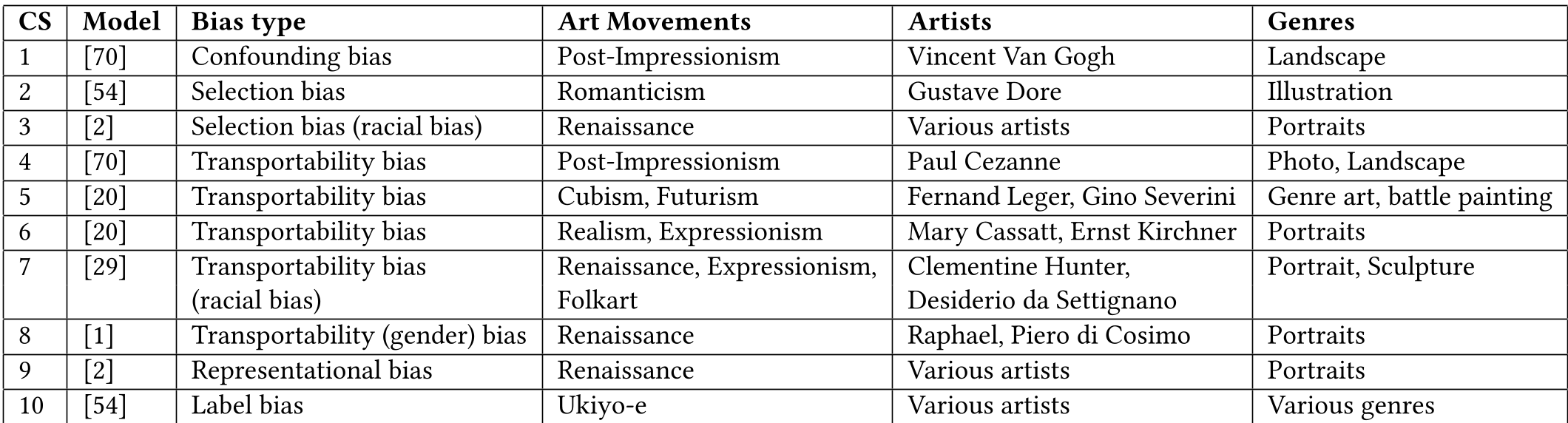 Table: Summary of biases across different models, artists, and genres.
Conclusion and Future Outlook
The takeaway is clear: generative art is currently suffering from "Automation Bias"—the tendency for humans to trust automated outputs even when they contradict historical facts.
To move forward, the field must:
- Incorporate domain-expert knowledge (art historians) into the loop.
- Move beyond "data-fitting" toward causal discovery that respects the intent behind the image.
- Diversify datasets to prevent the erasure of non-Western art forms like Ukiyo-e or Black folk art.
By failing to address these biases, we risk creating an AI-driven "cultural echo chamber" that flattens the rich, diverse history of human expression into a series of superficial, stereotyped filters.