
BCRSN: Redefining Music Emotion Recognition via Internal Fusion and Binary Decomposition
17527_Bidirectional Convolutional Recurrent Sparse Network (BCRSN) An Efficient Model for Music Emotion Recognition.
The paper introduces the Bidirectional Convolutional Recurrent Sparse Network (BCRSN) for continuous Music Emotion Recognition (MER). It extracts Sequential-Information-Included Affect-Salient Features (SII-ASF) by deeply fusing CNN and RNN architectures, outperforming MediaEval 2015 state-of-the-art methods in arousal and valence prediction.
Executive Summary
TL;DR: The Bidirectional Convolutional Recurrent Sparse Network (BCRSN) is a specialized architecture designed to tackle the complexities of continuous Music Emotion Recognition (MER). By embedding convolutional kernels directly into the recurrent structure and re-encoding numerical emotion values into weighted binary vectors, the authors achieve a model that is both computationally efficient and highly accurate in predicting the Arousal and Valence of music.
Context: This work moves beyond simple "stacked" architectures (CNN + RNN) and "handcrafted" features, establishing a new SOTA benchmark on the DEAM and MoodSwings Turk datasets.
The Bottleneck: Why Music Emotion is Hard
Traditional MER methods suffer from a "Semantic Gap." Handcrafted acoustic descriptors (like MFCCs) often lose the crucial sequential information—the way a melody builds tension over time. While deep learning models like CNNs can extract salient features and LSTMs can model sequences, simply stacking them often results in:
- Lost Granularity: CNN layers often capture local spatial patterns but ignore the global temporal flow until the very end.
- Regression Complexity: Predicting a continuous floating-point number (e.g., Valence = 0.742) is computationally heavier and harder to converge than classification.
Methodology: The BCRSN Architecture
The core innovation lies in the internal fusion of layers and the WHBR target representation.
1. Internal Fusion for SII-ASF
Instead of passing CNN outputs to an LSTM, BCRSN uses a CNN to replace the connection between the input layer and the hidden layer of a bidirectional RNN. This allows the network to learn Sequential-Information-Included Affect-Salient Features (SII-ASF).
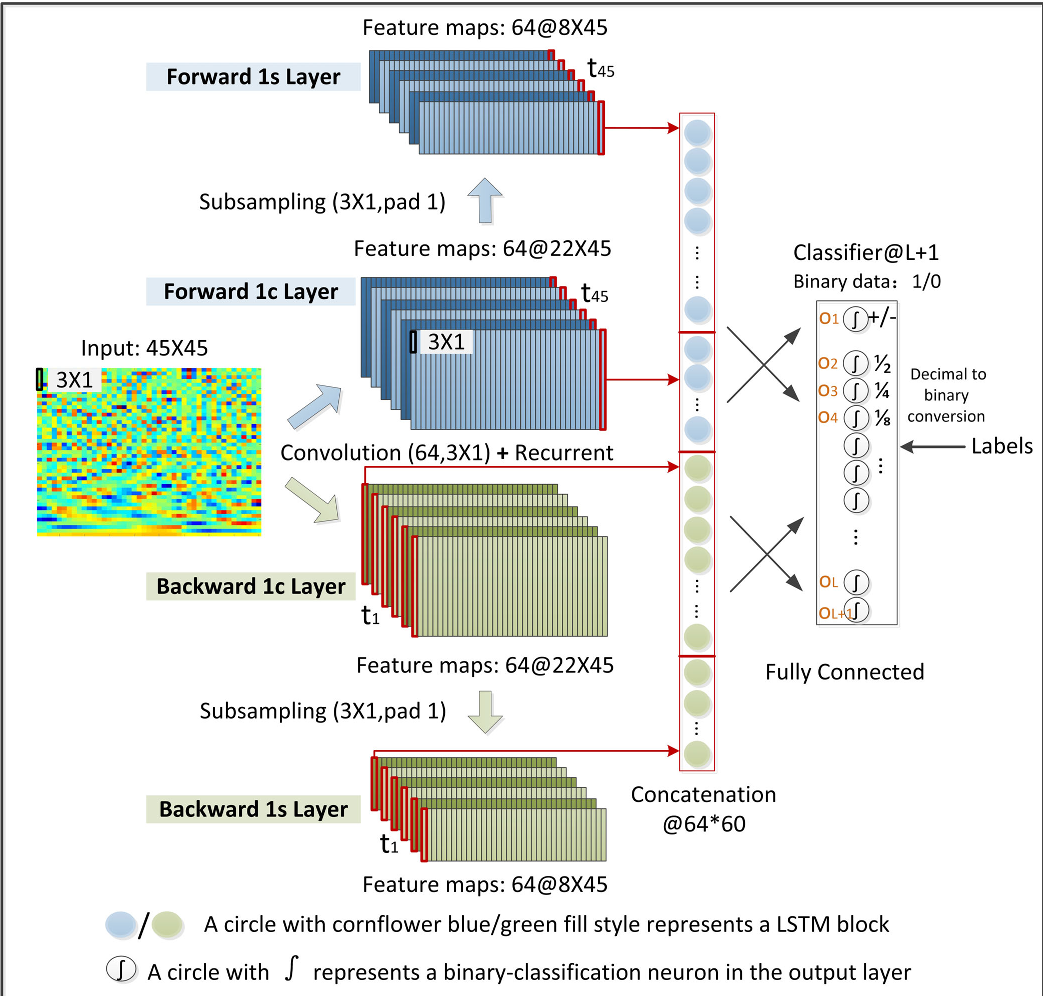
- Convolutional Recurrent Feature Maps (BCRFMs): Kernels observe local time-frequency patterns, while bidirectional LSTM modules replace standard neurons to maintain long-term dependencies.
- Lasso Penalty: By adding an regularization term to the objective function, the model forces the feature maps to be sparse, effectively performing "feature selection" during training.
2. Weighted Hybrid Binary Representation (WHBR)
To solve the regression bottleneck, the authors convert numerical ground truth into a weighted hybrid binary vector.
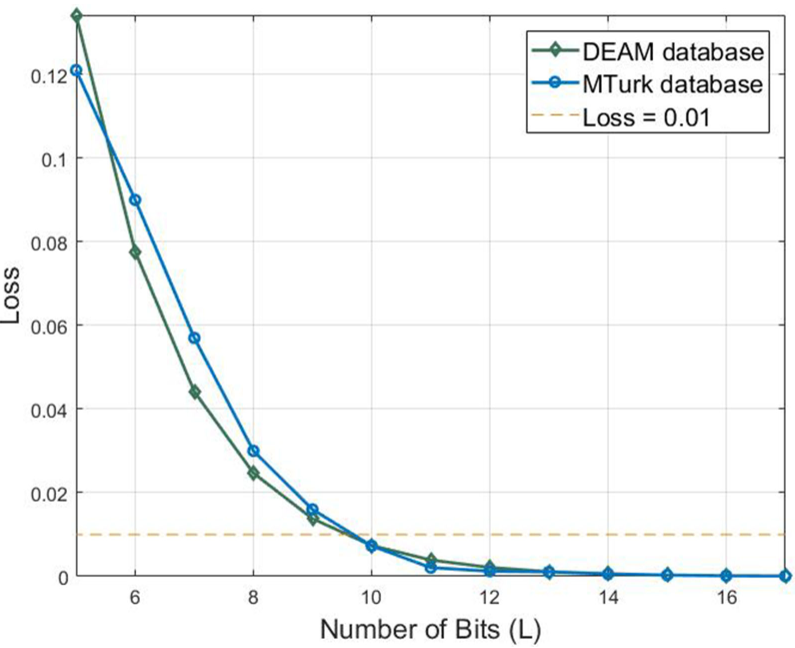
This transforms the difficult task of regression into a series of binary classification sub-problems (e.g., "Is the value ?", "Is it ?"). This not only speeds up convergence but also allows the model to prioritize significant bits (the sign and major magnitude) through a weighted loss function.
Experimental Results
The model was validated on the DEAM (1802 songs) and MTurk benchmarks.
- Accuracy Boost: The WHBR method alone improved the CCC metric significantly over traditional numerical regression.
- Training Efficiency: BCRSN showed faster convergence and required fewer parameters than stacked CNN-BLSTM models.
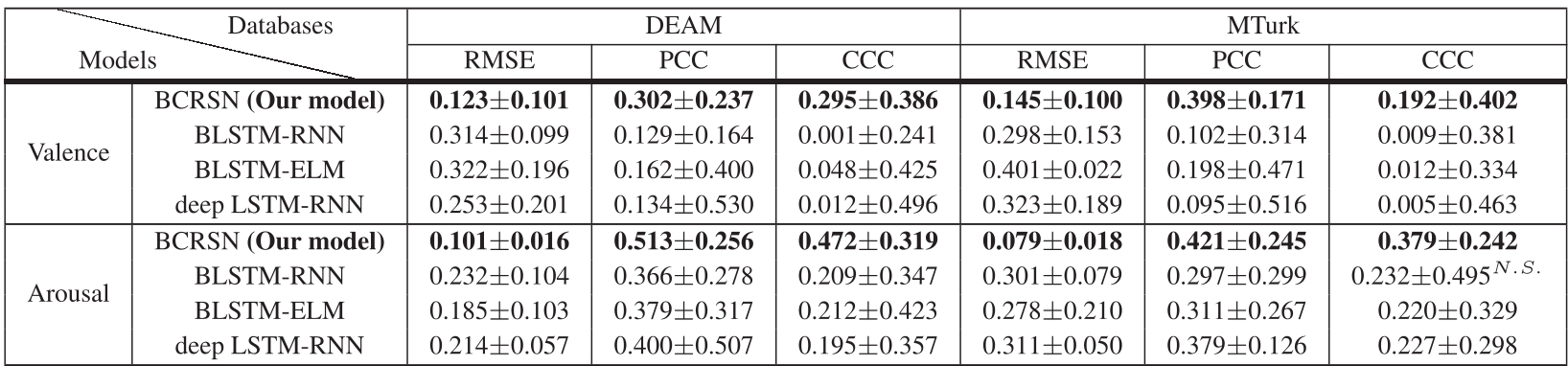
- SOTA Comparisons: As shown in the results below, BCRSN consistently outperformed previous leaders from the MediaEval 2015 competition.
Robustness Tests
The SII-ASF features were tested against:
- Genre Variation: (Jazz, Rock, Classical, Pop)
- Timbre styles: (Instrumental, Male/Female Vocals)
- Acoustic Noise: (Random Gaussian Noise)
In all cases, the sparse features (SII-ASF) maintained stable performance compared to non-sparse features, proving their "salience" in representing human emotion.
Critical Insight & Conclusion
The brilliance of BCRSN is not just in using "more" layers, but in how those layers interact. By fusing convolution into the recurrent step, the model treats time and frequency as a unified manifold rather than separate dimensions to be processed sequentially. Furthermore, the WHBR trick highlights a growing trend in DL: sometimes, discretization is the best way to handle continuous regression.
Future Outlook: The authors suggest integrating human physiological signals (EEG/ECG) next, moving from "perceived" emotion to "induced" (felt) emotion—a critical step for hyper-personalized music therapy and recommendation systems.