
The Living Matrix: Bidirectional Crosstalk Between Phytohormones and Metabolism
Bidirectional crosstalk between plant hormone signaling and metabolism
This review provides a comprehensive synthesis of the bidirectional crosstalk between the 9 major classes of phytohormone signaling and plant metabolism. It establishes a "metabolically embedded" regulatory framework where hormones like GAs, Auxin, and ABA rewire central carbon and nutrient flux, while metabolic sensors (e.g., SnRK1, TOR, and ROS) conversely modulate hormone biosynthesis and sensitivity.
TL;DR
For decades, plant scientists viewed hormones as "master regulators" and metabolism as a "downstream effector." This review, led by Fàbregas and Fernie, shatters that hierarchy. It argues that plant life is governed by a bidirectional, dynamically integrated system. Phytohormone signaling (the software) and metabolic status (the hardware and power supply) engage in constant crosstalk, using shared molecular "hubs" like the TCA cycle and ROS levels to decide whether a plant should grow, defend, or dormant.
The Core Conflict: Why "Linear Pathways" Fail
The central challenge in plant biology is the growth-stress tradeoff. A plant cannot maximize growth and defense simultaneously. Prior work often focused on transcript-based signal transduction—measuring mRNA changes after hormone application. However, mRNA levels rarely tell the whole story. The missing link is the interface: how metabolites like sucrose or malate feedback into the signaling machinery to say, "Stop, we don't have the energy for this hormonal command."
Methodology: The Integrated Conceptual Framework
The authors structure their analysis around the 9 major phytohormone groups, identifying specific "metabolic hubs" where signaling and flux converge.
1. The Energy Sensors: SnRK1 and TOR
Think of SnRK1 as a low-energy sensor (activated when sugars are low) and TOR as a high-energy sensor (activated when nutrients are abundant).
- ABA & Auxin Connection: ABA signaling represses TOR to stall growth during drought, while Auxin activates TOR to drive development.
- Ethylene Feedback: Glucose-activated TOR directly phosphorylates and inhibits EIN2, the master regulator of ethylene signaling, linking carbohydrate status to ripening and senescence.
2. TCA Cycle Intermediates as Signaling Molecules
The tricarboxylic acid (TCA) cycle is more than just an energy factory; its intermediates are regulators.
- 2-Oxoglutarate (2-OG): Acts as a mandatory substrate for the enzymes that synthesize bioactive Gibberellins (GAs) and Salicylic Acid (SA).
- Succinate & Malate: Multi-omics data show that shifting ABA receptor levels constitutively alters succinate pools, creating a feedback loop between water-stress signaling and mitochondrial respiration.
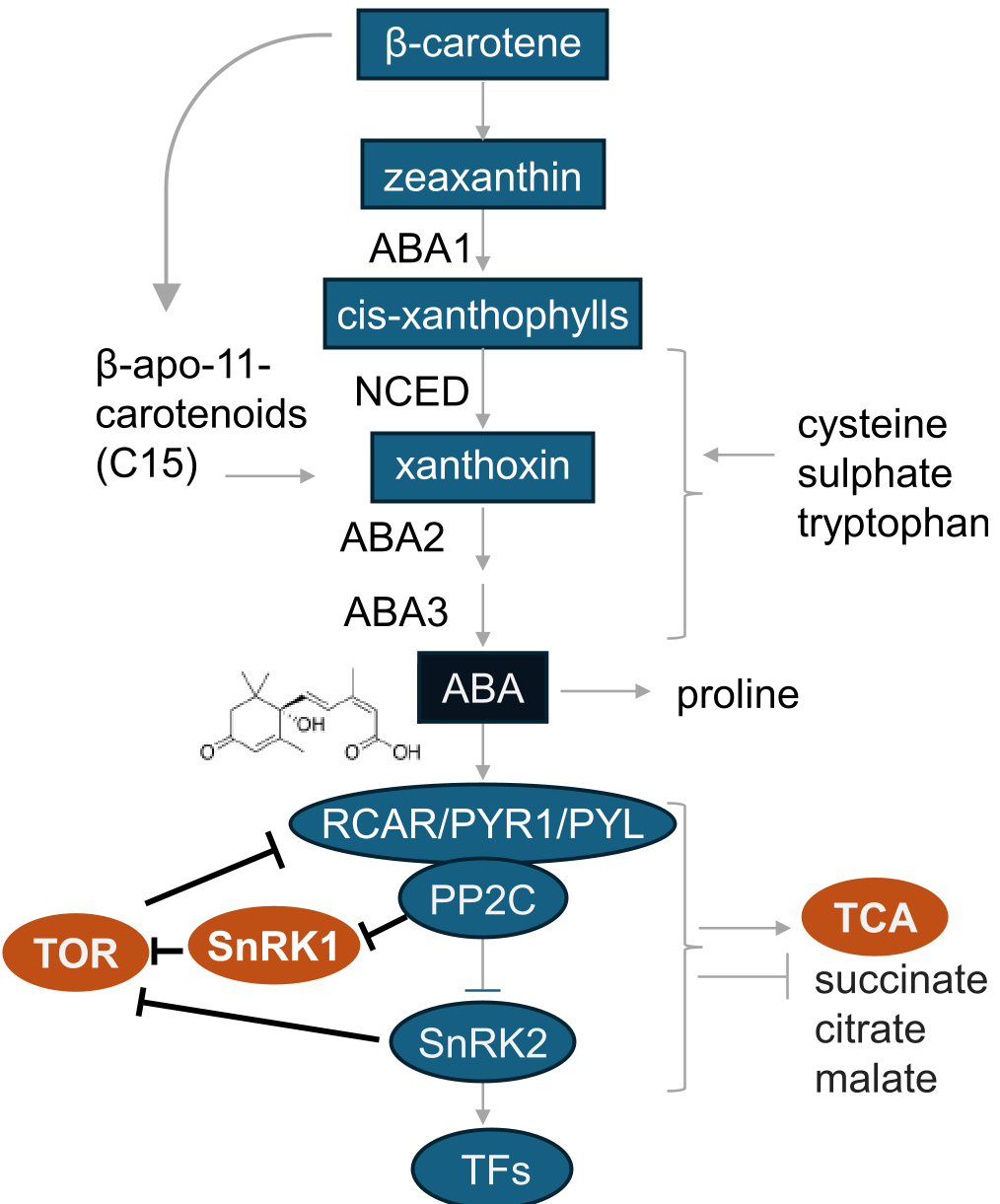 Note: The image illustrates the complex integration of ABA signaling with TCA cycle flux and energy-sensing kinases.
Mechanistic Deep Dives
Brassinosteroids (BRs) and Redox Gating
BRs drive cell elongation, but this process is "gated" by the metabolic state of the cell. The transcription factor BZR1 is redox-sensitive. When metabolic stress leads to ROS (Hydrogen Peroxide) accumulation, BZR1 becomes oxidized, which paradoxically enhances its activity to bridge stress response and growth.
Strigolactones (SLs): The Nutrient Gatekeepers
SLs are the "newest" hormones, primarily known for regulating shoot branching. The authors highlight that SL biosynthesis is inhibited by high Nitrate and Phosphate. When the plant is "starved" for these nutrients, SL levels spike, promoting symbiotic relationships (mycorrhizae) to scavenge for minerals.
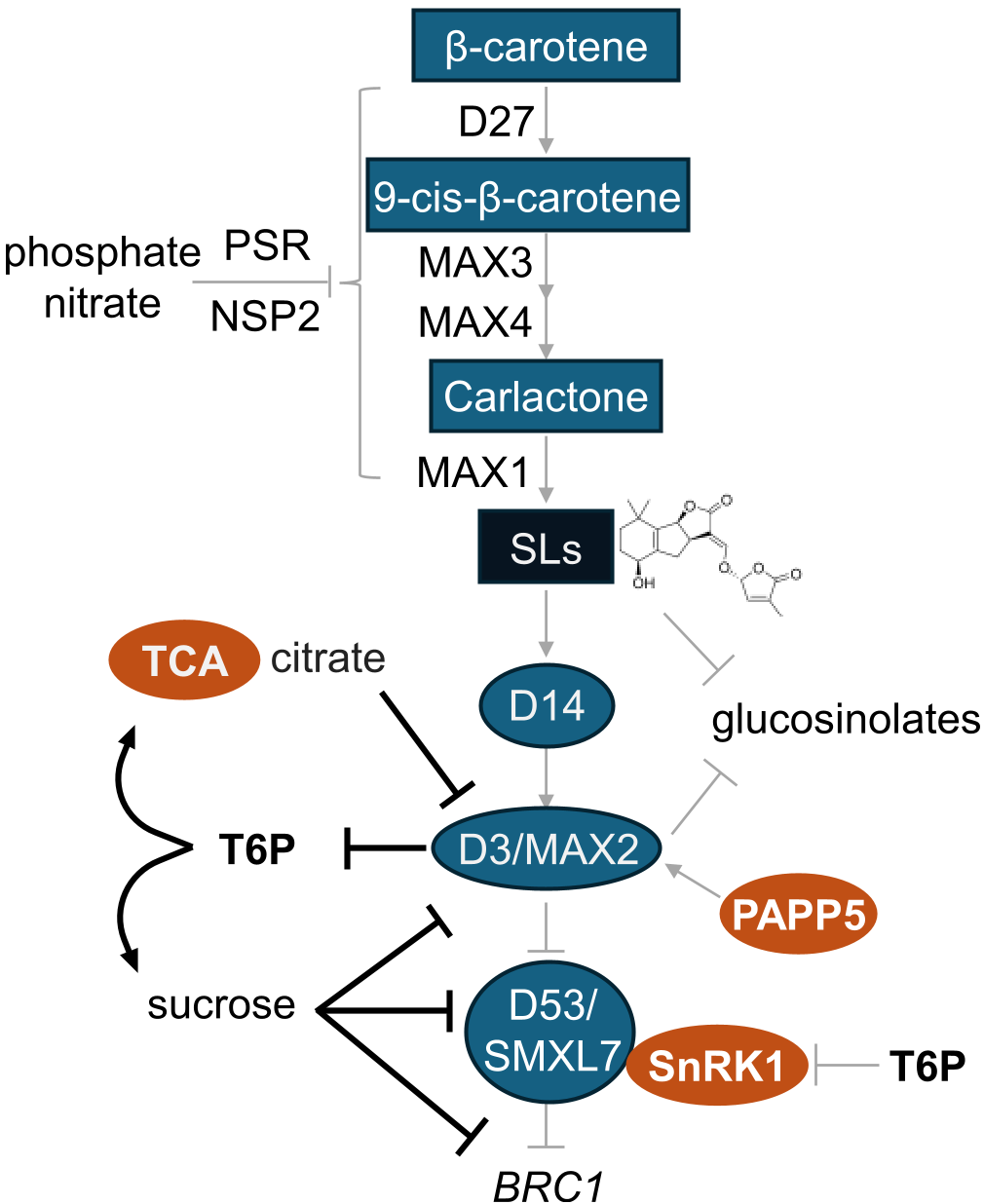 Note: The D14-D3-SMXL7 complex integrates sugar signals like Trehalose-6-Phosphate into the decision to branch or stay dormant.
Future Frontiers: From "What" to "Causal How"
The review concludes by pointing toward the next decade of research:
- Tissue-Resolved "Hormonomics": Creating 4D "atlases" that map hormone and metabolite concentrations simultaneously.
- Real-Time Biosensors: Moving from destructive sampling to in vivo monitoring using FRET sensors (like GPS2 for GAs).
- Single-Cell Fluxomics: Understanding how metabolic "microenvironments" in a single cell dictate hormonal sensitivity.
Critical Insight & Conclusion
This work demonstrates that for 8 of the 9 major phytohormones, we now have mechanistic proof of bidirectional regulation. The takeaway is clear: the future of precision agriculture and crop resilience lies not in tweaking individual genes, but in engineering these "shared hubs"—the nodes where energy, carbon, and specialized signals meet. By understanding the plant as a unified metabolic-hormonal matrix, we can better design crops that survive the fluctuating stresses of climate change.