
Scalable Dance Learning: Bridging Deep Learning and Choreographic Art
Bidirectional long short-term memory networks and sparse hierarchical modeling for scalable educational learning of dance choreographies
The paper presents a machine learning framework for the scalable educational assessment of dance choreographies using Bidirectional LSTMs and Hierarchical Sparse Modeling. By integrating 3D skeleton data with Labanotation, it achieves a coarse-to-fine evaluation of dancer performance, outperforming traditional shallow learning models in pose identification accuracy.
TL;DR
Preserving the "Intangible Cultural Heritage" (ICH) of folk dance requires more than just video recordings; it requires precise, quantifiable assessment. This paper introduces a dual-engine AI framework: Bidirectional LSTMs for granular pose identification and Hierarchical Sparse Modeling for high-level choreographic summarization. Together, they provide a "coarse-to-fine" evaluation system that helps students learn complex movements by comparing their 3D skeletal data against expert ground truths.
The Challenge: Why Quantitative Dance Assessment is Hard
In the realm of serious games (like those using Microsoft Kinect), most systems struggle with two things:
- Contextual Logic: A dance move isn't just a static frame; its meaning depends on what came before and what follows. Traditional "causal" models only look at the past, missing the "intent" of the full motion.
- Scalability of Feedback: Beginners need to know if they got the "big picture" (the main steps), while advanced dancers need a frame-by-frame analysis of micro-errors. Most systems only offer one or the other.
Methodology: The Core AI Architecture
The authors tackle these issues through two distinct but complementary modules.
1. Fine-Grained Pose Identification (Bi-LSTM)
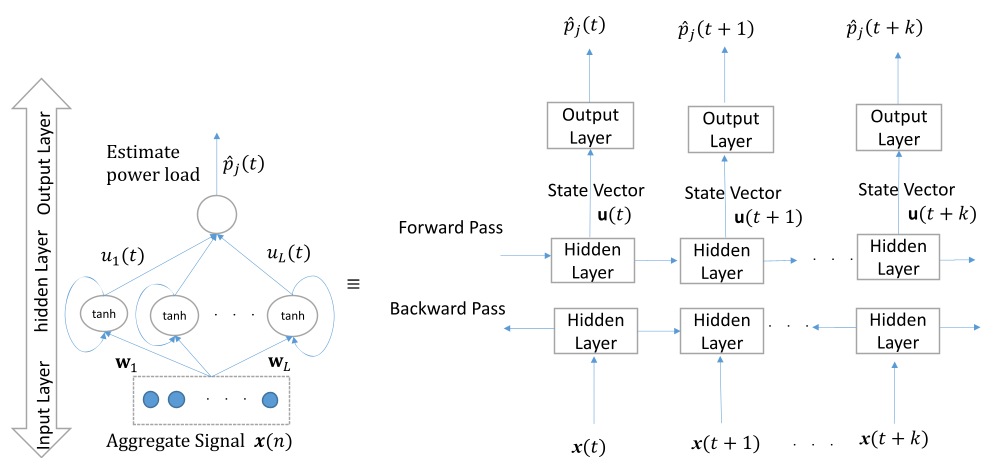
To identify specific poses (like "Cross Leg" or "Right Leg Up"), the system uses a Bidirectional Long Short-Term Memory (Bi-LSTM) network.
- The Intuition: Unlike standard LSTMs, the Bi-LSTM processes the dance sequence in both forward and backward time directions. This allows the model to "understand" that a specific arm position is part of a "Dancer's Left Turn" because it sees the preparation and the follow-through simultaneously.
- Input Features: Instead of raw pixels, the model uses physics-based features: velocity and acceleration of 3D skeletal joints.
2. Coarse Summarization (Hierarchical SMRS)
To provide a "big picture" view, the authors adapted the Sparse Modeling Representative Selection (SMRS) algorithm.
- How it works: SMRS finds a subset of "key frames" that can mathematically reconstruct the entire sequence.
- The Hierarchical Twist: By applying SMRS at multiple levels, the system creates layers of detail. Level 1 might show only the 7 most critical steps of a Sirtos dance, while Level 3 shows 70 frames, capturing the nuances of the performance.
Experimental Results & SOTA Comparison
The framework was tested on the TERPSICHORE dataset, featuring Greek folklore dances.
Superior Performance
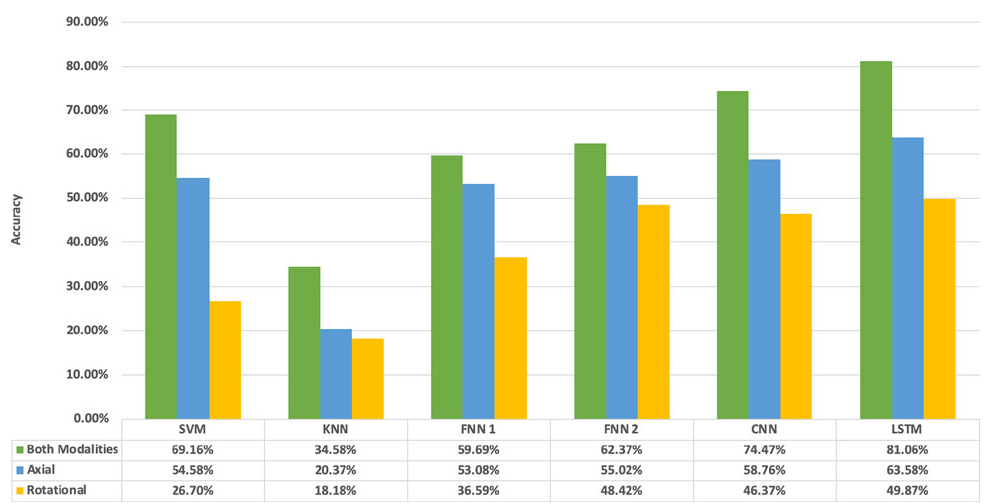
The deep learning approach significantly outperformed shallow paradigms like Support Vector Machines (SVM) and k-Nearest Neighbors (kNN).
- Peak Accuracy: Bi-LSTM achieved 81.06% accuracy.
- Robustness to Noise: To simulate a novice dancer making mistakes, the authors added 20% noise to the skeletal data. The Bi-LSTM remained at 56.15%, while kNN collapsed to 8.01%, proving that deep models can generalize better to "bad" dancing (noise) than simple classifiers.
Labanotation: Formalizing the Motion
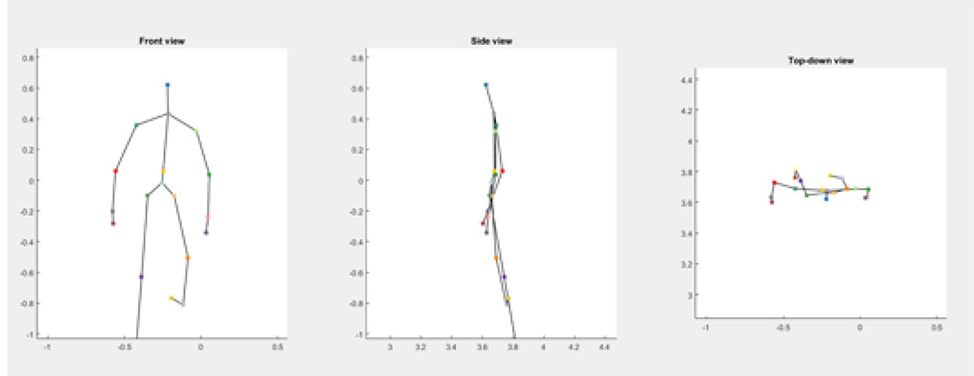
The system doesn't just output numbers; it translates 3D movements into Labanotation, a formal documentation system for dance. This allows experts to read the computer's assessment like a musical score, making the AI's feedback interpretable for human choreographers.
Critical Insight & Conclusion
The true value of this work lies in its Scalability. By combining Bi-LSTMs (for the "what") and Hierarchical SMRS (for the "where in the dance"), the platform creates a curriculum-friendly AI. A student can start by trying to match the 7 key frames (Level 1) and gradually work toward a perfect 81% match on the frame-by-frame Bi-LSTM assessment.
Limitations: While robust, the system still relies on 3D skeletal data from sensors like Kinect, which can have occlusion issues (one limb hiding another). Future work incorporating Graph Convolutional Networks (GCNs) could likely improve joint relationship modeling further.
Takeaway: This is a landmark example of using Deep Learning not just for classification, but for the preservation and pedagogy of human culture.