
BERT Meets Real Estate: Leveraging NLP for Secure Business Investment
Bidirectional Transformer based on online Text-based information to Implement Convolutional Neural Network Model For Secure Business Investment
This paper proposes a hybrid Transfer Learning framework that combines BERT and Convolutional Neural Networks (CNN) to predict real estate investment safety. By integrating semantic analysis of over 5 million online reviews from Airbnb and Zillow with traditional housing metrics, the model achieves a significant F1-score of 0.92 in identifying profitable rental properties.
TL;DR
Real estate investment, particularly for low-income individuals, is a high-stakes decision often plagued by information asymmetry. This paper introduces a sophisticated Transfer Learning model that fuses BERT (for sentiment analysis of 5 million+ reviews) with a CNN architecture to predict rental profitability. The result? A robust classification system that hits a 0.92 F1-score, proving that what people say online about a neighborhood is just as important as the number of bedrooms in a house.
The Motivation: Moving Beyond "Bed and Bath"
Traditional real estate valuation models are often "blind" to the lived experience of a neighborhood. While a house might have 4 bedrooms and a low price, high crime rates or poor transit accessibility—often discussed in Airbnb or Zillow reviews—can lead to high vacancy rates and negative Net Present Value (NPV).
The authors identified two major gaps in prior work:
- The Semantic Gap: Most models ignore the rich context of online reviews.
- The Geographical Bias: Existing studies often use skewed datasets limited to specific university campuses or cities, failing to account for the radical variance between neighboring zip codes.
Methodology: A Multi-Modal Pipeline
The authors didn't just build a simple regressor; they built a semantic pipeline that treats real estate data as a high-dimensional NLP problem.
1. Feature Engineering & PCA
The team collected data for 5 million US houses, including internal features (sq ft, year built) and external "deal-breakers" (walk score, transit score, crime rate). Interestingly, Principal Component Analysis (PCA) revealed that the importance of these features varies by house type. For example, HOA fees and transit scores are critical for Condos but less significant for Single-Family homes.
2. The BERT-CNN Architecture
The core innovation lies in the "New Model for Rent Investment Prediction":
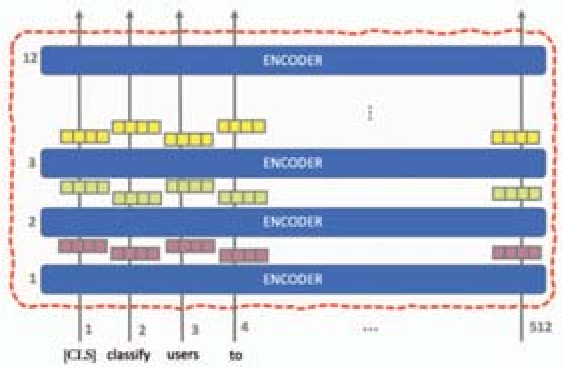
- BERT (Bidirectional Encoder Representations from Transformers): Used to extract deep, context-aware sentiment scores from millions of user comments.
- GloVe Embeddings: Handled the massive scale of the word corpus to ensure computational efficiency.
- CNN (Convolutional Neural Network): Specifically a CLSM (Convolutional Latent Semantic Model), which acts as the final decision layer, integrating the BERT sentiment scores with the numerical PCA features.
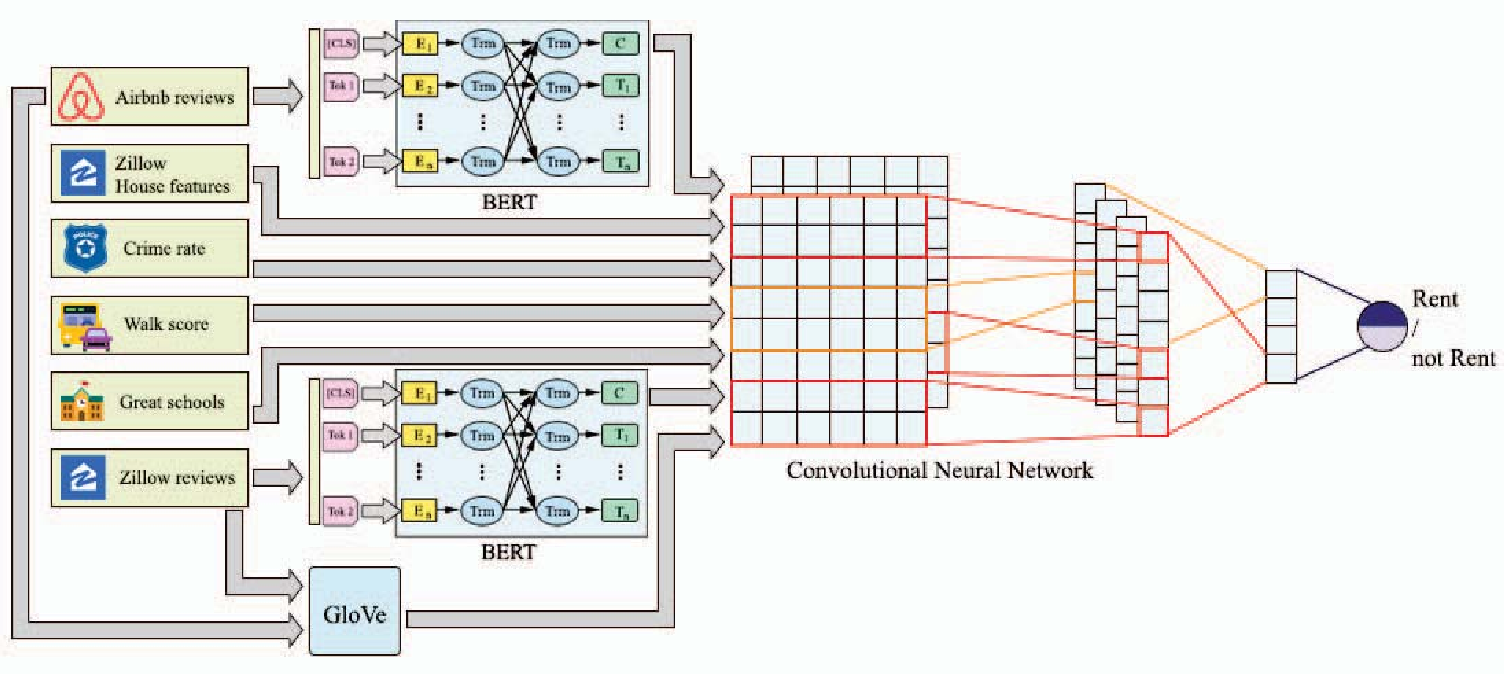
Performance: Why It Works
The paper conducted a rigorous head-to-head battle between Eager Learners (like Random Forest and Neural Networks) and Lazy Learners (like KNN and K-Star).
| Algorithm | F1-Score | MCC |
|---|---|---|
| K-Star (Lazy) | 0.81 | 0.76 |
| FFNN (Eager) | 0.82 | 0.83 |
| Proposed BERT-CNN | 0.92 | 0.88 |
The integration of Transfer Learning allowed the model to generalize across different zip codes and house types, effectively "learning" the relationship between neighborhood sentiment and property demand.
Critical Analysis & Insights
The real value of this work is its democratization of data. By quantifying the "unquantifiable" (neighborhood vibe), it provides inexpert investors with the same level of insight typically reserved for professional real estate agents.
Key Takeaways:
- Sentiment is a Leading Indicator: High positive sentiment in Airbnb reviews correlates strongly with lower vacancy rates, directly impacting Cash Flow (CF).
- Scale Matters: A dataset of 5 million properties is a significant contribution to the NLP community, providing a playground for future "People Analytics" applications.
Limitations: While the model is powerful, it remains susceptible to "Fake News" and bot-generated reviews on real estate platforms—a problem the authors acknowledge as a future challenge for disinformation detection.
Conclusion
This research marks a pivot point where real estate moves from a purely statistical domain to a multi-modal AI domain. By treating the city as a "text" to be decoded, the BERT-CNN model offers a safer path for investors in an increasingly volatile housing market.