
Scaling Social Simulation: A MapReduce Approach to Agent-Based Modeling
Handling big data on agent-based modeling of Online Social Networks with MapReduce
This paper introduces a MapReduce-based framework for building stochastic Agent-Based Models (ABM) of Online Social Networks (OSNs). By leveraging distributed computing, the method scales information diffusion modeling to accommodate massive streaming graph data, achieving SOTA performance in handling millions of nodes using a sample of the 2012 U.S. presidential election Twitter network.
TL;DR
Modeling how information spreads on Twitter is computationally expensive due to the sheer volume of data. This paper presents a MapReduce-based methodology to build agent-based models from massive OSN datasets. By decomposing user behavior into Markov Chain transitions and processing them across a distributed cluster, the researchers achieved a 90% performance boost and solved the "memory wall" problem that previously limited simulation scales.
The Memory Wall: Why Traditional Simulation Fails
In the context of Online Social Networks (OSNs), every user is an "agent" whose actions depend on their history and their connections. Prior attempts at simulation used in-memory processing.
As shown in the authors' analysis, while running time for in-memory solutions scales linearly, memory usage increases exponentially. For a network centered on a figure like Barack Obama, the first-degree followers alone total millions, and the second-degree reach billions. A single high-end server with 256GB of RAM hits a hard limit at roughly 152,000 users. To model the "real" social web, we need a shared-nothing architecture—which is where MapReduce comes in.
Methodology: The Three-Step Pipeline
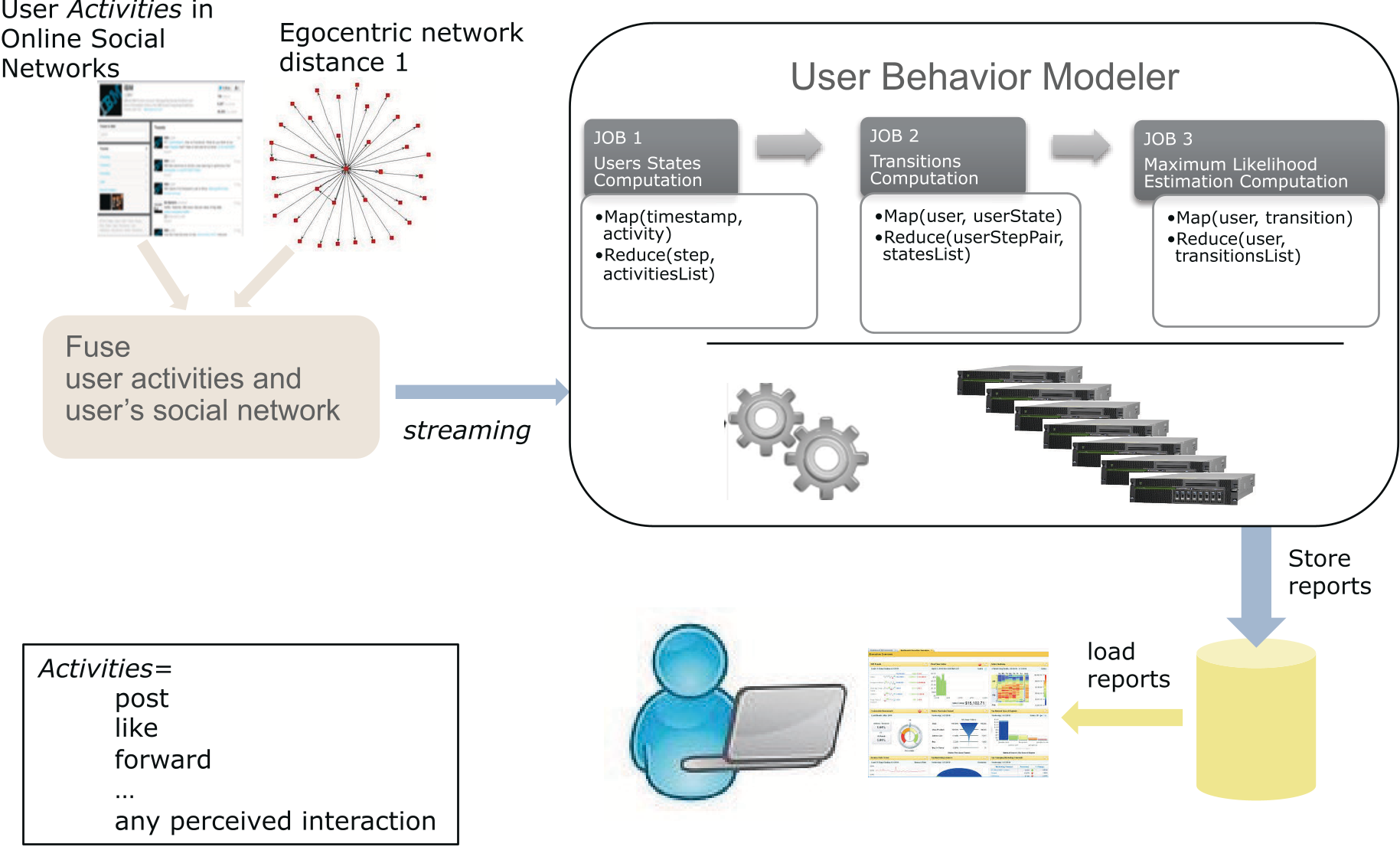
The core innovation is the decomposition of Agent-Based Modeling (ABM) into a three-stage distributed workflow, allowing the system to handle massive graph structures and activity logs without overloading any single node.
1. The Model: Markovian Agents
Each agent's behavior is modeled as a First-Order Markov Chain. The state at time depends on what the user read () and wrote () in the previous window.
- Input: User activity (tweets) + Graph structure (who follows whom).
- States: Seven distinct transition types (e.g., transitions from "reading and writing" to "writing").
2. The MapReduce Workflow
Instead of one massive process, the authors split the task:
- Job 1 (States Computation): Maps activities to discrete time steps (). The Reducer identifies if a user action (post) was a "WRITE" for the user or a "READ" for their followers.
- Job 2 (Transitions Computation): Uses a Secondary Sort technique to ensure user states are processed in chronological order. It counts how often an agent moves from one state (e.g., Idle) to another (e.g., Posting about "Obama").
- Job 3 (MLE Computation): Applies Maximum Likelihood Estimation with smoothing to convert counts into probabilities, which define the agent's behavior during the simulation.
Experimental Validation: Obama's Twitter Network
The authors tested their framework using 2012 U.S. Presidential Election data, encompassing 5.6 million tweets and a network of 32 million nodes.
Performance and Scalability
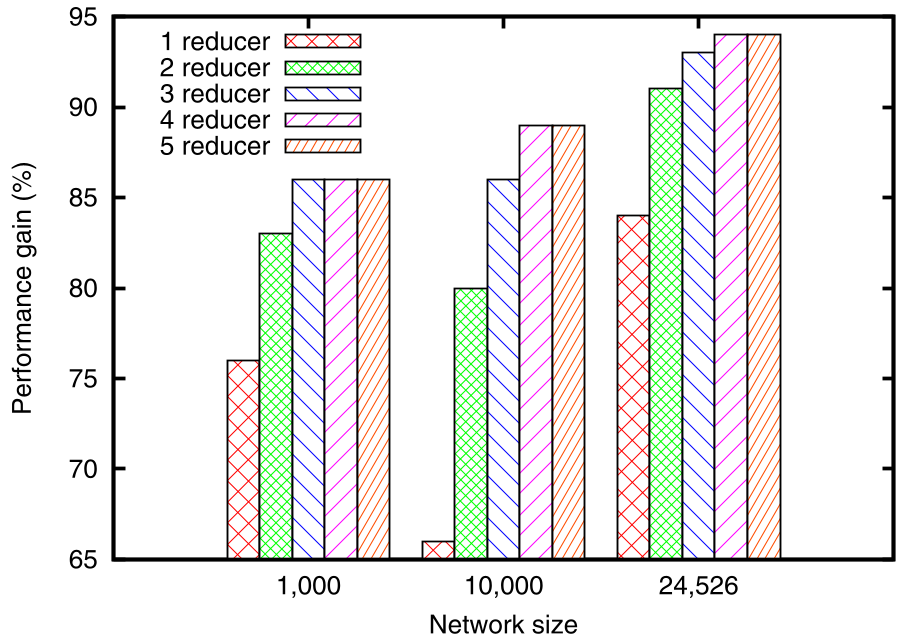
- Sublinear Scaling: Unlike the in-memory solution, the MapReduce approach shows sublinear growth in execution time as the network size increases.
- Reducer Optimization: The study found that for their specific hardware, 4 reducers provided the optimal balance. Adding a 5th reducer actually slowed down the process due to overhead, highlighting the importance of tuning in distributed systems.
Critical Insight: Scaling Out vs. Scaling Up
The paper provides a crucial proof-of-concept for Scaling Out. By moving the state computation to HDFS and MapReduce, the system is no longer bound by the RAM of a single machine.
However, there is a trade-off: the Job 1 Reducer is computationally heavy because it must check if the followers of every active user are "users of interest." This "shuffle and sort" overhead is the price paid for the ability to handle snapshots that are terabytes in size.
Conclusion and Future Outlook
This research bridges the gap between Big Data Infrastructure and Social Complexity Science. By proving that agent-based modeling can be handled by MapReduce, the authors pave the way for more complex simulations, such as multi-topic sentiment analysis and real-time forecast of viral information diffusion.
Future iterations likely need to move toward Stream Processing (like Spark Streaming) to handle the "Real-Time Updates" challenge mentioned in the problem description, moving from batch-processed historical models to alive, evolving digital twins of social networks.