
Empowering Healthcare with Spark: A Zero-Code Big Data Analysis Platform
A Big Data Analysis Platform for Healthcare on Apache Spark
This paper introduces a web-based big data analysis platform for healthcare built on Apache Spark. By integrating a multi-layered architecture (Web, Workflow, and Spark), it enables non-programmers to execute SOTA data mining tasks like disease prediction using a drag-and-drop interface.
TL;DR
Researchers from Tsinghua University have developed a specialized big data platform that bridges the gap between complex distributed computing and clinical expertise. By leveraging Apache Spark, a graphical Workflow Layer, and a specialized Intermediate Result Cache, the platform allows medical staff to perform high-speed disease prediction and data mining without writing a single line of code.
The Scalability vs. Usability Gap
In the modern healthcare landscape, the "volume, velocity, and variety" of data are exploding. While data mining techniques (Classification, Clustering, Regression) are proven tools for disease prediction, they face two major hurdles:
- Technical Barrier: Powerful tools like Hadoop and Spark are "developer-only" environments. Doctors, who possess the domain intuition, often lack the Scala or Python skills to manipulate RDDs.
- Resource Inefficiency: Standard Spark applications often re-calculate the entire DAG from scratch even if only a small parameter at the end of the pipeline is changed, wasting massive amounts of energy and time.
Methodology: The Three-Tier Architecture
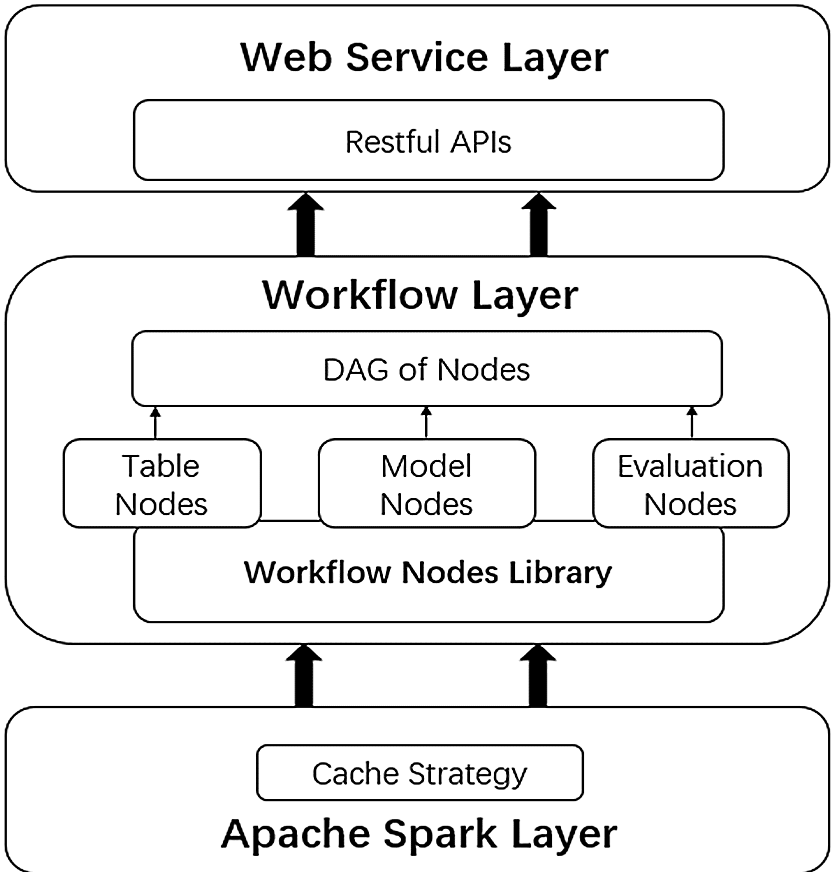
The platform is structured into three distinct layers to decouple user interaction from heavy-duty computation.
1. The Spark Layer (The Engine)
This layer handles the RDD operations. The standout feature here is the Intelligent Cache Strategy. The system calculates a unique hash for every node based on its input data and parameters.
- Logic: Before executing a node, the system checks a Hash Map. If the hash exists, it fetches the result instantly.
- Memory Management: To prevent memory overflow, an LRU (Least Recently Used) eviction policy is applied to the cache.
2. The Workflow Layer (The Logic)
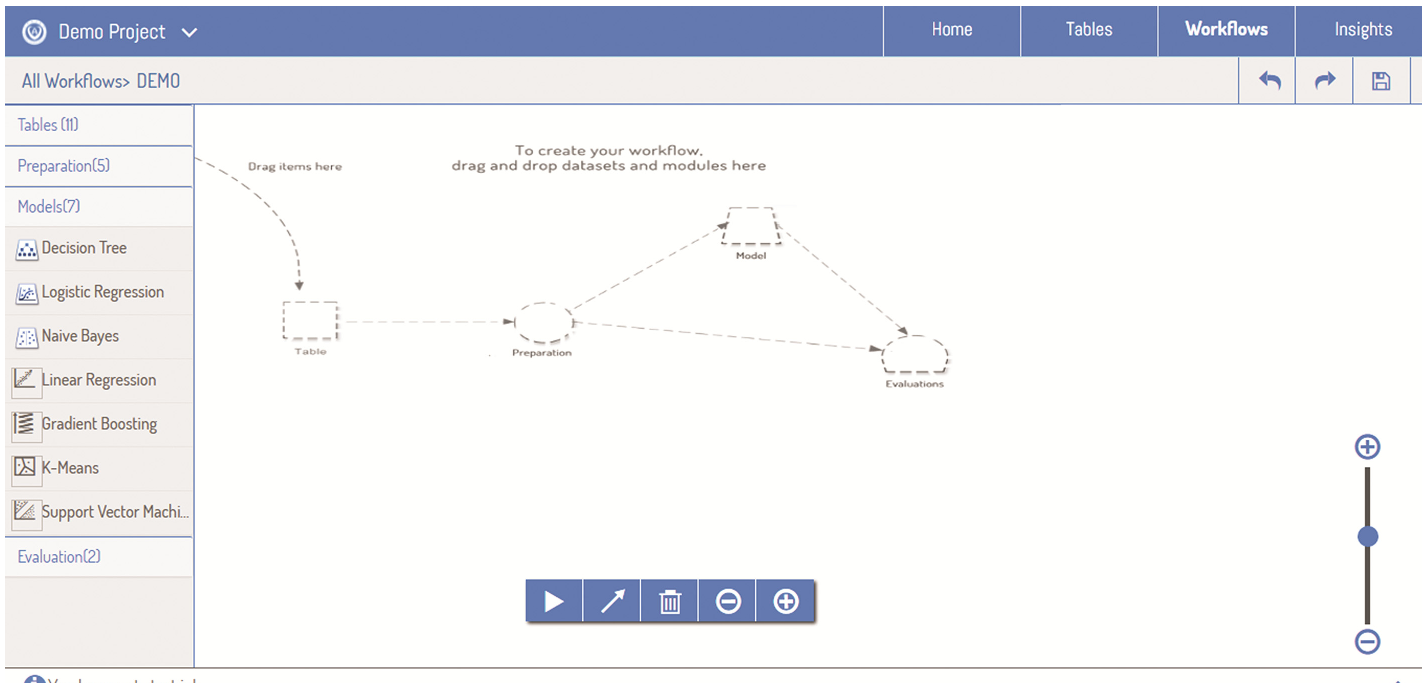
This layer acts as the translator. It converts a user's visual "boxes and lines" into a Directed Acyclic Graph (DAG). It includes a library called workflowLib, allowing researchers to easily add new machine learning models like Naïve Bayes or Decision Trees.
3. The Web Service Layer (The Interface)
By wrapping the Spark Context in a daemon process, the platform ensures that the "Brain" of the system stays alive across different user sessions, which is critical for maintaining the global cache.
Real-World Application: Cardiovascular Disease Prediction
The authors demonstrated the platform's efficacy using a project focused on cardiovascular diseases.
Experimental Setup
- Dataset: 1,571 cardiovascular patients with 31 disease features.
- Models: Decision Tree, Naïve Bayes, and Logistic Regression.
- Workflow: Data sampling -> Feature Selection -> Model Training -> Evaluation.
Performance Metrics
The platform enabled doctors to identify which features had the most weight in predicting specific conditions. For instance, the Logistic Regression model achieved:
- Aortic Dissection Prediction: >99% Accuracy.
- Pulmonary Embolism: ~64% Accuracy (limited by smaller sample size).
Deep Insight: Why the Cache Strategy Matters
In traditional Spark, if a researcher wants to compare a Decision Tree with a Max Depth of 5 vs. a Max Depth of 10, the system might reload and preprocess the entire dataset twice. In this platform, the Preprocessing nodes remain cached. Only the Model node and Evaluation node are recalculated, reducing the wait time from minutes to seconds. This "Hot Swap" capability is essential for exploratory data analysis in clinical settings.
Critical Analysis & Conclusion
Takeaway
The paper successfully demonstrates that high-performance computing does not have to be high-friction. By treating Spark jobs as reusable components in a cached DAG, they achieve both System Efficiency and User Friendliness.
Limitations
- Data Heterogeneity: While the platform handles tabular data (CSV/EMR) well, it currently lacks native support for unstructured data like MRIs or clinical notes.
- Cache Granularity: The LRU cache is currently limited to the node level; sub-node data sharing could potentially save even more memory.
Future Outlook
The authors plan to introduce a "Code-Snippet" feature, allowing power users to write custom SQL or Python scripts directly into a node, blending the simplicity of zero-code with the flexibility of professional programming.