
The Lurker Game: Solving the Activity Dilemma in Big Social Networks through Evolutionary Games
SPECIAL SECTION ON BIG DATA ANALYTICS IN INTERNET OF THINGS AND CYBER-PHYSICAL SYSTEMS
This paper introduces the "Lurker Game" model, an evolutionary public goods game designed to analyze and mitigate the activity dilemma in big social networks. By integrating empirical data from Weibo with a novel game-theoretic framework that includes individual incentives, the study identifies critical thresholds for transforming passive "lurkers" into active contributors.
TL;DR
Why do social networks like Weibo or X (formerly Twitter) often feel like "ghost towns" despite having millions of users? This paper argues it’s an evolutionary dilemma. By proposing the Lurker Game, the authors reveal that without a specific incentive mechanism tied to a user's social "degree," the natural state of a network is passivity. The study combines Weibo's big data with game theory to prove that "active clusters" of influencers are the only thing keeping social ecosystems alive.
The Tragedy of the Social Commons
In a social network, information is a public good. It is produced by a few but consumed by many. The "Lurker" is the ultimate free-rider: they gain the benefits of news and entertainment without the "cost" of posting, commenting, or verifying. When lurking becomes the dominant strategy, the network loses its value.
Current models often treat all users as equal players. However, as the authors' empirical analysis of 422,171 Weibo profiles shows, a user with 1.7 million followers has a vastly different impact and motivation compared to someone with 500 followers. This disparity is the heart of the "Activity Dilemma."
Methodology: The Lurker Game Model
The authors bridge the gap by introducing a Lurker Game based on the Public Goods Game (PGG) but with a twist: the Individual Incentive.
1. The Payoff Logic
An active user brings profit to neighbors but incurs a cost . In the Lurker Game, the profit for an active user is enhanced by their degree and a gain coefficient .
- Active Strategy ():
- Lurking Strategy ():
2. Strategy Evolution
Users aren't static. They look at their neighbors and ask, "Are they doing better than me?" Using the Fermi function, the model simulates how users switch between being active and lurking based on the payoff difference and environmental noise ().
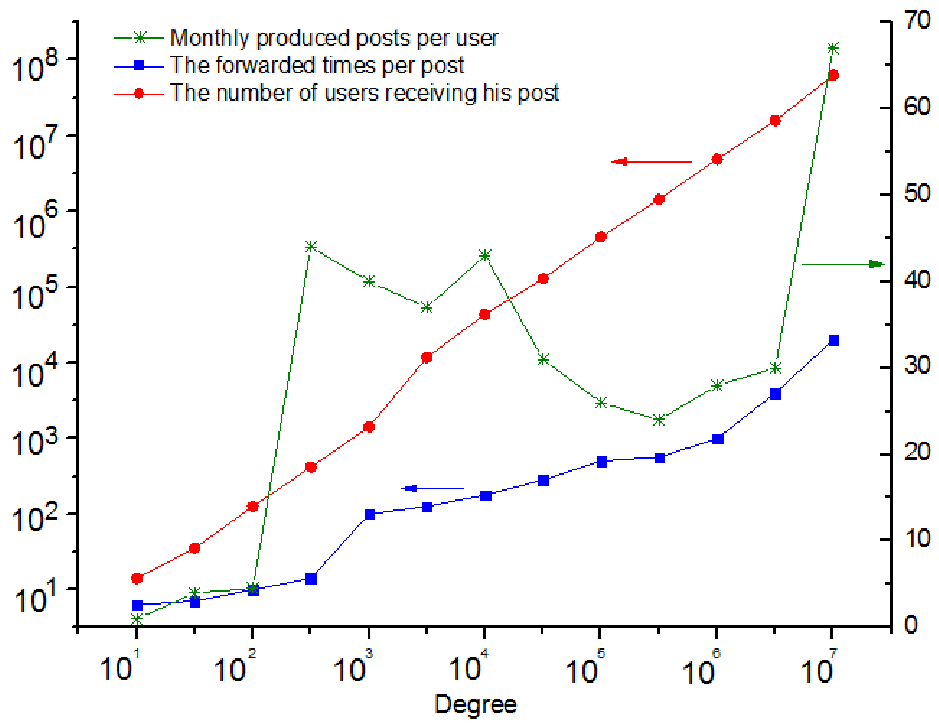 Figure 1: Comparison of user influence (Activity, Transmissibility, Coverage) against user degree in Weibo.
Key Insights from Simulations
The Power of Incentive ()
The research identifies a "phase transition." As the incentive constant increases, the network shifts from a "lurker-dominant" state to an "active-dominant" state. When is large enough, even marginal users are pulled into activity.
The Rise of the Central Cluster
The most striking finding is the formation of Central Clusters. In a mature network, high-degree (central) vertices connect to each other. Because of their high connectivity, they provide enough mutual incentive to remain active even if their marginal "fan" followers are lurking. This cluster acts as the "heartbeat" of the social network.
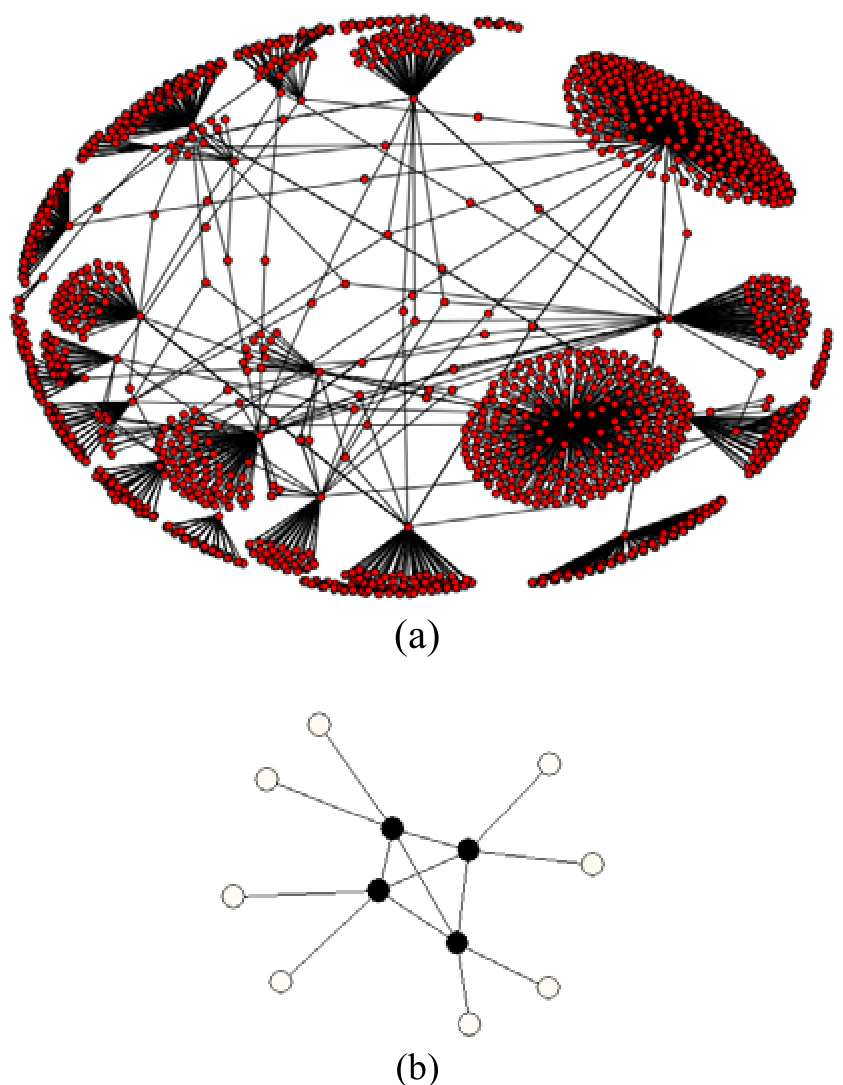 Figure 5: The topology of the Weibo data showing how central vertices connect to form a resilient active core.
The Chaos of Noise
The study also warns about environmental noise (). When the social environment becomes too "noisy" (irrational behaviors, harassment, or algorithmic chaos), even a high incentive cannot maintain activity. Active users lose interest because their rational strategy no longer yields predictable influence, leading to a network-wide collapse.
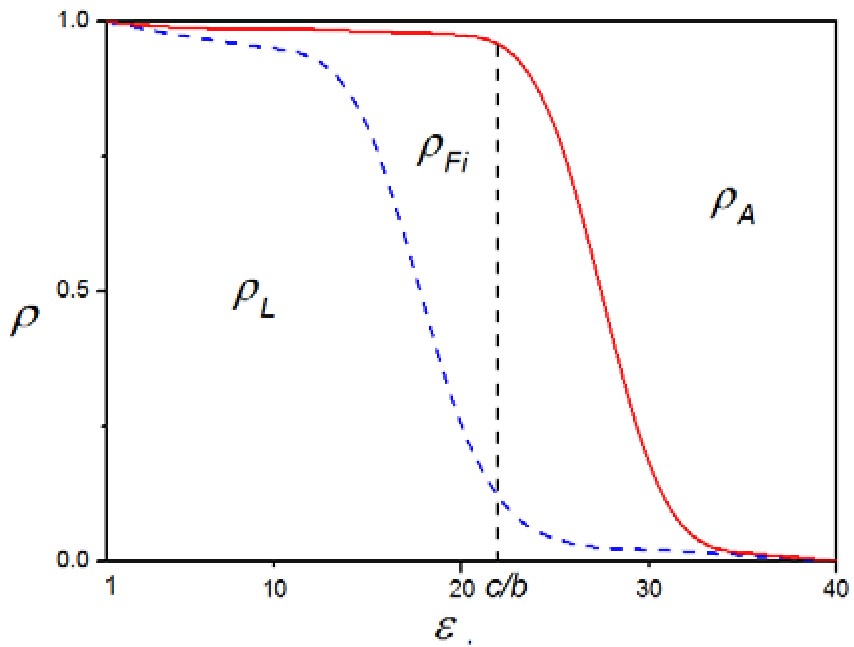 Figure 3: Fractions of pure active vs. fluctuating strategies as a function of incentive ().
Critical Analysis & Conclusion
The Lurker Game provides a rigorous mathematical explanation for why platform "gamification" and "influencer programs" are not just marketing gimmicks—they are survival necessities.
Takeaways:
- Incentive must scale with degree: Rewards shouldn't be flat; they must account for the reach of the user to maintain the core "Active Cluster."
- Clustering matters: High clustering coefficients (friends of friends knowing each other) significantly lower the barrier to activity.
- The "Dull Atmosphere" is sticky: Without external intervention or incentives, a network filled with lurkers will stay that way, as active users will eventually adopt the "fitter" strategy of lurking.
The paper successfully maps evolutionary biology concepts onto digital sociology, providing a roadmap for platform designers to navigate the delicate balance between user effort and platform vitality.