
Strategic Marketing in the Age of Social Big Data: A Comprehensive Blueprint
A glimpse on big data analytics in the framework of marketing strategies
2017-03-11
Summary
Problem
Method
Results
Takeaways
Abstract
This paper provides a comprehensive review of big data analytics within strategic marketing, focusing on "Social Big Data." It introduces an operative methodology for deriving actionable insights from social media using a four-level framework: integration, development, brand reputation, and customer relationship.
## TL;DR
Social Big Data has transcended its status as a buzzword to become the backbone of modern competition. This paper maps the complex landscape of "Society 2.0," where digital traces from Facebook, Twitter, and LinkedIn are converted into strategic assets. By synthesizing a 52-paper literature review, the authors provide a cyclic operative methodology that bridges the gap between raw distributed computing (Hadoop/Spark) and high-level marketing pillars: Integration, Promotion, Reputation, and Customer Relationships.
## The Evolution of the "V's": Moving Beyond Scale
For years, the industry relied on Laney's three V's (Volume, Velocity, Variety). However, this paper argues that for marketing, these are insufficient. The modern framework expands to **9 V's**, including:
* **Veracity**: The truthfulness of social insights—crucial for avoiding "garbage-in/garbage-out" scenarios.
* **Volatility**: Determining how long data remains relevant before it becomes "stale" in a fast-moving market.
* **Value**: The ultimate goal—turning social noise into ROI and competitive advantage.
The author emphasizes that "Society 2.0" has reduced the "six degrees of separation" to fewer than four, creating a hyper-connected environment where a brand's reputation can be made or broken in real-time.
## Methodology: The Cyclic Innovation Model
The core contribution of the paper is its **Cyclic Operative Methodology**. Unlike linear models, this approach suggests that marketing strategies must be fluid.
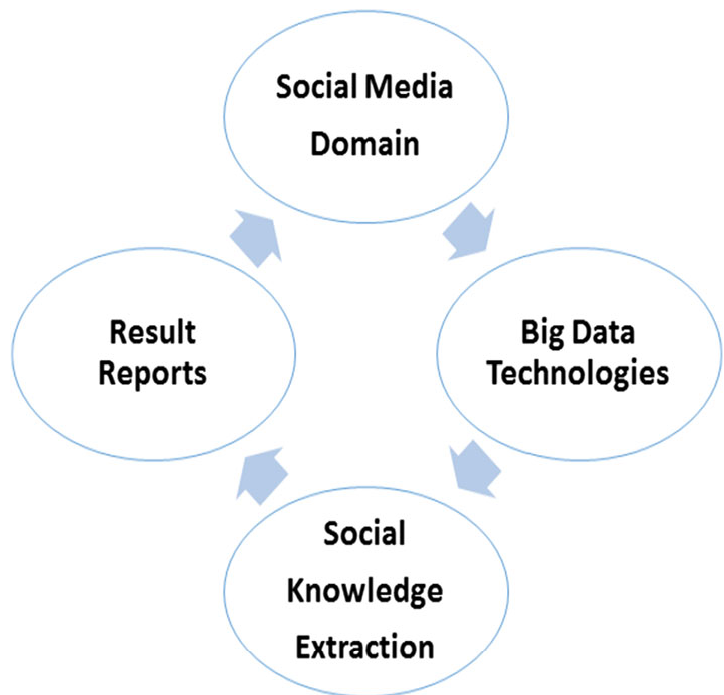
### The Four Phases:
1. **Strategic Domain Definition**: Identifying which social channels (OSNs) and topics (keywords) matter most to the stakeholders.
2. **Technology Selection**: Choosing between batch processing (Hadoop/Spark) for historical trends and stream processing (Storm/Samza) for real-time sensing.
3. **Knowledge Extraction**: Using NLP and Machine Learning to move beyond simple keyword counting into the realm of **Sentiment Analysis**.
4. **Reporting**: Translating data into visualizations like "Rivers of News" or "Share of Conversation."
## Comparative Analysis: Four Pillars of Support
The paper reviews 52 case studies and classifies them into a four-level framework, providing a "who's who" of big data application:
| Category | Focus Area | Key Insight |
| :--- | :--- | :--- |
| **Integration** | Market Research | Using social data for "Anticipatory Shipping" (Amazon model). |
| **Development** | Ads & Promotion | Viral geofencing—triggering ads when users enter a specific geographic boundary. |
| **Reputation** | Brand Management | Real-time public opinion polling during political elections or product launches. |
| **Relationship** | Social CRM | Identifying "Customer Churn" before it happens by detecting dissatisfaction in social tags. |
## Critical Insights: Why Does This Work?
The effectiveness of this approach lies in its **Proactive Nature**. Traditional marketing is reactive—waiting for sales reports to arrive. Social Big Data analytics allow for **Emotional Sensing**, where companies react to passions and feelings rather than just costs. For example, the paper discusses how sentiment-aware recommendation systems can outperform traditional collaborative filtering by understanding the *mood* of the user’s review.
## Future Outlook & Limitations
While the methodology is robust, the authors highlight several unresolved challenges (Open Issues):
* **Privacy & Ethics**: The thin line between personalized marketing and "Big Brother" surveillance.
* **The Global Gap**: Social data sources vary wildly between Western and Eastern markets (e.g., Facebook vs. Weibo), requiring localized lexicon-independent models.
* **Human-in-the-Loop**: The need for "Data Scientists" who don't just run algorithms but understand the nuances of human culture to interpret results correctly.
## Conclusion
This paper serves as both a roadmap for researchers and a manual for CMOs. By moving from a "data-collecting" mindset to a "knowledge-extracting" mindset, enterprises can finally harness the flood of Society 2.0 to drive innovation and customer loyalty.