
From Metal to Intelligence: Navigating the Business Logic of Manufacturing Servitization
Business understanding, challenges and issues of Big Data Analytics for the servitization of a capital equipment manufacturer
This paper presents a case study on applying Big Data Analytics to a chemical manufacturing production process to facilitate a "servitization" strategy. Using the CRISP-DM framework, the authors detail how a capital equipment manufacturer can transition from selling hardware to providing high-value predictive maintenance and process optimization services.
TL;DR
The digitalization of the manufacturing industry is no longer just about internal efficiency; it's about Servitization. This paper explores how a capital equipment manufacturer leverages Big Data Analytics to transform from a "machine seller" into a "service provider." By applying the CRISP-DM methodology to a real-world chemical production pilot, the authors reveal that the hardest part of Industrial AI isn't the math—it's the business alignment.
Contextual Positioning
In the landscape of Industry 4.0, this work sits at the intersection of Industrial Internet and Predictive Analytics. While many papers focus on the "SOTA" of a specific algorithm, this study serves as a pragmatic guide for R&D teams to navigate the "Business Understanding" phase, which is often the graveyard of industrial data science projects.
The "Semi-Artisanal" Problem
Despite being a multibillion-dollar industry, many chemical manufacturing plants still operate on "educated guesses." Expert operators manage critical parameters without a solid scientific formula, leading to:
- Inconsistent Quality: High levels of waste and impurities.
- Data Silos: Information fragmented across different transformation phases (taking 2-4 weeks to complete).
- Hidden Costs: A lack of automated systems to relate 200+ variables to the final product quality.
The motivation for the authors was to bridge the "Business-Data Gap"—ensuring that a predictive model actually translates into a 20% profit increase for the plant manager, rather than just a low RMSE score for the data scientist.
Methodology: The CRISP-DM Framework
The authors utilize the CRoss-Industry Standard Process for Data Mining (CRISP-DM) to structure their findings.
1. Data Capture Architecture
To solve the data availability problem, they deployed a specialized infrastructure to centralize logs from sensors, equipment, and external contextual sources.
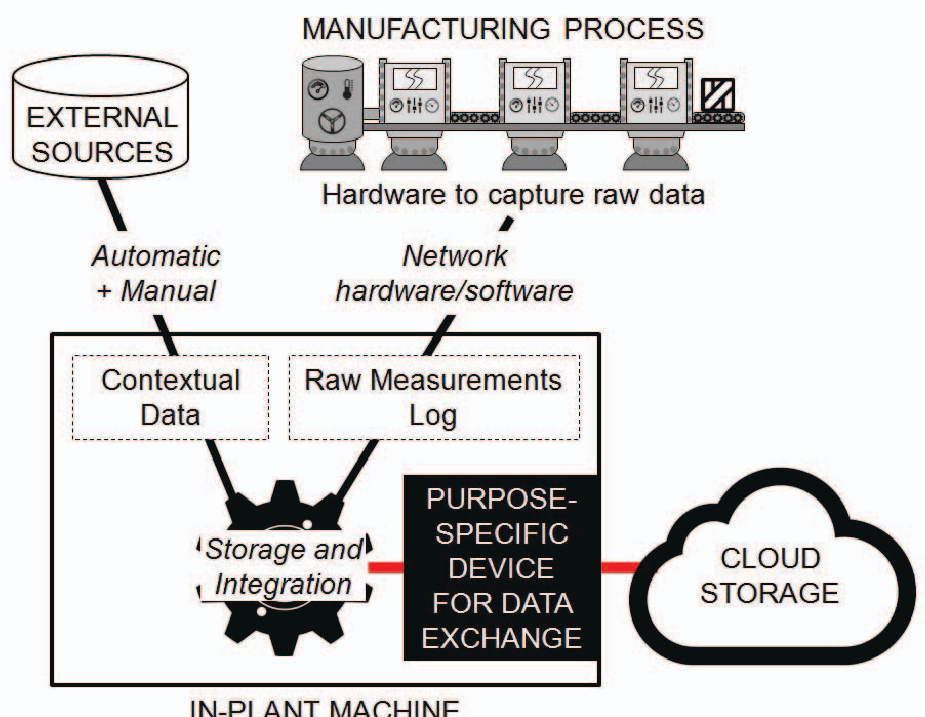 Figure: The multi-layered architecture for capturing massive raw data from the production floor to the cloud.
2. The "Tidy Dataset" Challenge
A core methodology insight is handling the temporal lag. Since chemical transformation takes weeks, the system uses RFID traceability tags to link raw material inputs at Week 1 with product quality outputs at Week 4. This creates a "batch view" or a "tidy dataset" where each row represents a single instance of a product, despite the data arriving asynchronously.
Experiments & Stakeholder Insights
The study identifies three key stakeholders, each requiring different "views" of the data:
- Production Operator: Needs real-time technical performance and "traceability" (Why is the model predicting a failure?).
- Plant Manager: Needs the link between "waste reduction" and "economic profit."
- Equipment Manufacturer: Needs a scalable product that works across different "machine fleets."
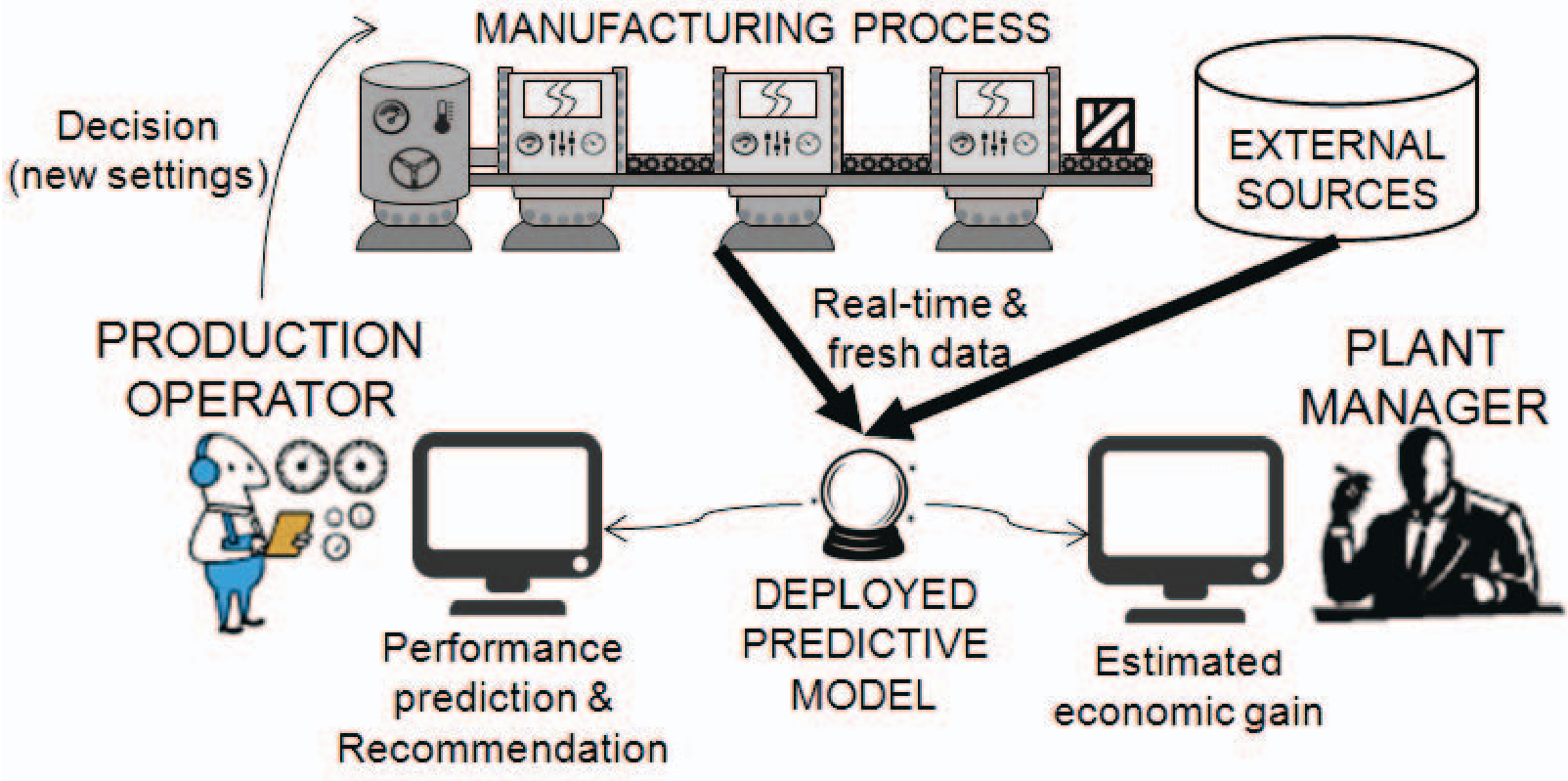 Figure: Mapping technical data points to user-specific business value.
Key Technical Benchmarks:
- Target Data Size: 100,000 fully characterized instances.
- Variable Count: 200 initial indicators (up to 300).
- Technology Stack: Apache Spark/Hadoop for scalability + R for statistical depth.
Critical Analysis: Why This Matters
The true value of this paper lies in its honesty regarding constraints. The authors point out that "Pure Data Mining" assumptions often fail in the real world because:
- Ownership Conflict: Data comes from machines sold by competitors.
- Wait Time: You cannot "train" a model until the continuous process has run long enough to generate failures.
- Human in the Loop: The model shouldn't replace the operator; it should be a Decision Guidance System.
Conclusion
This study proves that the servitization of capital equipment is a viable business strategy, provided that the data science team masters the Business Understanding phase. The shift from "selling a machine" to "selling an optimized outcome" is the definitive future of Industrie 4.0.
Future Outlook: The authors propose a "network of processes" where learning happens across a fleet of manufacturing plants globally, effectively creating a distributed industrial intelligence.