
TS_u_Datalog: Balancing Privacy and Business in Social Networks through Temporal Logic
A Big Data Privacy Respecting Dissemination Method for Social Network
The paper introduces TS_u_Datalog, a hybrid distributed logic language that integrates Active-U-Datalog with Distributed Temporal Logic (DTL). It aims to provide a robust framework for digital content dissemination in social networks, achieving a balance between the conflicting interests of users, advertisers, and service providers.
TL;DR
Social networks are no longer just communication tools; they are complex economic ecosystems involving users, advertisers, and providers. This paper introduces TS_u_Datalog, a powerful distributed logic program that uses advanced temporal logic to execute digital "contracts." It ensures that while advertisers get their data and providers get their revenue, user privacy and access rights are strictly managed through enforceable, time-aware rules.
Background: The Struggle for Balance
In the modern "Sharing Economy," a three-way tug-of-war exists:
- Users want free content but fear for their privacy.
- Advertisers need personal data for targeted marketing.
- Providers need a mechanism to mediate these interactions legally and automatically.
The authors argue that current social networks lack a "contractual access control" system that can handle the dynamic and distributed nature of these relationships. Previous tools like Dedalus or SNLog were too simple—they couldn't handle complex time constraints like "User must click an ad every 7 days or lose access."
Methodology: The Logic of Space and Time
The core innovation is the fusion of Active_UD_Datalog (which handles distributed updates) with Distributed Temporal Logic (DTL).
1. Spatial-Temporal Predicates
The logic represents data as p(x1, ..., xn-1) @ xn, where @xn denotes the entity (location) where the data resides. TS_u_Datalog extends this by adding a temporal dimension:
- : Execution at the -th time step.
- : Execution always during time steps.
- : Execution at least once during every time-step window (ideal for periodic tasks).
2. Active Rules (ECA)
The system operates on an Event-Condition-Action (ECA) framework. When a specific event occurs at one node (e.g., a user downloads a file), it can trigger a temporal transaction at another node (e.g., a "report" obligation starts on the user's side).

Real-World Application: The Motivational Example
The paper illustrates the logic's power through a complex dissemination policy:
- VIP Status: A user becomes a VIP ONLY if they pay $1000 and allow the
ADV_serverto read their profile. - Temporal Debt: Once a VIP downloads a video, they are obliged to click an ad every 7 days (
GF ≤ 7D). - Automatic Expiry: Downloaded videos are automatically flagged for deletion after 120 days (
F ≤ 120D).
This level of granular, time-dependent control is difficult to achieve with traditional Access Control Lists (ACLs) but is handled elegantly by TS_u_Datalog's rules.
Performance & Comparison
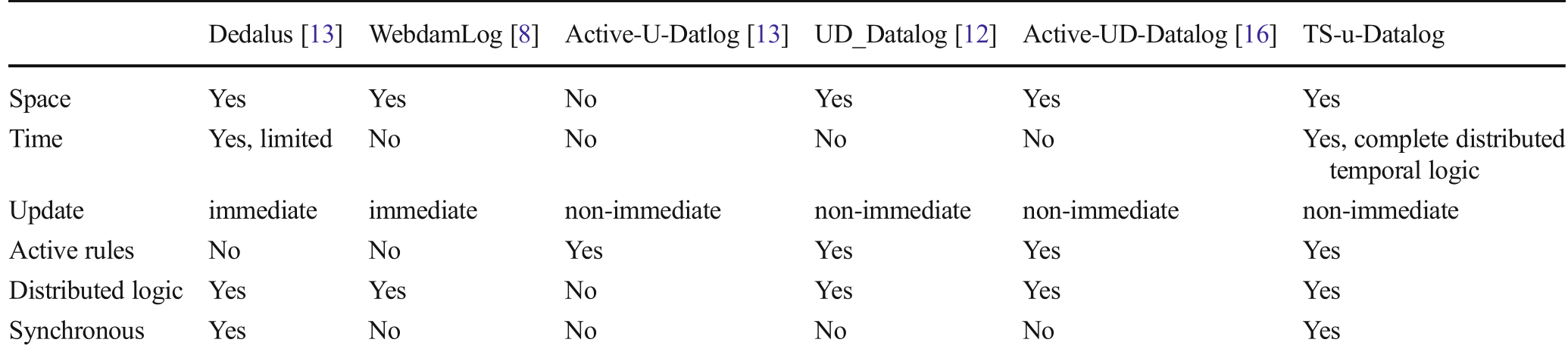
The authors provide a contrastive analysis against existing Datalog variants. TS_u_Datalog is the only one to offer complete distributed temporal logic combined with non-immediate updates.
| Feature | Dedalus | WebdamLog | TS_u_Datalog |
|---|---|---|---|
| Space Awareness | Yes | Yes | Yes |
| Time Expressiveness | Limited | No | Complete (DTL) |
| Active Rules | No | No | Yes |
| Updates | Immediate | Immediate | Non-immediate |
Critical Insight & Conclusion
The significance of TS_u_Datalog lies in its Inductive Bias toward distributed consistency over time. By treating time as a first-class citizen in the logic, it moves social network management away from "best-effort" policy enforcement toward guaranteed contractual compliance.
Limitations: While the logic is mathematically sound, the paper notes that the complete evaluation method for hyper-scale social networks (billions of nodes) requires further research to ensure computational efficiency.
Future Outlook: This work paves the way for integrating smart contracts into non-blockchain environments, suggesting that social networks could eventually function as decentralized, self-governing legal entities.