
From Big Data to Edge Intelligence: Reimaging 4G/5G Social Connectivity with Micro-Social-Clouds
Big-Data Inspired, Proximity-Aware 4G/5G Service Supporting Urban Social Interactions
2016-05-01
Summary
Problem
Method
Results
Takeaways
Abstract
This paper introduces the Micro-Social-Cloud (MSC), an NFV-based mobile service designed to support proximity-aware social interactions within an individual's inner social circle. By leveraging big data from a large-scale CDR dataset in Milan, the authors propose an edge-computing architecture that autonomously detects co-location and offloads in-proximity traffic, achieving a 50% reduction in unicast signaling messages.
## TL;DR
Researchers from the University of Milan have proposed a paradigm shift for mobile operators: using their vast, untapped Call Detail Record (CDR) data to power "Micro-Social-Clouds" (MSC). By detecting physical proximity between "inner-circle" friends using network-level events, this NFV-enabled architecture slashes signaling traffic by 50% and moves social interactions to the network edge, where they belong.
## The Motivation: The "Synchronization" Traffic Problem
We’ve all done it: sending a "ring" or a quick text when we are five minutes away from a meeting spot. This paper proves that these short-duration, high-frequency interactions are not random—they are highly localized and concentrated among your strongest social ties.
Current social apps handle this poorly. They force devices to "poll" GPS constantly, draining batteries and flooding the core network with location updates. The authors ask: **Why not let the mobile operator—the entity that already knows where you are and whom you call—handle this at the edge?**
## Methodology: Data-Driven Social Proximity
The study began with a massive dataset of ~1 million users in Milan. The findings were stark:
1. **Concentration**: Social encounters trigger a massive spike in phone activity.
2. **Proximity**: These activities are functional—synchronizing the actual meeting.
3. **The Inner Circle**: 80% of these interactions involve your closest friends (top 20% of your contact list).
### The MSC Architecture
To solve the signaling overhead, the authors proposed an architecture built on **Network Function Virtualization (NFV)**. Instead of the app asking the phone for GPS, the **Mobility Management Entity (MME)** inside the LTE core detects when you move into a new cell and notifies the MSC application layer via an API.
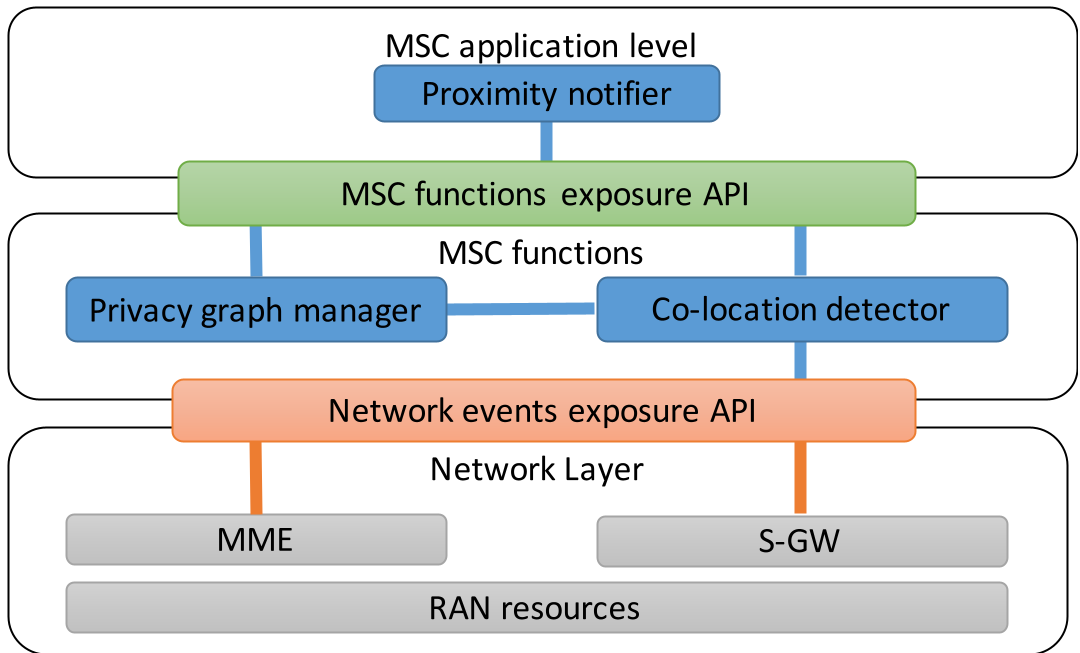
The "Secret Sauce" is the **Privacy Graph**. It ensures that proximity is only shared if both parties have explicitly consented, turning a "green led" on in your contact list only when a trusted friend is nearby.
## Experimental Results: Efficiency Gains
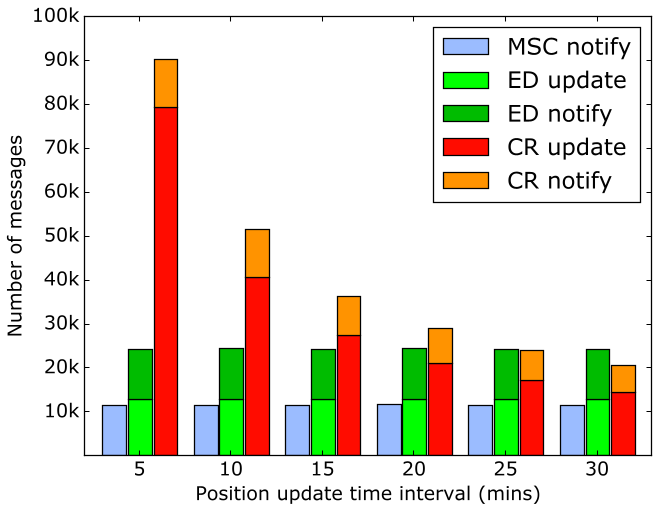
The researchers compared their event-driven approach against traditional "Constant Rate" (CR) and "Evolved Detection" (ED) methods.
* **Signaling Overhead**: The MSC architecture reduced unicast messages by **50%** compared to the best existing cloud-based solutions.
* **Contextual Relevance**: By targeting the "inner social circle," the system ensures that the proximity alerts are actually useful to the user, rather than spamming them with notifications about every random acquaintance.
## Critical Insight: Data Monetization and Edge Payoff
This work is a blueprint for the future of 5G. It demonstrates that the payoff for placing cloud services at the **edge** isn't just lower latency—it's **traffic offloading**.
By acting as the "Social Notifier," the operator moves traffic from the expensive core network to local edge cells. This transforms the operator from a "passive pipe" into a platform that understands and supports human behavior.
### Limitations & Future Work
While the results are promising, the spatial granularity is still tied to cell tower radius (~100m in urban Milan). Future iterations using 5G Small Cells or Beamforming could refine this to "same room" proximity. Additionally, scaling the "Privacy Graph" across different carriers remains a collaborative hurdle for the industry.
## Conclusion
The Micro-Social-Cloud turns "Big Data" into "Small, Personal Clouds." It bridges the gap between our virtual social networks and our physical reality, proving that the most efficient way to support sociality is to understand its inherent location-centered nature.