
Harmonizing Textual Chaos: A Comparative Study of Online Reviews vs. Social Media Sentiment Analysis
Big data and sentiment analysis using KNIME: Online reviews vs. social media
This paper presents a comparative sentiment analysis system for gadget reviews using the KNIME workbench, processing data from distinct sources: structured online reviews and unstructured Twitter posts. By leveraging Hadoop and HBase for big data storage, the authors implement dictionary-based scoring methods to extract business insights from over 1.2 million entries.
TL;DR
This research tackles the challenge of extracting sentiment from disparate data sources—structured online reviews and informal tweets—using the KNIME analytics platform. By building specialized dictionaries and utilizing Hadoop/HBase for big data handling, the authors reveal that while online reviews offer depth, the informal lexicons of social media are surprisingly more robust for cross-platform application.
Background Positioning
In the era of "Big Data," organizations are drowning in text but starving for insights. This work sits at the intersection of Text Mining and Business Intelligence, providing a roadmap for practitioners to navigate the linguistic divide between professional reviewers and the average social media user.
The Core Challenge: Linguistic Disparity
The authors identify a fundamental friction in sentiment analysis:
- Online Reviews: Clear, grammatically correct, and descriptive.
- Tweets: Shorthand, internet slang (#loveit), sarcasm, and emojis.
The industry pain point is clear: formal dictionaries are too rigid for the "wild west" of Twitter, while simplistic positive/negative filters are too shallow for long-form product reviews.
Methodology: Dual-Engine Workflow
The researchers developed two separate logic paths within KNIME to handle these formats.
1. The Review Engine (Phrase-Level)
For formal reviews, the system uses Regular Expressions to capture "Adjective + Noun" combinations (e.g., "amazing battery"). They categorized feedback into seven dimensions, such as Value for Money, Composition, and Look/Appearance.
A sophisticated scoring logic was applied:
- Negations: Reverses the sentiment score.
- Intensifiers: Increments the score (e.g., "really good" vs. "good").
- Downtoners: Decrements the score (e.g., "merely good").
2. The Twitter Engine (Word-Level)
For tweets, the focus shifted to a Frequency-Driven Approach using TF*IDF (Term Frequency * Inverse Document Frequency). The dictionary was expanded using the MPQA subjectivity lexicon, specifically adapted to include hashtags and emojis.
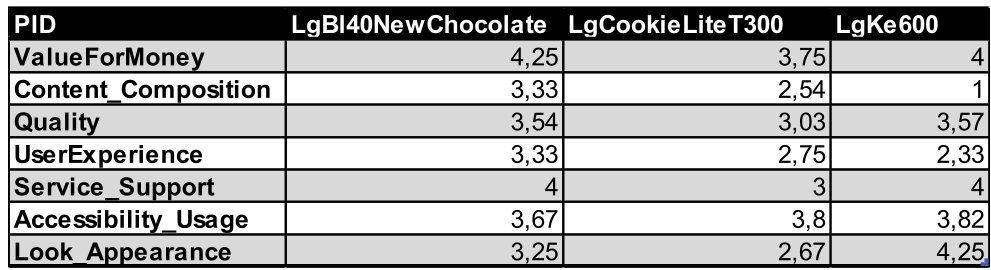 Figure: Aggregated sentiment scores across different product models and categories.
Experimental Insights & Results
The scale of the experiment was massive, involving over 1.2 million data points collected via Apache Nutch and custom Java streaming packages.
The most striking finding was the "Dictionary Transferability":
- Twitter-to-Review Transfer: High success. A dictionary trained on informal slang performs surprisingly well on formal text because formal text still contains the root sentiment words found in slang.
- Review-to-Twitter Transfer: Failure. Formal dictionaries look for complex phrases that simply do not exist in the 280-character, fragmented world of tweets.
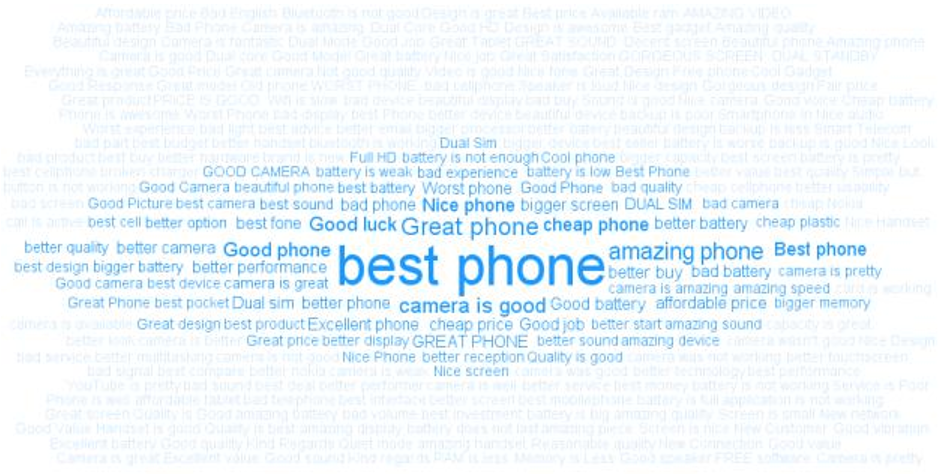 Figure: Tag cloud generated from online reviews highlight key product features and descriptors.
Critical Analysis & Future Outlook
Contribution: This paper provides a practical blueprint for building a scalable sentiment analysis pipeline using open-source tools (KNIME, Hadoop). The distinction between "phrase-level" and "word-level" analysis is a vital lesson for data architects.
Limitations: The reliance on manual dictionary building is a bottleneck. In today’s rapidly evolving linguistic landscape, manual updates struggle to keep pace with new slang. Furthermore, the exclusion of the "Service/Support" category due to low data density suggests a need for more targeted crawling strategies.
Conclusion: For developers and researchers, the takeaway is clear: if you are building a sentiment engine, start with social media data. Its "minimum viable language" is more adaptable than the formal structures of professional reviews. The future of this work likely lies in replacing manual lexicons with Transformer-based embeddings that can capture context without explicit rule-making.