
TEXEV: Harnessing Big Data Patterns for Real-Time Social Event Detection
Using big data values to enhance social event detection pattern
TEXEV is a social event detection system that combines NLP linguistic markers with Twitter-specific metadata to extract structured event representations (4-tuple: Named Entity, Temporal Marker, Cause-Effect Verb, and Hashtag Frequency). It achieves a SOTA F1-score of 0.82 by processing massive Twitter streams to identify real-world occurrences like elections and natural disasters.
TL;DR
The paper introduces TEXEV, a specialized framework designed to extract structured event information from the noisy, informal stream of Twitter. By leveraging "Big Data values"—specifically the correlation between hashtags, temporal markers, and user authority—the system transcends the limitations of traditional NLP tools, achieving an 82% F1-score in detecting real-world events ranging from the "Arab Spring" to historic concerts.
Background Positioning
In the landscape of Event Detection (ED), Twitter serves as a "social sensor." However, the data is notoriously "dirty." TEXEV is positioned as a hybrid architecture that bridges the gap between classic linguistic pattern matching and modern social network analysis (SNA).
Problem & Motivation: The "Chaos" of Microblogs
Traditional NLP tools assume well-formed sentences. Twitter provides anything but:
- Informality: "pls" for "please," "forgt" for "forgot."
- Noise: Advertisements, personal chatter, and spam clutter the event signal.
- Ungrammaticality: Short forms and hashtags make traditional dependency parsing nearly impossible.
The authors argue that we shouldn't try to "fix" the text to fit old models. Instead, we should use the redundancy and structural specificities (retweets, mentions, co-occurring hashtags) to infer structure where grammar is absent.
Methodology: The TEXEV Pipeline
The system treats event detection as a multi-stage refinement process.
1. Hashtag Intelligence
Instead of treating hashtags as simple keywords, the authors normalize them using the Soundex algorithm (grouping words by pronunciation) and use Normalized Pointwise Mutual Information (NPMI) to group related tags. This allows the system to realize that different hashtags might refer to the same latent event.
2. The 4-Tuple Representation
TEXEV extracts a structured representation of an event:
Event = {Named Entity, Temporal Marker, Cause-Effect Verb, Co-occurrent Hashtag}
3. Pattern Matching and Ranking
The system uses specific linguistic templates to identify event mentions, such as:
- [Event] + [Calendar Term] (e.g., "Presidential election ... before Dec 31")
- [Subject] + [Cause-Consequence Verb] + [Event] (e.g., "Tornado caused damage")
Crucially, it ranks the "Informativeness" of tweets using three feature sets:
- Content: TF-IDF similarity.
- Tweet: Retweet counts and URL presence.
- Author: PageRank-based authority and follower counts.
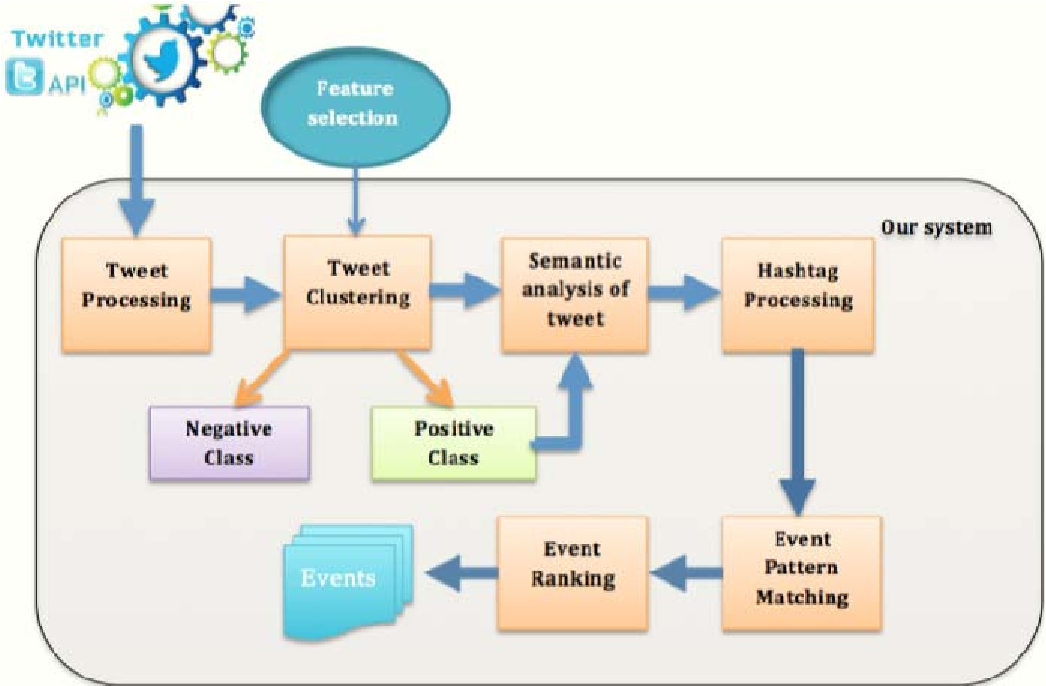 Figure 1: The TEXEV System Architecture showing the flow from raw stream to categorized events.
Experiments & Results
The authors collected 10 million tweets in early 2016 for evaluation.
Key Findings:
- The Power of Integration: Using only Named Entities yields a low Precision (0.36). Adding temporal markers, verbs, and hashtags pushes Precision to 0.86.
- Social Features Matter: Incorporating Twitter-specific features (retweets/authority) increased both Precision and Recall, proving that social signals act as a powerful filter for "newsworthiness."
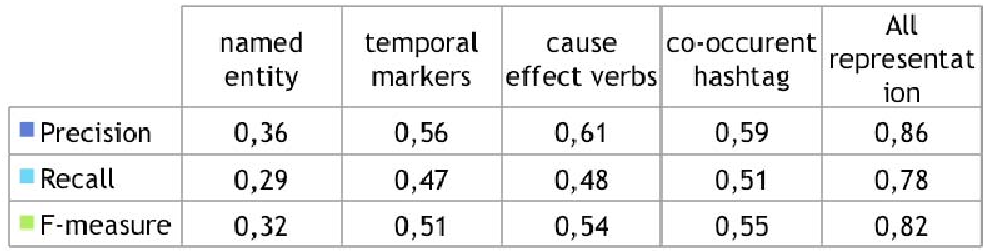 Table 1: The impact of different representation components on F-measure.
Real-world Examples:
The system successfully captured diverse events:
- Historic: Rolling Stones' free concert in Havana.
- Crisis: Terrorist attacks in Belgium.
- Entertainment: Leonardo DiCaprio winning his first Oscar.
Critical Analysis & Conclusion
Takeaway
TEXEV proves that context is king. In the absence of syntactic clarity, temporal and social correlations (the "Big Data values") provide sufficient structure to ground events in time and space across multiple languages (French, English, Arabic).
Limitations & Future Work
While the system is robust, it relies heavily on pre-defined dictionaries of event terms and manually validated patterns. The authors mention that future iterations will focus on automated summarization and broader thematic categorization, likely moving toward more unsupervised neural architectures to reduce manual pattern crafting.
Editor's Note: This work highlights a crucial shift in NLP—away from viewing text as an isolated string and toward viewing it as a node in a massive, real-time social graph.