
Digital Personalities: How Our Traits Sculpt Our Social Media Behavior
The relationships among the Big Five Personality factors, self-esteem, narcissism, and sensation-seeking to Chinese University students’ uses of social networking sites (SNSs)
This study investigates how personality traits, including the Big Five factors, narcissism, self-esteem, and sensation-seeking, influence specific feature usage on Social Networking Sites (SNSs) among Chinese university students. Utilizing regression analysis on data from 265 Renren users, it identifies unique behavioral patterns tied to psychological profiles, moving beyond simple time-spent metrics.
TL;DR
Why do some people constantly update their status while others only "lurk" and comment? This study decodes the psychological DNA behind SNS usage among Chinese university students. It reveals that our online actions—from uploading "thirst traps" to playing farm sims—are deeply rooted in the Big Five personality factors, narcissism, and self-esteem. The findings suggest that we don't just "use" social media; we inhabit it in ways that mirror our offline psyches.
The Motivation: Beyond "Time Spent"
For years, digital psychologists focused on a blunt instrument: Total Time Online. But two hours spent debating politics on a "Wall" is fundamentally different from two hours spent playing Mafia Wars. The authors of this study argue that to understand the impact of technology on well-being, we must look at feature-level behavior. They chose to study Renren (China's Facebook equivalent at the time) to see if personality translates into specific digital footprints.
The Methodology: Mapping the Mind to the Interface
The researchers surveyed 265 students, using a battery of validated psychological scales:
- The Big Five Inventory (BFI): Measuring Extraversion, Agreeableness, Conscientiousness, Neuroticism, and Openness.
- Narcissistic Personality Inventory (NPI-16): To track self-importance and exhibitionism.
- Sensation Seeking & Self-Esteem Scales: To understand the drive for novelty and self-worth.
The Behavioral Model
The study mapped these traits against five core SNS activities:
- Number of Friends (Social Reach)
- Playing Online Games (Entertainment)
- Commenting (Social Receptivity)
- Self-Photo Uploading (Visual Self-Presentation)
- Status Updates (Self-Expression)
Core Insights: Who Does What?
1. The Extravert’s Megaphone
As expected, Extraversion was the strongest predictor of having a large friend list and frequent status updates. Interestingly, extraverts were less likely to play games. Why? Because games are a distraction from their primary goal: active social signaling.
2. The Neurotic's Safe Haven
The study found a fascinating link between Neuroticism and status updates. For those high in neuroticism, the "status" box acts as a controlled environment for self-expression. Unlike face-to-face talk, it is asynchronous—it gives them time to craft their words and avoid the anxiety of immediate social rejection.
3. The Narcissist’s Gallery
Narcissism was the primary driver for uploading attractive photos. This validates the "self-promotion" hypothesis: narcissists use the SNS interface as a digital stage to garner the admiration they crave.
4. The "High Self-Esteem" Commenter
Contrary to the idea that people with low self-esteem hide behind comments, the study found that High Self-Esteem individuals comment more. They feel their opinions are valuable and are more confident in engaging with others' content.
Experimental Results
The regression analysis provided clear quantitative evidence of these links. The table below illustrates how different traits (independent variables) significantly sway specific behaviors.
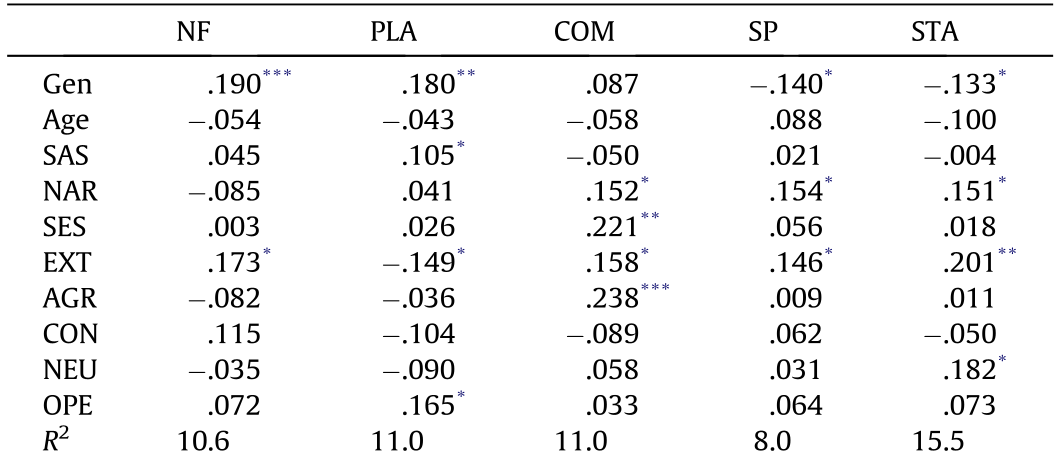
Key Takeaway from Data: Gender also played a massive role. Females were significantly more likely to upload photos and update statuses, while males dominated the "number of friends" and "online games" categories.
Critical Analysis & Conclusion
The "Digital Mirror" Effect
This research confirms that SNS usage is an extension of the self, not a replacement.
- Agreeable people are "nice" online (they comment more).
- Open people seek novelty (they play games).
- Narcissists seek attention (they post photos).
Limitations and Future Outlook
While the study provides a robust snapshot, it accounts for roughly 8% to 15.5% of the variance in behavior. This suggests that while personality is a key "anchor," other factors—like situational peer pressure, cultural norms, and platform algorithms—likely drive the rest of our digital actions.
As we move into an era of AI-curated feeds, the relationship between personality and usage will likely become even more polarized. Platforms will learn to exploit these traits (e.g., showing more games to high sensation-seekers) to maximize engagement. Understanding our own "Digital Personality" is the first step in reclaiming agency over our social lives.