
Big Social Data: Decoding Human Interests through the Digital "Like" Graph
Big Social Data - Predicting Users' Interests from their Social Networking Activities
This paper presents a hybrid framework for predicting undisclosed user interests by analyzing Facebook "Likes" and microtext metadata. It combines Natural Language Processing (NLP) for entity extraction from User Generated Content (UGC) with a Potential Link Prediction (PLP) algorithm specifically adapted for bipartite social graphs to generate high-confidence recommendations.
TL;DR
Researchers from the University of Malta have developed a robust framework to uncover what you are interested in, even if you’ve never explicitly said so. By analyzing the microtext metadata of Facebook "Likes" and applying a Potential Link Prediction (PLP) algorithm to a bipartite social graph, the system achieves over 80% accuracy in predicting user interests, provided it has a baseline of at least 10 likes to work with.
Background Positioning
In the landscape of Computational Social Science, this work sits at the intersection of NLP-based Entity Extraction and Graph-based Recommendation Systems. Unlike generic recommender systems that use simple Collaborative Filtering, this research treats the social network as a bipartite graph (Users Entities), focusing specifically on the "noisy" microtext that usually makes Big Social Data difficult to process.
Problem & Motivation: The Sparsity of Microtext
Current recommendation engines face a recurring challenge: Sparsity.
- The Content Problem: Metadata for social pages (the "About" section) is often "Microtext"—short, informal, and linguistically sparse. Traditional bag-of-words models fail here because there isn't enough text to build reliable word vectors.
- The Link Problem: Most users only "Like" a fraction of available content, making it hard to find "similar users" using standard Pearson correlation or Cosine similarity.
The authors' intuition was that a "Like" is not just a binary signal but a gateway to a latent entity. If we can extract the entities behind the Likes and map them onto a graph, we can predict new interests by calculating the "potential" for a link to form between a User node and an Entity node.
Methodology: From Text to Graph
The pipeline is divided into two sophisticated phases:
1. The Extraction Phase (NLP)
The system performs Language Identification (using langid.py) and Key-Phrase Extraction on page titles and descriptions. It uses a specialized weighting system where phrases found in the Title are weighted differently than the About section (1.0 vs 1.5 in testing). This transforms a simple "Like" into a weighted list of semantic entities.
2. The Prediction Phase (Graph Theory)
The core engine is the Adapted PLP Algorithm. Instead of a standard matrix, the data is stored in a Neo4J Graph Database.

The algorithm calculates a weight between users based on shared entities and the degrees of those nodes. It then searches for "Candidate Node Pairs" (CNPs)—entities liked by similar users that the target user hasn't interacted with yet.
```cypher
// Sample of the adapted PLP logic in Cypher
MATCH (B:User {name:'USER_ID'})-[*2]-(C:User)
...
WITH B, C, 2.0/(DB+DC)*SUM(1.0/DV) AS WBC
...
RETURN x.name AS name, SUM(WBC) AS likelihood
```
Experiments & Results: The Power of Volume
The researchers conducted a survey with 45 users, building a graph of 476 entities and 55 users.
Key Findings:
- Data Thresholding: There is a linear correlation between the number of likes a user provides and the accuracy of the prediction. For users with <10 likes, accuracy was low. However, for users with 100+ likes, the accuracy reached a staggering 85%.
- Crowd-Sourced Filtering: One of the most effective components was filtering out "bad" suggestions. If an entity was consistently rated as "Irrelevant" by prior users, the system stopped suggesting it. This "mostly-relevant" filter boosted total accuracy from 55% to 69% across all users.
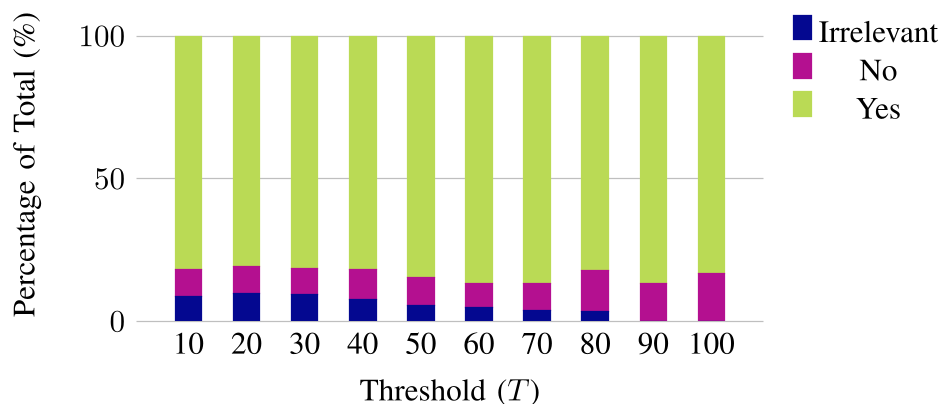 Fig 2: Prediction accuracy (Yes responses) significantly stabilizes and increases as the threshold (T) of known likes moves past 10.
Critical Analysis & Conclusion
Takeaway
The study proves that predictive models do not need massive, clean datasets if they use linked knowledge graphs and semantic weighting. By treating social data as a bipartite graph and incorporating human-in-the-loop feedback (crowd-sourced filtering), the system effectively self-corrects over time.
Limitations
- Temporal Decay: The current model doesn't account for "fading interests." An entity liked 5 years ago has the same weight as one liked yesterday.
- Sentiment Blindness: The system assumes every "Like" is positive. However, some users follow pages out of "hate-watching" or irony, which could skew the interest profile.
Future Outlook
The next step for this technology lies in Sentiment Analysis and Location Awareness. By understanding how a user talks about a page and where they are, the system could move from simple interest prediction to high-precision intent prediction.