
A Bilateral Recommendation Strategy: Balancing User Interest and Social Influence in EBSNs
A Bilateral Recommendation Strategy for Mobile Event-Based Social Networks
This paper introduces a Bilateral Recommendation Strategy for mobile Event-Based Social Networks (EBSNs) that optimizes for two objectives: user interest and event influence. By leveraging behavioral sequences for interest prediction and the Hegselmann-Krause model for social influence, the system achieves SOTA precision in arranging offline social events.
Executive Summary
TL;DR: Most event recommendation systems (like Meetup or Douban) only care about what you like. This paper argues that's only half the story. The authors propose a Bilateral Recommendation Strategy that matches the right users to the right events by considering two factors: the user's hidden "comparison" behavior and the event organizer's desire for influential participants.
Background: Positioned in the intersection of Mobile Social Networking and Recommender Systems, this work shifts the paradigm from "passive matching" to "active bilateral optimization," treating event planning as a competitive resource allocation problem with spatio-temporal constraints.
Problem & Motivation: The One-Sided Recommendation Trap
Current Event-Based Social Networks (EBSNs) suffer from two primary flaws:
- Static Logic: They look at your "interest labels" (e.g., "I like hiking"). But in reality, users click and compare many hiking events before choosing one. Traditional collaborative filtering (CF) misses this "intra-session" logic.
- Host Neglect: Event organizers want influential, reliable attendees. If a recommendation only satisfies the user, it might lead to poor event quality or high no-show rates.
The authors' insight is that a successful event needs a bilateral fit: the user must be highly interested (Recency + Frequency), and the participant must add social value (Interaction Strength).
Methodology: The Core Engine
The strategy is powered by two distinct modules:
1. The Utility Score Estimation Method (USEM)
Instead of just looking at historical attendance, the authors analyze the behavioral sequence within a session.
- Frequency: How many times did you look at this event?
- Recency: Was this the last thing you clicked before deciding?
They use an exponential decay function to reward events that appear later in the sequence, suggesting a higher "final decision" probability.
2. Theoretical Social Modeling
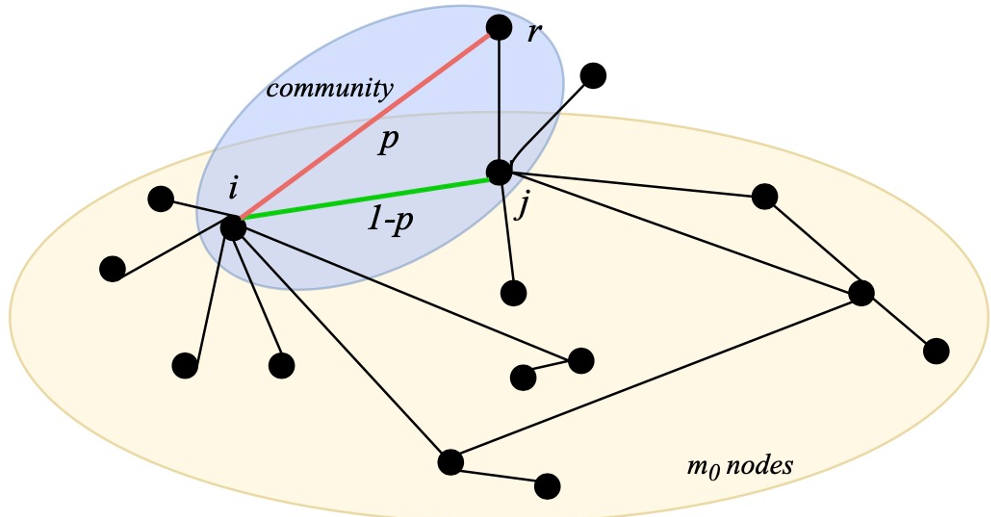
The authors model the EBSN as a Scale-Free Network with a variable clustering coefficient. They introduce two key metrics:
- Interpersonal Similarity: The ratio of mutual friends.
- Interaction Strength: The historical frequency of information exchange.
3. The Bilateral Strategy (Algorithm 1)
The algorithm effectively treats event capacity as a "budget." It assigns users based on high utility scores but allows for the "replacement" of low-utility users with high-influence users to maximize the event's social impact without violating spatio-temporal or travel budget constraints.
Experiments & Results
The researchers tested their strategy on millions of records from Meetup.
Precision Benchmarking
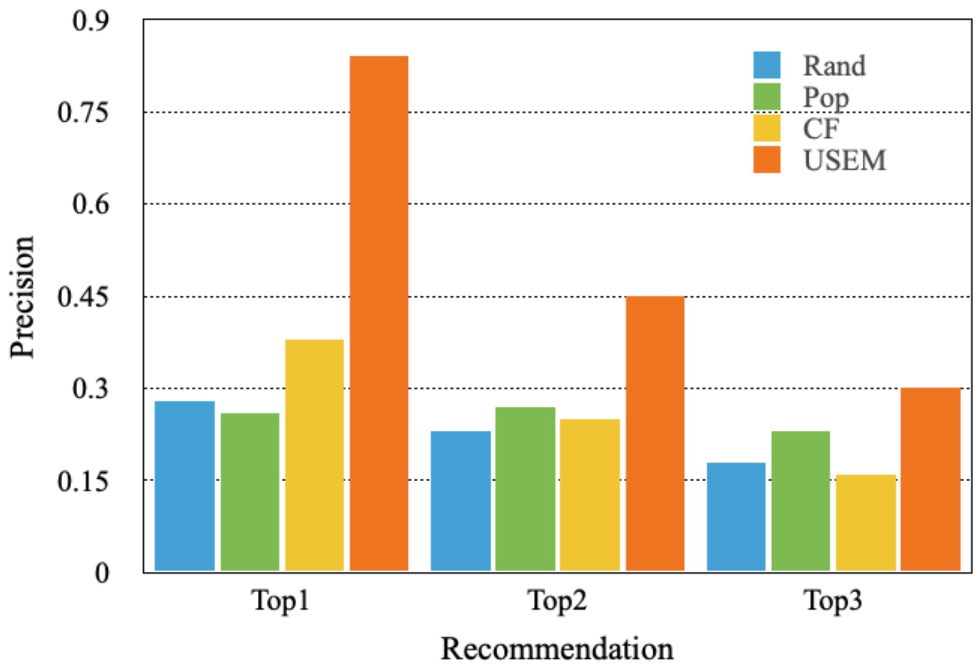
The USEM method crushed traditional baselines. As shown in the comparison, the gap between USEM and traditional Collaborative Filtering (CF) is substantial, especially in "Top 1" prediction accuracy.
Balancing Act (The Alpha Parameter)
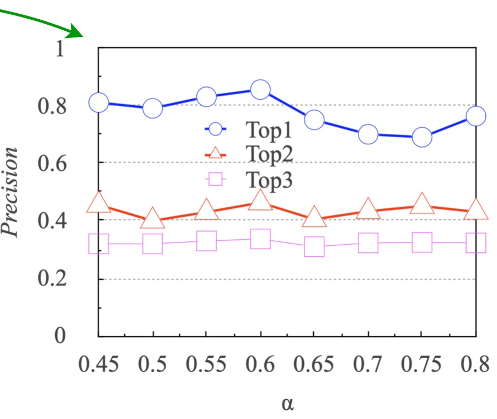
A crucial finding was the optimal balance between similarity and interaction strength. By setting , the system achieved the highest recommendation precision, proving that mutual friends (Similarity) are slightly more predictive of influence than raw interaction counts.
Scalability
The algorithm scales nearly linearly. While slightly slower than unilateral planning due to the complexity of influence calculation, it remains feasible for real-world deployment (e.g., processing 2000 events in ~23 minutes).
Critical Analysis & Conclusion
Takeaway: This paper successfully formalizes the intuition that "not all attendees are equal." By treating recommendations as a two-way street, it provides a blueprint for more sustainable and high-quality social platforms.
Limitations:
- The model assumes a static "Travel Budget," whereas in reality, users might increase their budget for a sufficiently "influential" event.
- The computational overhead of calculating the Influence Weight Matrix () for millions of users remains a challenge for real-time mobile updates.
Future Work: The authors suggest incorporating dynamic factors like weather changes and "pandemic effects" (like COVID-19) into the behavioral model to make the system more resilient to real-world volatility.