
Bridging the Linguistic Gap: Bilingual Sentiment Analysis for English and Roman-Urdu
Towards Creation of Linguistic Resources for Bilingual Sentiment Analysis of Twitter Data
The paper introduces a semi-automated framework for bilingual sentiment analysis specifically targeting English and Roman-Urdu tweets. By developing a specialized Bilingual Sentiment Lexicon (BSL) and a language classification mechanism, the authors achieved a 76% accuracy rate in classifying sentiment strength across a dataset of 89,000 tweets related to Pakistani political events.
Executive Summary
TL;DR: This paper presents a specialized pipeline to extract political sentiments from a massive dataset of 89,000 tweets in Pakistan, handling both English and Roman-Urdu (Urdu written in Latin script). By building a first-of-its-kind Bilingual Sentiment Lexicon (BSL), the researchers achieved up to 98% precision in sentiment polarity detection.
Positioning: This work serves as a foundational effort in low-resource language processing, specifically addressing the cultural and linguistic nuances of South Asian social media where code-mixing is the norm rather than the exception.
Problem & Motivation: The "Roman-Urdu" Challenge
While sentiment analysis is a mature field for English, it remains "infant" for languages like Urdu—especially when Urdu is transliterated into English alphabets (Romanized).
The authors identify two critical gaps:
- Resource Scarcity: Existing tools like SentiStrength cannot interpret Romanized Urdu.
- Transliteration Variance: A single Urdu word can be spelled in Roman script in multiple ways (e.g., "khushi," "khusi," "khushee"), making traditional dictionary lookups fail.
Methodology: Building the Bilingual Bridge
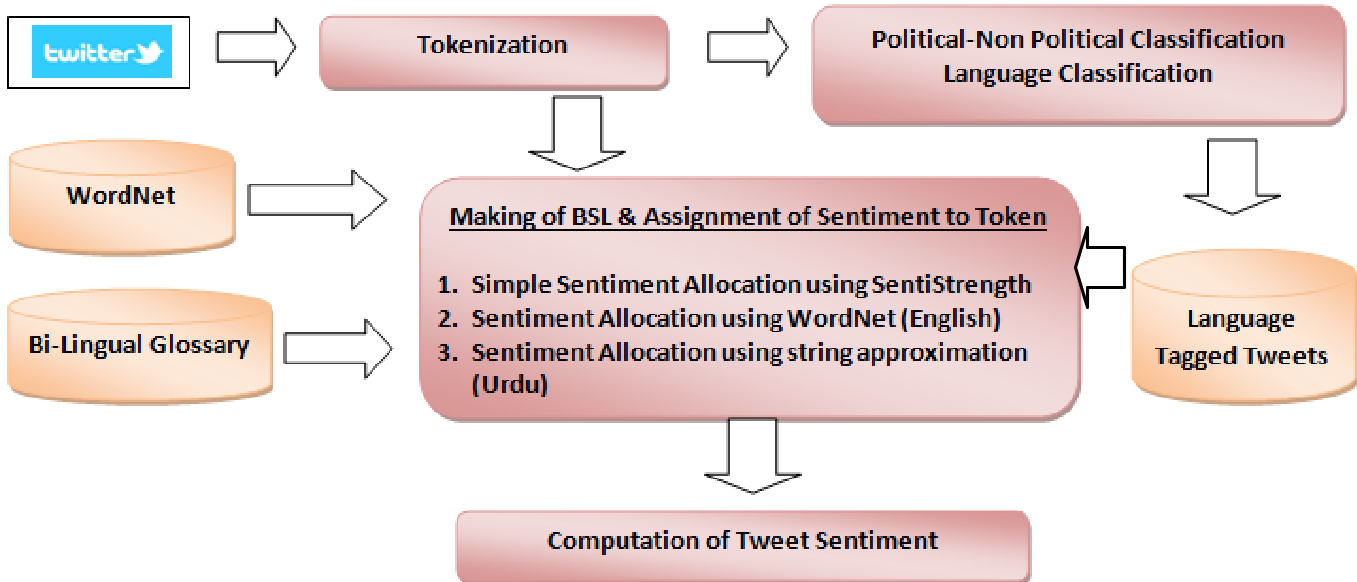
The researchers proposed a three-stage workflow to transform raw, messy social media data into actionable political insights.
1. Language Classification
To distinguish English from Roman-Urdu, they employed a weighting formula that measures the ratio of English tokens (verified via WordNet) against the total token count of the tweet.
2. The BSL Construction (The Core)
The BSL was created semi-automatically by:
- Using SentiStrength for initial English sentiment scores.
- Utilizing WordNet to expand coverage through synonyms.
- Translating Roman-Urdu terms into English and inheriting their sentiment scores.
- Applying Bigram-Cosine Similarity to map informal, misspelled Roman-Urdu words to their standardized forms in the lexicon.
Experiments & Results
The authors tested their approach on three sets: English, Roman-Urdu, and Random Bilingual samples.
| Metric | English Test Set | Roman-Urdu Test Set | Random Test Set |
|---|---|---|---|
| Precision | 98% | 96% | 98% |
| Recall | 75% | 63% | 68% |
| Accuracy | 83% | 69% | 76% |
Analysis of the "Recall Gap"
The results reveal a significant "Recall Gap" in Roman-Urdu (63% vs. 75% in English). This is primarily due to the diversity of transliteration. If a user uses a highly unique spelling not captured by the Bigram-Cosine similarity or the BSL, the system fails to identify the sentiment token, leading to "neutral" classifications for emotional tweets.
Critical Insight & Conclusion
Takeaway
The paper successfully demonstrates that lexicon-based approaches are viable for bilingual sentiment analysis even without complex neural networks, provided there is a robust mechanism to handle transliteration variation. The creation of the BSL (with 5,800 combined terms) is a significant contribution to the community.
Limitations & Future Work
- Contextual Blindness: As a lexicon-based method, it may struggle with sarcasm or context-dependent sentiments (e.g., "This party is a joke").
- Recall Improvement: The authors rightly suggest that the next frontier is developing a more comprehensive WordNet for Urdu to improve the term identification rate.
- Data Bias: The study notes that political sentiment on Twitter may not perfectly reflect the national mood in regions where internet penetration is low.
For developers and researchers in the South Asian NLP space, this paper provides a roadmap for handling English-transliterated regional languages—a technique that could easily be adapted for Roman-Hindi or Roman-Bengali.