
Talk-to-Me: Bridging the Gap in Mobile Emotion Recognition via Bimodal Fusion
Bimodal feature-based fusion for real-time emotion recognition in a mobile context
This paper presents a bimodal fusion framework for real-time emotion recognition within a mobile environment. By integrating linguistic valence assessment with an optimized set of 89 acoustic features using a Logistic Model Tree (LMT), the system achieves a state-of-the-art 90.8% precision, significantly outperforming unimodal approaches.
TL;DR
Recognizing human emotion in real-time on a mobile device is notoriously difficult due to the "ambiguity of expression." This paper introduces a bimodal system that fuses linguistic valence (what we say) with acoustic prosody (how we say it). By utilizing a Logistic Model Tree (LMT), the researchers achieved a 90.8% precision rate, solving the classic "Joy vs. Anger" acoustic confusion and the limitations of neutral text analysis.
The "Affective Gap" in Unimodal Systems
Current Emotion Recognition (ER) systems usually fall into two traps:
- Text-Only Failures: They miss sarcasm, hidden distress, or nuance when the words used are "neutral" but the tone is heavy.
- Acoustic-Only Failures: High-arousal emotions like Joy and Anger often share similar acoustic profiles (high pitch, high energy), leading to frequent misclassification.
The authors argue that emotion is inherently multi-layered. To build a truly empathetic mobile assistant—like their prototype "Talk-To-Me"—the system must reconcile the potentially contradictory cues between speech and text.
Methodology: The Bimodal Engine
The architecture relies on a "Feature-level Fusion" strategy, processing two distinct streams of data before feeding them into a specialized classifier.
1. Linguistic Stream: Contextual Valence Shifting
Instead of simple word-matching, the system uses 7 rules to adjust the emotional "weight" (valence) of words based on syntax. For example:
- Negation: "Not happy" flips the valence.
- Intensifiers: "Very sad" boosts the valence score.
- Presupposition: Words like "barely" or "neglect" shift the perceived sentiment.
2. Acoustic Stream: The Optimized 89
The authors narrowed down 236 initial features to 89 critical cues categorized into:
- Prosodic: Pitch, Energy, and Duration (vital for arousal).
- Spectral: MFCCs and Formants (capturing timber and resonance).
- Voice Quality: Signal-to-Noise Ratio (SNR) and spectral variability.
3. The Fusion: Logistic Model Tree (LMT)
Why LMT? Unlike standard Decision Trees or SVMs, the LMT uses Logistic Regression at its leaf nodes. This allows it to model the probability of an emotion more fluidly, which is crucial when linguistic and acoustic features provide conflicting evidence.
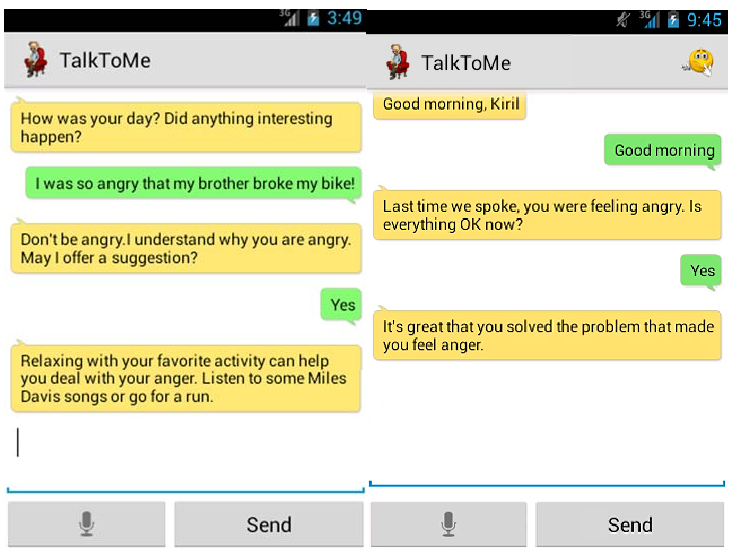 Figure 1: The Talk-to-Me Mobile Application Interface and Interaction Flow.
Experimental Breakthroughs
The system was tested against four major datasets (EMA, EMO-DB, Polish, and SAVEE).
- Superiority of Fusion: The Average Precision jumped to 90.8%, a massive leap from the 64.9% achieved by text-only analysis.
- Solving the Anger/Joy Paradox: In acoustic-only tests, Anger and Joy are often confused. However, the fusion model used linguistic "joy" markers to correctly identify high-energy speech, reducing errors by nearly 12% compared to acoustic-only models.
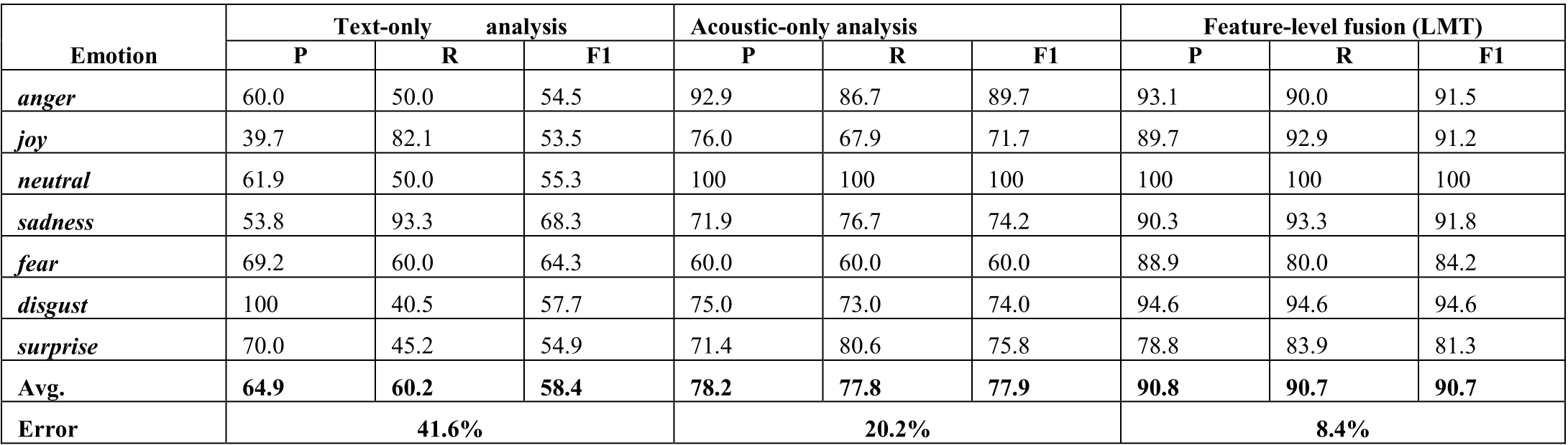 Table 1: Comparative Analysis – Bimodal Fusion (LMT) vs. Unimodal Methods.
Critical Insight: Why it Works
The "Secret Sauce" discovered in the study is the Dynamic Modality Weighting.
- Anger Detection relies heavily on acoustic features (SNR, Speech Energy).
- Disgust and Fear rely more on linguistic context (specific valence markers). By using an LMT, the system effectively learns which "channel" to trust more for specific emotional categories.
Limitations & Future Outlook
While the results are impressive, the study primarily uses acted speech (professional actors). Real-world "spontaneous" speech in noisy mobile environments remains the final frontier. Future work aims to incorporate noise-reduction strategies and explore Long Short-Term Memory (LSTM) networks to capture the temporal evolution of emotions across a dialogue.
Conclusion
This paper proves that for mobile AI to be truly "empathetic," it can't just read our words; it must hear our voice. The bimodal LMT approach provides a computationally efficient path to achieving this on-device, paving the way for more responsive mental health and social interaction apps.