
BiNet: Revolutionizing Trust Prediction via Context-Aware Sub-network Extraction
BiNet: Trust Sub-network Extraction Using Binary Ant Colony Algorithm in Contextual Social Networks
The paper introduces BiNet, a social context-aware trust sub-network extraction model using a Novel Binary Ant Colony Algorithm (NBACA). It aims to extract high-utility, dense sub-networks from large Online Social Networks (OSNs) to facilitate efficient and effective trust prediction between participants.
TL;DR
Trust prediction is the backbone of modern recommendation systems, but processing massive social graphs is a computational nightmare. BiNet introduces a sophisticated Binary Ant Colony Algorithm (NBACA) to extract small, dense, and highly relevant sub-networks. By focusing on contextual factors like social intimacy and role expertise, BiNet delivers sub-networks that are superior in quality and computational efficiency compared to previous SOTA methods like SCAN and FDRS.
Problem & Motivation: The Complexity Wall
In Online Social Networks (OSNs), predicting whether User A should trust User H for a specific task (e.g., tennis coaching) involves navigating millions of nodes.
The challenges are twofold:
- Contextual Noise: Most social relations are irrelevant to a specific goal (e.g., a "mechanics" relationship doesn't help predict "tennis coaching" trust).
- Computational Explosivity: Identifying the "best" subset of nodes (a sub-network) that maximizes trust information while minimizing size is an NP-Complete optimization problem.
Prior works often ignored network density or lacked the heuristic "intelligence" to navigate large search spaces efficiently, often getting stuck in local optima.
Methodology: The "Intelligence" behind BiNet
1. Multi-Dimensional Trust Utility
BiNet doesn't just look at edges; it calculates a Node Utility () based on:
- Expertise (RIF) & Reliability (RLB).
- Source-specific factors: Similarity and intimacy relative to the source node.
- Target-specific factors: Similarity and intimacy relative to the target node.
2. NBACA: A Smarter Ant Colony
The core innovation is the Novel Binary Ant Colony Algorithm (NBACA). Unlike standard ACAs where ants move between physical nodes, in BiNet's binary graph, an "ant's path" represents a decision string: 1 if a node is included in the sub-network, 0 if it is excluded.
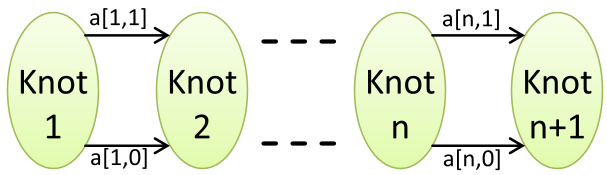
Key Enhancements:
- Heuristic Initialization: Pheromones are not distributed equally; they are biased towards high-utility nodes from the start.
- Mutation Strategy: To avoid "crowding" around one solution, a mutation process forces ants to explore variants with more or fewer nodes, essentially broadening the search horizon.
- Percentage Pheromones: Reduces memory overhead by only tracking selection probability () since .
Experiments: Performance under Pressure
The authors tested BiNet against SCAN (Monte Carlo based), FDRS (Greedy path addition), and BACO (Baseline Binary ACA) using the Epinion and Slashdot datasets.
Results Analysis
BiNet consistently found sub-networks with higher objective function values (a balance of utility and density) across all tests.
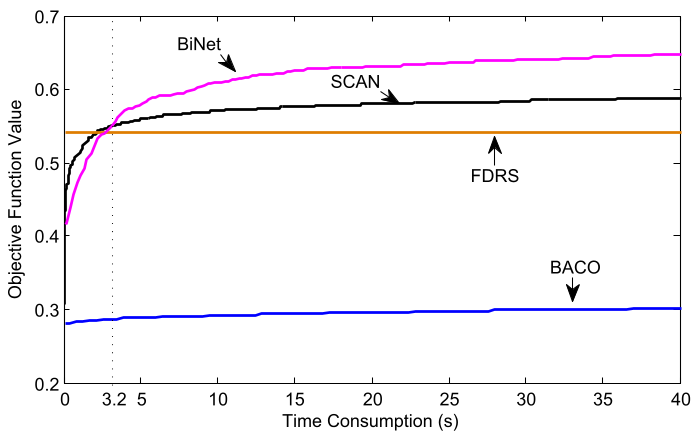
As shown in the figures:
- Speed of Convergence: BiNet overtakes competing models within the first 3.5 seconds of execution.
- Quality: At the 40-second mark, BiNet shows a ~7-8% improvement over SCAN and a staggering ~50% improvement over the baseline BACO.
- Robustness: The "Best, Mean, and Worst" cases (Table 1) indicate that BiNet is stable and not sensitive to specific data distributions.
Critical Insight & Conclusion
BiNet's success lies in its Inductive Bias. By embedding social psychology principles (like preference similarity) directly into the optimization's heuristic function, the algorithm doesn't "wander" blindly.
Takeaways:
- Efficiency: Precision sub-network extraction is a mandatory pre-processing step for real-time trust systems.
- Versatility: The NBACA framework isn't limited to social networks; it can be applied to feature selection, knapsack problems, or any binary optimization task.
- Future Work: Integrating this with Graph Embedding techniques (like Node2Vec or GCNs) could further refine node utility scores before the ant colony search begins.
Final Verdict: BiNet is a robust advancement in social computing, proving that bio-inspired algorithms, when properly "educated" with domain heuristics, remain a formidable tool against NP-Complete challenges.