
BFFAG: Revolutionizing Text Psychology Analysis through Advanced Binary Farmland Fertility Optimization
A novel binary farmland fertility algorithm for feature selection in analysis of the text psychology
This paper introduces two binary variants of the Farmland Fertility Algorithm (FFA), namely BFFAS (sigmoid-based) and BFFAG (genetic-operator-based), specifically for wrapper-based feature selection. BFFAG achieves state-of-the-art performance in classification accuracy and feature reduction on 18 UCI datasets and an IMDB sentiment analysis task.
Executive Summary
TL;DR: To tackle the challenge of high-dimensional feature selection in text psychology—where relevant emotional cues are buried in thousands of irrelevant words—this paper introduces BFFAG. By adapting the Farmland Fertility Algorithm (FFA) with genetic-inspired binary operators and a dynamic mutation strategy, the authors achieved a more robust search mechanism that significantly outperforms traditional methods like Genetic Algorithms (GA) and Particle Swarm Optimization (BPSO).
In the landscape of optimization, this work represents a SOTA advancement in discrete meta-heuristics, successfully bridging the gap between continuous biological metaphors and the binary requirements of modern machine learning pipelines.
The Problem: The Curse of "Noisy" Sentiment Data
In fields like text psychology (e.g., analyzing IMDB reviews), we deal with thousands of unique tokens. Most of these features are redundant or "noisy," which:
- Increases training time exponentially.
- Dilutes classification accuracy as the model learns from irrelevant patterns.
Traditional wrapper-based methods (which use a classifier to evaluate feature subsets) often get trapped in local optima—they find a decent set of features but fail to explore the global search space for the absolute best combination.
Methodology: Simulating Fertility in a Binary World
The original FFA mimics how different segments of farmland are improved based on soil quality. The authors propose two ways to "binarize" this logic:
1. The Sigmoid Approach (BFFAS)
A baseline approach where continuous values are squashed through a sigmoid function to represent probabilities of selecting a feature.
2. The Genetic Operator Approach (BFFAG) - The Core Innovation
Instead of simple thresholding, BFFAG introduces structural changes to the search logic:
- BGMU (Binary Global Memory Update): Uses crossover-style logic to blend the current solution with the "Global Best" memory.
- BLMU (Binary Local Memory Update): Refines solutions by comparing them against the "Local Best" within specific segments (sub-populations).
- Dynamic Mutation (DM): Crucial for Inductive Bias control. It starts with high mutation rates to ensure wide exploration and gradually tightens the search as iterations progress.
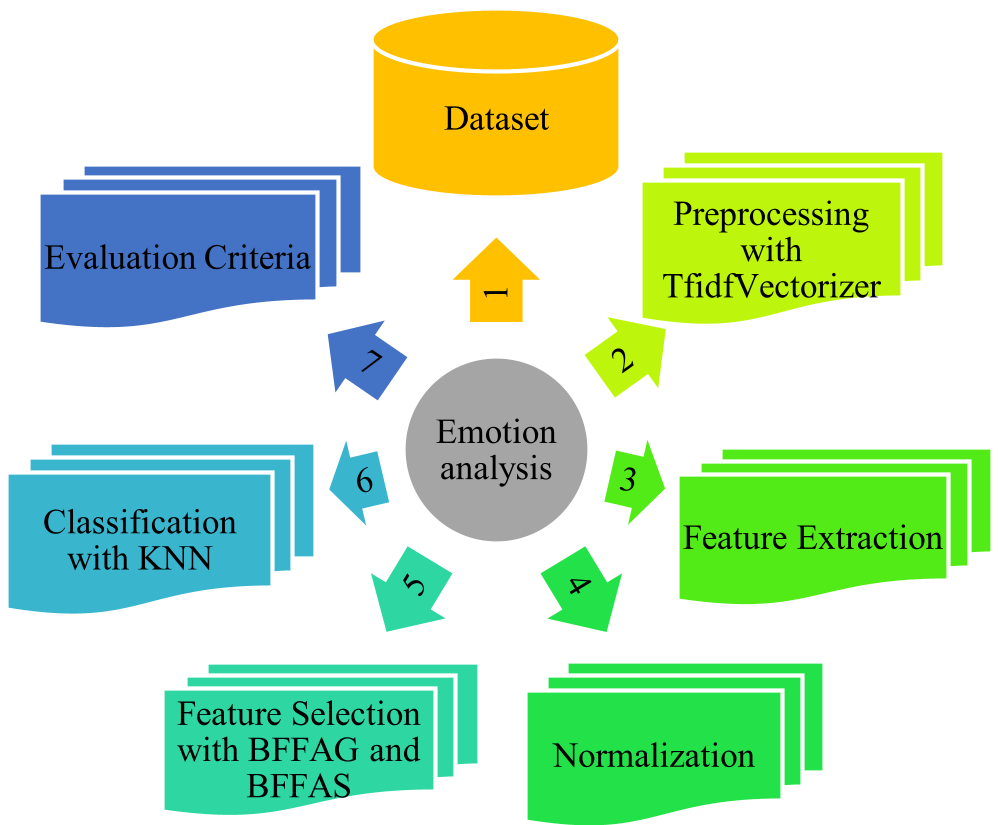 Figure 1: The application architecture shows the pipeline from text preprocessing to the BFFAG-driven feature selection.
Experiments and Results
The authors validated their method on 18 UCI datasets and the IMDB Large Movie Review Dataset (3675 features).
Key Metrics:
- Convergence: BFFAG showed a faster and deeper convergence rate in 15 out of 18 datasets compared to BBA, BPSO, and GWO.
- Feature Reduction: On the "Lung Cancer" dataset (D10), which starts with 56 features, BFFAG reduced the count to an average of 22.1 features while maintaining high accuracy.
- Accuracy: On the IMDB sentiment task, BFFAG consistently achieved higher classification accuracy than all other meta-heuristics across various iteration counts.
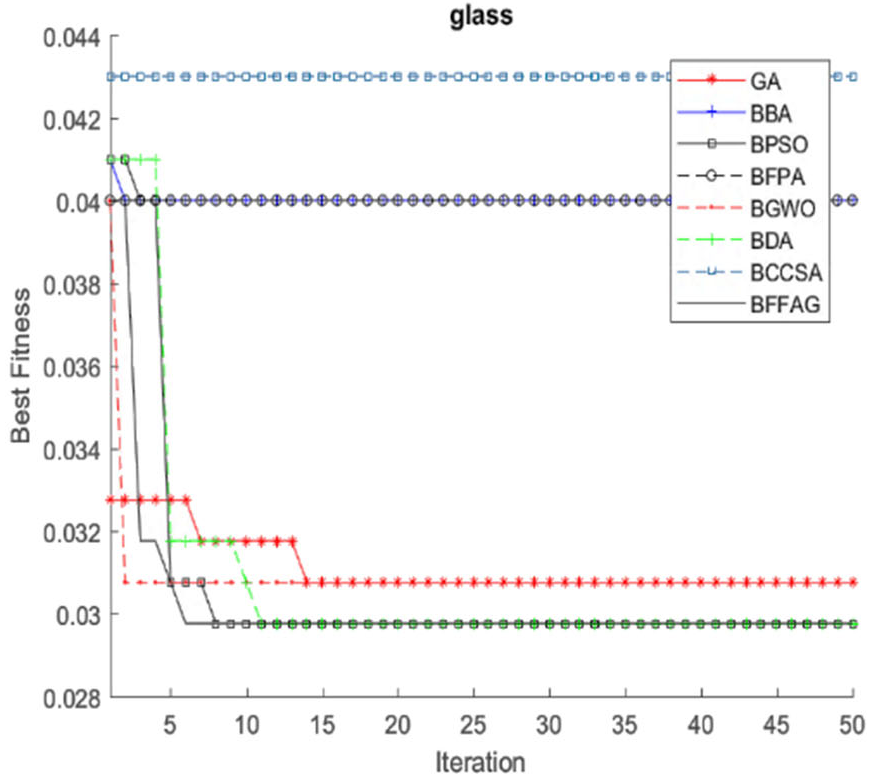 Figure 2: Convergence plots demonstrate BFFAG's ability to avoid local optima where other algorithms (like BBA) plateau early.
Deep Insight: Why Does It Work?
The effectiveness of BFFAG lies in its stochastic balance. Most binary optimizers suffer from "stagnation"—once they find a good bit-string, they stop changing.
- Segmented Population: By dividing the "farmland" into segments, the algorithm preserves diversity (preventing early convergence).
- Memory Utilization: The dual-memory system (Global vs. Local) allows the algorithm to pivot between "exploiting" a known good feature set and "exploring" nearby variations.
- Adaptive Mutation: The DM operator acts as a cooling schedule (similar to Simulated Annealing), ensuring the "farmers" don't settle for poor soil too early.
Conclusion & Future Outlook
BFFAG is a powerful tool for any data scientist dealing with high-dimensional tabular or text data. While the paper focuses on sentiment analysis, its logic can be extended to genomics, fraud detection, and multi-objective engineering design.
Limitations: The computational overhead of "segmentation" and "memory updates" might be higher than simple filters for extremely large datasets (>1M features), a frontier the authors suggest for future work.