
SoS-ACO: Giving Ants a "Sense of Smell" to Navigate Massive Social Networks
A bio-inspired algorithm for searching relationships in Social Networks
The paper introduces SoS-ACO (Sense of Smell - Ant Colony Optimization), a bio-inspired pathfinding algorithm designed for massive Social Network graphs. By incorporating a "Sense of Smell" to detect high-centrality "Food Nodes," the method significantly outperforms classical ACO and matches Dijkstra's accuracy with much higher efficiency.
TL;DR
Searching for connections in a social network with millions of users is like finding a needle in a haystack. While Dijkstra’s algorithm finds the perfect needle but takes forever, and Ant Colony Optimization (ACO) gets lost in the straw, a new algorithm called SoS-ACO adds a "Sense of Smell" to the mix. By allowing virtual ants to smell "Food" (high-centrality hub nodes), it finds high-quality paths in milliseconds, outperforming traditional swarm intelligence by orders of magnitude.
The Problem: The "Lost in the Clouds" Paradox
Social networks are "Small-World" graphs—they have high clustering and short path lengths (the "six degrees of separation" rule). However, for a computer, the sheer number of possible branches at every step is a nightmare.
- Dijkstra/A*: These are the gold standard for accuracy, but on massive graphs, the computational overhead becomes a bottleneck for real-time applications.
- Classic ACO: Virtual ants wander randomly, depositing pheromones. In a graph with 80,000 nodes, the probability of an ant randomly stumbling upon a specific destination is near zero. They essentially "starve" before finding the goal.
The authors realized that ants in nature don't just wander; they use multiple senses.
Methodology: Hunger, Food, and the Scent of Success
The core innovation is SoS-ACO (Sense of Smell - Ant Colony Optimization). The strategy is broken down into three elegant phases:
1. Identifying the "Food"
Instead of searching for a specific destination node immediately, the algorithm identifies Food Nodes (). These are the "celebrities" of the network—nodes with the highest centrality (most connections). Statistically, most paths in a social network pass through these hubs.
2. The Diffusion of Odor
The algorithm simulates an "odor" () that radiates from these food nodes. The intensity of the smell decreases as it travels across edges: This creates a gradient field across the graph. Unlike pheromones (which are dynamic and deposited by ants), this odor is a static property of the graph’s topology, acting as a permanent navigation beacon.
3. The Bi-Directional Hunt
The search uses two colonies of ants: one starting at the source and one at the destination.
- Normal Mode: Ants move based on pheromone levels.
- Smell Mode: Once an ant enters an "odor area," it stops wandering and follows the gradient directly to the Food Node.
- The Meeting: When an ant from the source and an ant from the destination both reach the same Food Node, a complete path is formed.
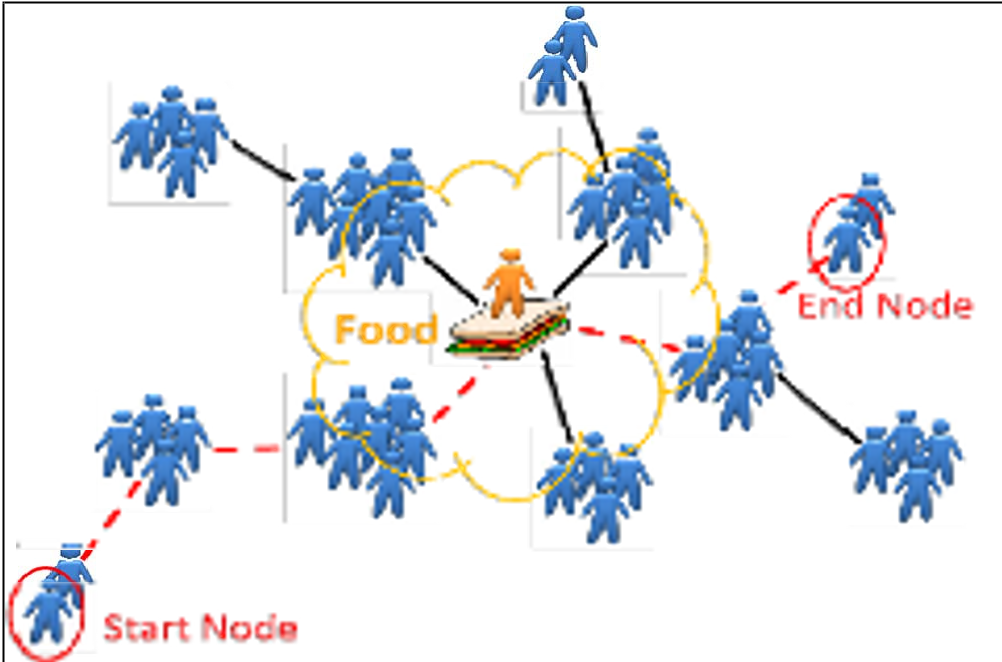 Figure 1: Virtual ants using the diffused odor to locate a central hub node, facilitating a meeting point for path completion.
Experimental Results: Speed vs. Quality
The researchers tested SoS-ACO on the Slashdot dataset (82,168 nodes and 948,464 edges).
| Algorithm | Mean Execution Time (sec) | Mean Path Cost |
|---|---|---|
| Dijkstra | 563.39 | 4.51 (Optimal) |
| Classic ACO | 254.21 | 387.69 |
| SoS-ACO (Proposed) | 0.59 | 6.40 |
Analysis of the Results
- Efficiency: SoS-ACO is nearly 1,000x faster than Dijkstra. While Dijkstra effectively searches the entire graph, SoS-ACO narrows the search space to a localized "scent trail."
- Path Quality: While SoS-ACO isn't "optimum" (it found paths with a cost of 6.4 vs Dijkstra's 4.5), a path of length 6 in a social network is perfectly acceptable, whereas the classic ACO's path of 387 is useless.
- Scalability: As shown in the table below, increasing the "odor threshold" () to cover 37% of the graph drastically stabilizes the results and reduces standard deviation.
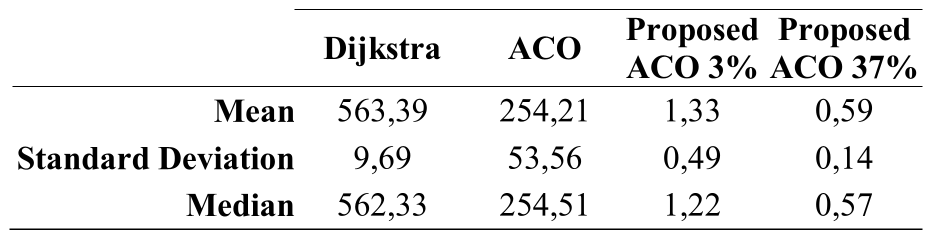 Table: Comparison of Mean Time (sec) between Dijkstra, Classic ACO, and SoS-ACO versions.
Critical Insight: Why Does This Matter?
The genius of SoS-ACO lies in its Inductive Bias. It assumes that in Social Networks, "all roads lead through Rome" (the hubs). By hard-coding this topographic reality into the ants' behavior through the "Sense of Smell," the authors transformed a chaotic search into a guided trek.
Limitations & Future Work
While impressive, SoS-ACO currently relies on pre-calculating high-centrality nodes. In a dynamic graph where users join or leave every second, the "odor field" needs to be updated. The authors suggest that because the odor diffusion is so fast (taking only seconds), it could theoretically adapt to real-time changes much better than traditional hierarchical pre-processing methods.
Conclusion
SoS-ACO is a masterclass in bio-mimicry. It proves that by adding a layer of "physical intuition" (odor) to a "social behavior" (ants), we can solve complex graph problems that are otherwise computationally prohibitive. For modern social platforms, this could be the difference between a "People You May Know" feature that works in real-time and one that lags by hours.