
BIOG: Accelerating Rumor Containment in Social Networks via MIOG Structure
BIOG: An Effective and Efficient Algorithm for Influence Blocking Maximization in Social Networks
This paper introduces BIOG (Block Influence Out Graph), an efficient algorithm for the Influence Blocking Maximization (IBM) problem in social networks. It leverages a novel graph structure, MIOG, to approximate potential influence regions and uses a greedy strategy with a custom "blocking score" to identify optimal positive seeds for rumor containment.
TL;DR
Social networks are double-edged swords; while they facilitate rapid information sharing, they also accelerate the spread of misinformation. The Influence Blocking Maximization (IBM) problem seeks to find a set of "positive seeds" to counteract "negative seeds" (rumors). BIOG provides a surgical solution by introducing the MIOG graph structure, achieving massive speedups (up to 40x) while matching the effectiveness of traditional, slow greedy algorithms.
Problem & Motivation: The Computational Wall
The core challenge of IBM is the "Competitive Independent Cascade Model." To know which nodes to protect, one must simulate how rumors spread thousands of times (Monte-Carlo simulations).
- Greedy Algorithms: Effective but glacial; they cannot scale beyond small networks.
- Prior Approximations (MIAs): Structures like MIA often pick only a single "best path," ignoring the high-redundancy reality of social connections.
- The Bottleneck: Recomputing the influence of every node after selecting a single seed is too expensive for real-time response.
Methodology: The MIOG Insight
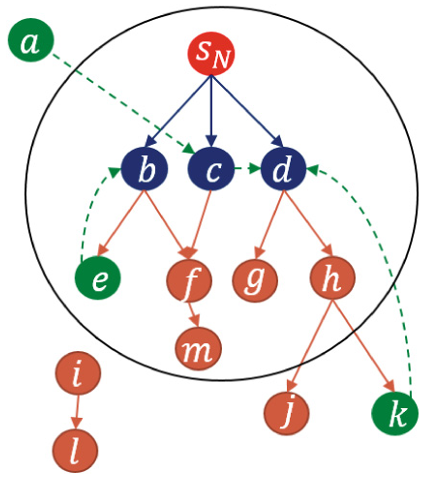
The authors propose the Maximum Influence Out-Graph (MIOG). Unlike previous structures that simplify too much, MIOG retains all maximum influence paths that meet a probability threshold .
1. The Blocking Score
Instead of full simulation, BIOG calculates a Global Blocking Score . This score is derived from the activation probability of nodes reachable by within the MIOG of negative seeds. It captures not just who can influence, but specifically how much "negative probability" can neutralize.
2. Candidate Selection & Incremental Updates
To save time, BIOG doesn't look at all nodes. It filters for Candidate Nodes (Class 1 and 2): those directly adjacent to negative seeds or their immediate influence paths.
When a positive seed is selected, the algorithm doesn't restart. It performs a Local Update:
- Recalculates (activation probability) only for nodes impacted by the new seed.
- Adjusts blocking scores in-place.
Experiments & Results: Efficiency Gains
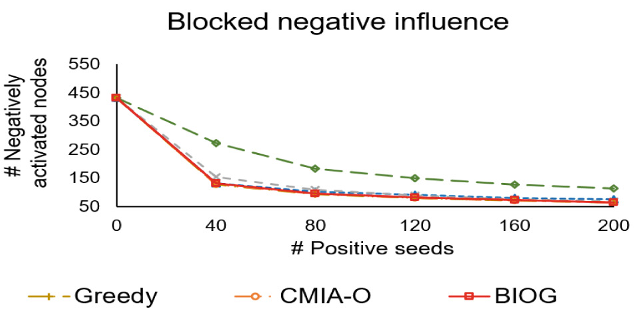
The performance metrics on the NetPHY dataset (37k nodes, 232k edges) are particularly telling. BIOG maintains the same "Blocked Influence" plateau as the CMIA-O benchmark but does so in a fraction of the time.
- Effectiveness: Under both Independent Cascade (IC) and Weighted Cascade (WC) models, BIOG matches the high-quality seed selection of the Greedy algorithm.
- Efficiency: On the Email dataset, while Greedy takes over a day, BIOG finishes in 25 seconds.
Critical Analysis & Conclusion
BIOG’s primary contribution is the balance of precision and pruning. By moving from global simulations to localized MIOG structures, the authors proved that we can fight rumors nearly in real-time.
Takeaway: The "Blocking Score" is a powerful heuristic that captures the physical intuition of "cutting off a path" before it spreads.
Limitations: The algorithm assumes the negative seeds are known and static at the start. In modern social media, negative seeds often emerge dynamically. Future research could adapt BIOG for dynamic networks where the negative source moves or evolves over time.