
BioWatch: Tackling Subject Variability in Wearable Blood Pressure Monitoring
BioWatch: A Noninvasive Wrist-Based Blood Pressure Monitor That Incorporates Training Techniques for Posture and Subject Variability
BioWatch is a noninvasive, wrist-wearable system for continuous blood pressure (BP) monitoring using Pulse Transit Time (PTT) derived from integrated ECG and PPG sensors. It achieves high accuracy through posture-specific and individual-specific regression models, validated across 11 subjects with diverse physiological profiles.
TL;DR
BioWatch is a specialized wrist-worn device that provides continuous, cuffless blood pressure monitoring by measuring the time delay between a heartbeat (ECG) and the resulting pulse wave at the wrist (PPG). By implementing posture-specific and individual-specific training, the authors achieved clinical-grade accuracy (RMSE ~7-9 mmHg), overcoming the variability that has long plagued PTT-based wearables.
Background: Why PTT-based BP is a Hard Problem
Pulse Transit Time (PTT) is the time it takes for a pressure wave to travel from the heart to a peripheral site. Conceptually, as Blood Pressure (BP) rises, the arterial walls stiffen, and the pulse wave velocity increases, resulting in a shorter PTT.
However, translating PTT to BP in the real world is notoriously difficult because:
- Individual Differences: Arterial stiffness varies wildly with age, height, and vascular health.
- Hydrostatic Pressure: Changing your arm position relative to your heart alters the local pressure and PTT, even if your systemic BP remains constant.
- Posture Impact: The Pre-Ejection Period (PEP) of the heart changes between sitting, standing, and lying down.
The BioWatch Methodology
The BioWatch system integrates two Analog Front Ends (AFEs) for high-fidelity ECG and PPG acquisition. The user completes the ECG circuit by touching a top electrode with their opposite hand.
1. Multi-Model Regression
Instead of relying on a single "magic formula," the authors tested five different fitting functions (Polynomial and Exponential) to map Pulse Wave Velocity (PWV) to Systolic (SBP) and Pulse Pressure (PP).
Insight: They estimated Diastolic BP (DBP) by subtracting Pulse Pressure from SBP, as DBP alone correlates poorly with PTT.
2. Posture-Aware Calibration
The team discovered that a model trained in a "Sitting" position performs poorly when the user is "Supine." As shown below, the scatter plots of PTT vs. BP form distinct clusters based on body orientation.
3. Accelerometer-Based Compensation
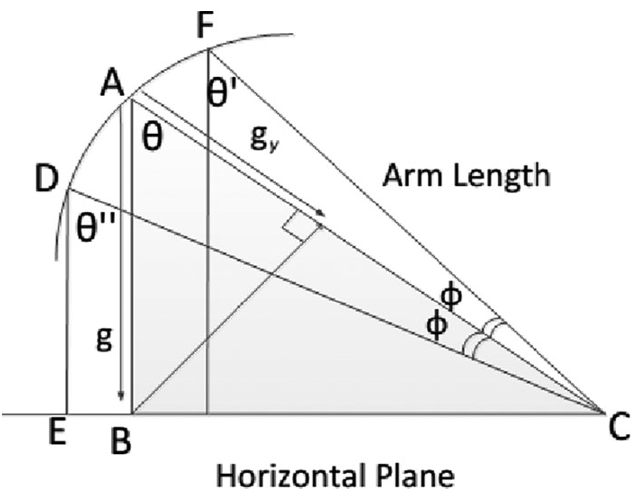
To ensure the user holds their arm at the correct height (chest level), BioWatch uses an internal accelerometer to monitor the projection of gravity () along the arm. If the arm deviates by more than ±2 cm, the system provides feedback to correct the position.
Experimental Results
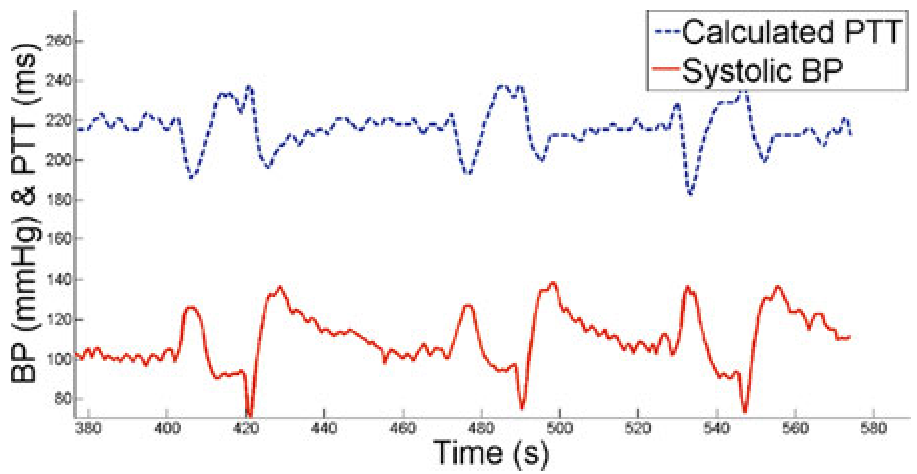
The researchers validated BioWatch using the Valsalva Maneuver—a breathing technique that induces rapid, sharp fluctuations in BP. This provided a rigorous test of the system's dynamic tracking capability.
- Accuracy: The RMSE for SBP was ~8 mmHg and DBP was ~6 mmHg across 11 subjects.
- The Cost of No Calibration: When a single equation was used for all postures, the error (RMSE) increased by up to 55.76%. When a single equation was used across all subjects, the error jumped by over 80%.
(Note: The figure shows the model's ability to track blood pressure spikes in real-time.)
Critical Insight & Future Outlook
The BioWatch study serves as a "reality check" for the wearable industry. It proves that while PTT is a valid proxy for BP, general-purpose models are insufficient. The 98% accuracy of their arm-position classifier suggests that integrating IMU (Inertial Measurement Unit) data is not just an add-on, but a requirement for reliable cuffless BP.
Limitations: The current system still requires a reference BP cuff for initial calibration (training). The next frontier in this research will likely be "zero-calibration" models that use deep learning to infer vascular parameters without needing an external cuff.
Summary
By combining hardware integration (ECG + PPG in a watch) with intelligent software (posture-specific regression and IMU feedback), BioWatch bridges the gap between clinical monitoring and daily wearable utility.