
Bipartite Consensus: A New Frontier for Global Trust in Polarized Social Networks
Bipartite Consensus for Global Trust in Social Network Services
This paper introduces a novel framework for evaluating global trust (reputation) in Social Network Services (SNS) using bipartite consensus on signed graphs. By modeling trust and distrust relationships through discrete-time dynamics, the method achieves non-trivial global trust values despite opinion divergence in polarized networks.
TL;DR
In a world where "distrust" is as prevalent as "trust," simple averages for reputation fail. This paper proposes a mathematical framework using bipartite consensus on signed graphs to evaluate global trust. It allows a network to reach two separate but stable reputation values for opposing groups, solving the problem of opinion divergence and providing a robust mechanism for system security and recommendation filtering.
The "Average" Trap: Why Global Trust is Broken
Most current Social Network Services (SNS) treat reputation as a scalar sum. If User A trusts User B, the score goes up; if they distrust them, it might go down or stay neutral. However, in polarized environments—think political debates—a simple average produces a "neutral" score that reflects no one's reality.
The Core Insight: Distrust is not just the absence of trust; it is a directed, antagonistic relationship. By modeling the network as a signed graph (where edges are +1 for trust and -1 for distrust), we can identify clusters of homophily (similarity) and controversy.
Methodology: From Structural Balance to Eventual Positivity
1. The Signed Trust Network
The authors model the SNS as a directed weighted signed graph . Unlike standard PageRank, the adjacency matrix contains negative weights .
2. Bipartite Consensus under Structural Balance
A network is structurally balanced if it can be split into two groups where everyone within a group "likes" each other, and everyone between groups "dislikes" each other. The authors utilize a Gauge Transformation to flip the signs of nodes such that the system acts like a standard consensus problem.
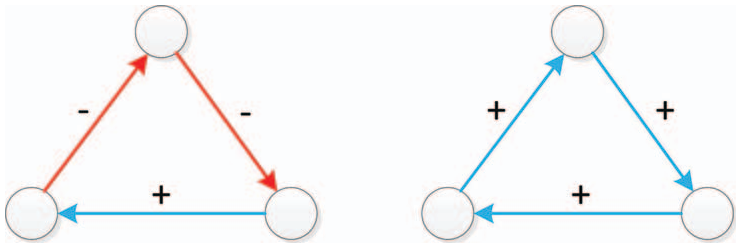 Fig 1. Visualizing Structural Balance: Intra-group edges are positive, inter-group are negative.
3. Generalizing with Eventual Positivity
Since real social networks are rarely perfectly balanced, the authors introduce Eventual Positivity. They prove that if a matrix becomes positive for some , the system still converges to a stable bipartite state. This allows the model to handle "noisy" social structures where controversy doesn't follow a perfect split.
Experimental Potential & Applications
The paper highlights two critical use cases for this bipartite reputation:
- System Security (Adversary Detection): By identifying the "negative" cluster in a bipartite consensus, the system can automatically flag malicious nodes or botnets that are distrusted by the majority of the "integrity" group.
- Trust-Aware Recommendations: The authors modify the standard collaborative filtering formula.
Only users with a positive reputation () are allowed to influence a target user's recommendation, effectively filtering out "bandwagon attacks."
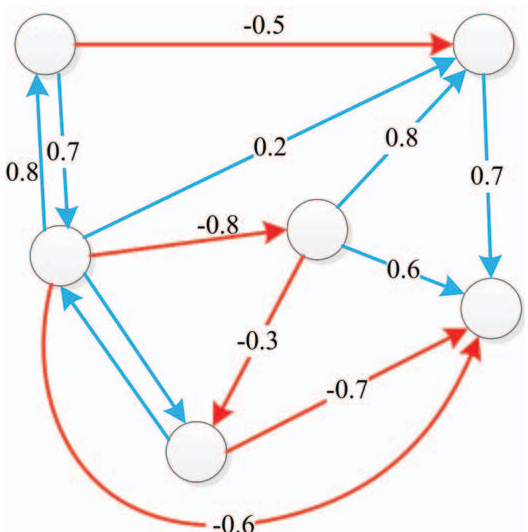 Fig 2. An example of a complex signed trust network where bipartite consensus can be reached.
Critical Analysis & Takeaways
Key Contribution: This is the first work to bridge the gap between control theory (bipartite consensus) and social network reputation management. It moves beyond the "naive trust" assumption.
Limitations:
- The model assumes a strongly connected graph, which might not hold in highly fragmented social networks.
- The computational cost of finding the gauge transformation matrix for massive graphs (billions of nodes) is not fully addressed.
Future Outlook: The integration of bipartite consensus into deep learning (Signed GNNs) is the logical next step. As social platforms become more polarized, algorithms that recognize "controversial integrity" rather than "universal popularity" will be essential for maintaining user trust.
Conclusion
By mathematically formalizing distrust, this paper provides a path toward SNS-based applications that are resilient to manipulation and reflective of complex social dynamics.