
Birds of a Feather: Decoding the Personality Mechanics of the Blogosphere
Birds of a feather: How personality influences blog writing and reading
This paper investigates how personality traits (Big Five) influence social interaction in the blogosphere. By utilizing Linguistic Inquiry and Word Count (LIWC) and a two-part human experiment, it demonstrates that blog readers can achieve high consensus on author personalities and are more attracted to writers they perceive as having similar traits, validating the "law of similarity-attraction" in Web 2.0 environments.
TL;DR
Does your personality leak into your blog posts? According to this study, the answer is a resounding yes. Using the Big Five personality model, researchers found that readers not only form consistent impressions of a blogger's personality through text alone but are also significantly more attracted to "kindred spirits"—writers they perceive as having personalities similar to their own. This confirms that the psychological law of Similarity-Attraction remains a potent force in the digital age.
The "Zero-Acquaintance" Dilemma
In the real world, we use body language, tone, and facial expressions to "size up" others. Blogs strip these cues away, leaving only raw text. Historically, researchers believed this made personality judgment in Computer-Mediated Communication (CMC) inaccurate or shallow. The authors of this study challenged that notion, asking: Can a short blog entry trigger the same evaluative social responses as a face-to-face meeting?
Methodology: The Two-Part Social Experiment
The researchers conducted a controlled lab experiment to eliminate "noise" from the wild internet (like profile pictures or previous fame).
- Phase 1 (Writing): Authors wrote entries in two distinct genres: Personal Diaries and Commentaries.
- Phase 2 (Judging): Naive readers evaluated these entries (blinded) for personality traits and interpersonal attraction.
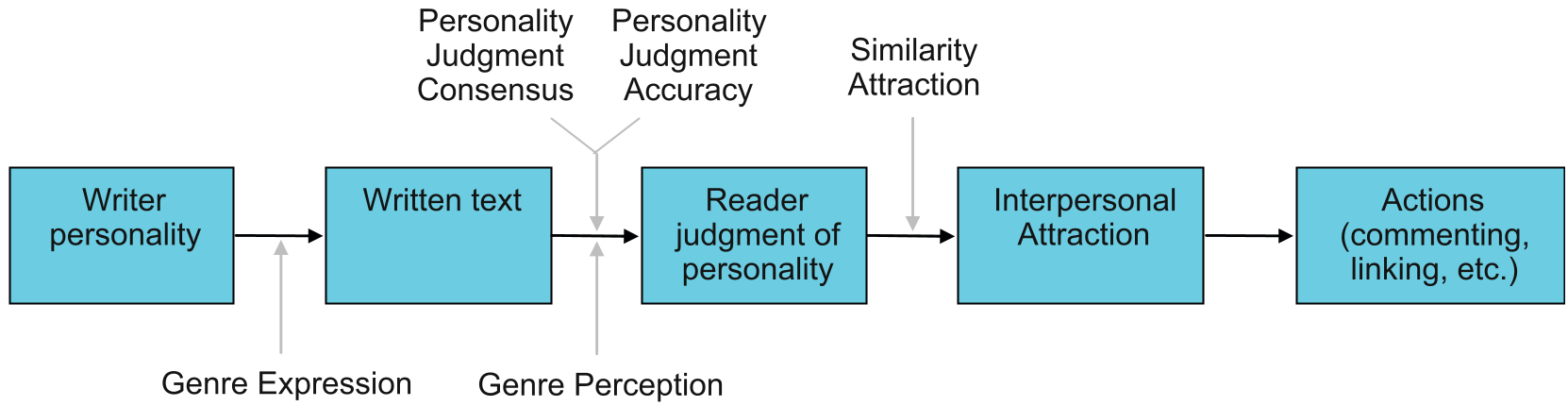 Figure 1: The framework showing how author personality is encoded in text and decoded by readers to influence attraction.
Key Insights: How Personality "Leaks" into Text
Using the LIWC (Linguistic Inquiry and Word Count) tool, the study identified specific markers that signal character:
- Extraverts: Used significantly more positive emotion words (e.g., "great", "fun") in commentary.
- Neurotic/Low Conscientious Writers: Utilized more negative emotion words.
- Openness: High openness authors tended to use fewer articles (a/an/the), suggesting a more complex or less formal linguistic style.
Interestingly, these cues were more "telling" in Commentary than in Personal Diaries. Why? In a diary, emotional language is expected. When a writer injects personality into a dry commentary about politics or tech, it becomes a much stronger signal of their underlying traits.
Results: The Similarity-Attraction Effect
The most striking discovery was the validation of the "Birds of a Feather" hypothesis.
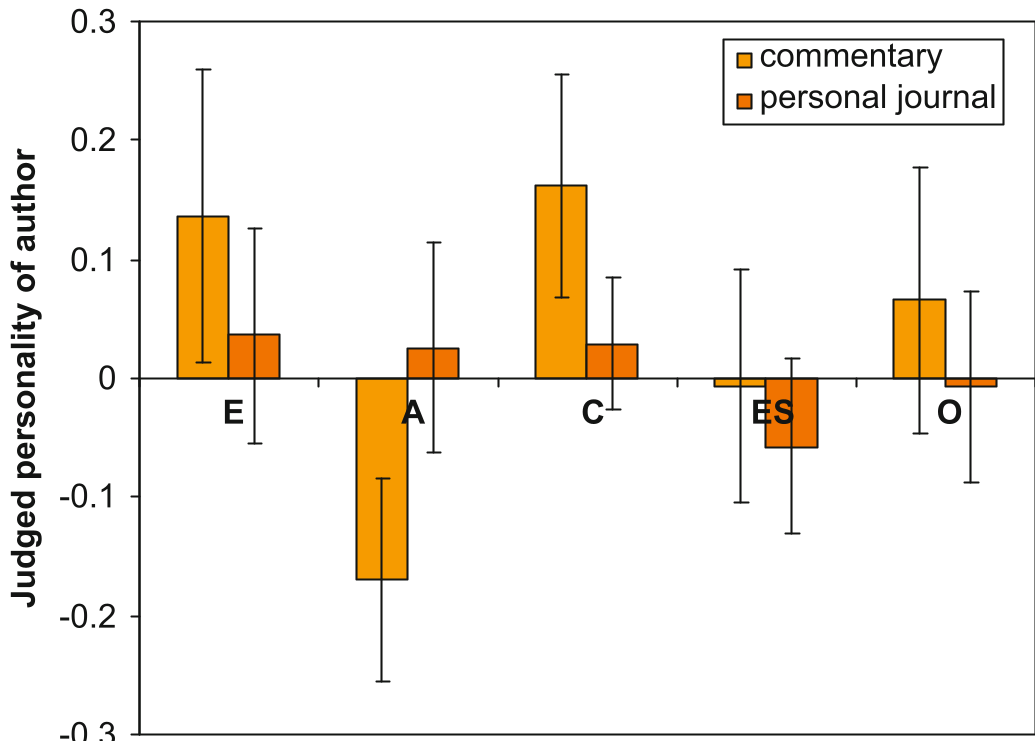 Figure 2: Analysis of how different genres (Diary vs. Commentary) shift reader perceptions of personality traits.
- Consensus vs. Accuracy: Readers were remarkably good at agreeing with each other on who was an extravert or a neurotic, even if they didn't always match the author's own self-rating.
- Attraction: Readers reported a much higher desire to interact with or work with authors they believed shared their personality traits. This was particularly true for Agreeableness and Openness.
Critical Analysis & Conclusion
This research proves that human social evolution hasn't been bypassed by Web 2.0. We are still hardwired to seek similarity, even in the "lean" environment of a blog.
Limitations
- Small Sample Size: With only 8 authors and 12 readers, the statistical power is limited.
- Student Demographic: The high education level of participants might lead to more "astute" personality detection than the general public.
Future Outlook
For developers of recommender systems and social networks, this study provides a roadmap. Rather than just matching users by "interests," platforms could match users by linguistic compatibility. If a system knows you are a highly conscientious reader, it might prioritize "conforming" commentary that mirrors your linguistic style, thereby increasing your engagement and "attraction" to the community.
In the end, even in a world of avatars and screen names, our true selves are written between the lines.