
This paper provides a comprehensive review of tidal Love numbers—coefficients that quantify the tidal deformability of compact objects like black holes and neutron stars. It synthesizes theoretical frameworks from Newtonian gravity to General Relativity (GR), employing Effective Field Theory (EFT) and post-Newtonian techniques to analyze static, dynamical, and nonlinear responses.
TL;DR
In the world of General Relativity (GR), not all celestial bodies "feel" the pull of their neighbors in the same way. While neutron stars bulge and deform under tidal forces—revealing secrets of their dense nuclear interiors—black holes in four dimensions remain perfectly rigid. This paper reviews the multifaceted theory of Love numbers, the response coefficients of gravity, and explores the recently discovered "hidden symmetries" that explain why black holes are so uniquely stubborn.
Background: The Anatomy of a Tidal Response
When a compact object like a neutron star is caught in the orbit of another massive body, it doesn't just move as a point particle. It undergoes tidal deformation. The leading-order effect is a quadrupolar bulge. In the language of Effective Field Theory (EFT), this is captured by Love numbers.
For neutron stars, these numbers are a window into the Equation of State (EoS). For black holes, however, the static Love numbers are exactly zero. This discrepancy is more than a technical detail; it is a profound clue about the structure of spacetime itself.
Problem & Motivation: The Naturalness Puzzle
From an EFT perspective, any term not forbidden by symmetry should exist in the action. We can easily write down dynamic operators representing tidal deformability. Why then, when we perform the full GR calculation for a Schwarzschild or Kerr black hole, does the "response" term vanish?
The difficulty lies in the boundary conditions. At the event horizon, we must impose an "ingoing-only" condition. For static fields, this regularity requirement forces the part of the gravitational solution that would represent a "Love" response to disappear, leaving only the external field.
Methodology - The Core: From Newtonian Tides to EFT
The authors bridge the gap between classical and relativistic gravity using two primary tools:
- Worldline EFT: The compact object is treated as a point particle on a worldline, supplemented by local operators.
- Black Hole Perturbation Theory: Using the Master Equations (Regge-Wheeler for Schwarzschild, Teukolsky for Kerr), the authors solve for the metric fluctuations .
Architecture of the Response
The key is the radial equation. In the static limit (), the perturbation equations for many black holes can be mapped to Hypergeometric functions.
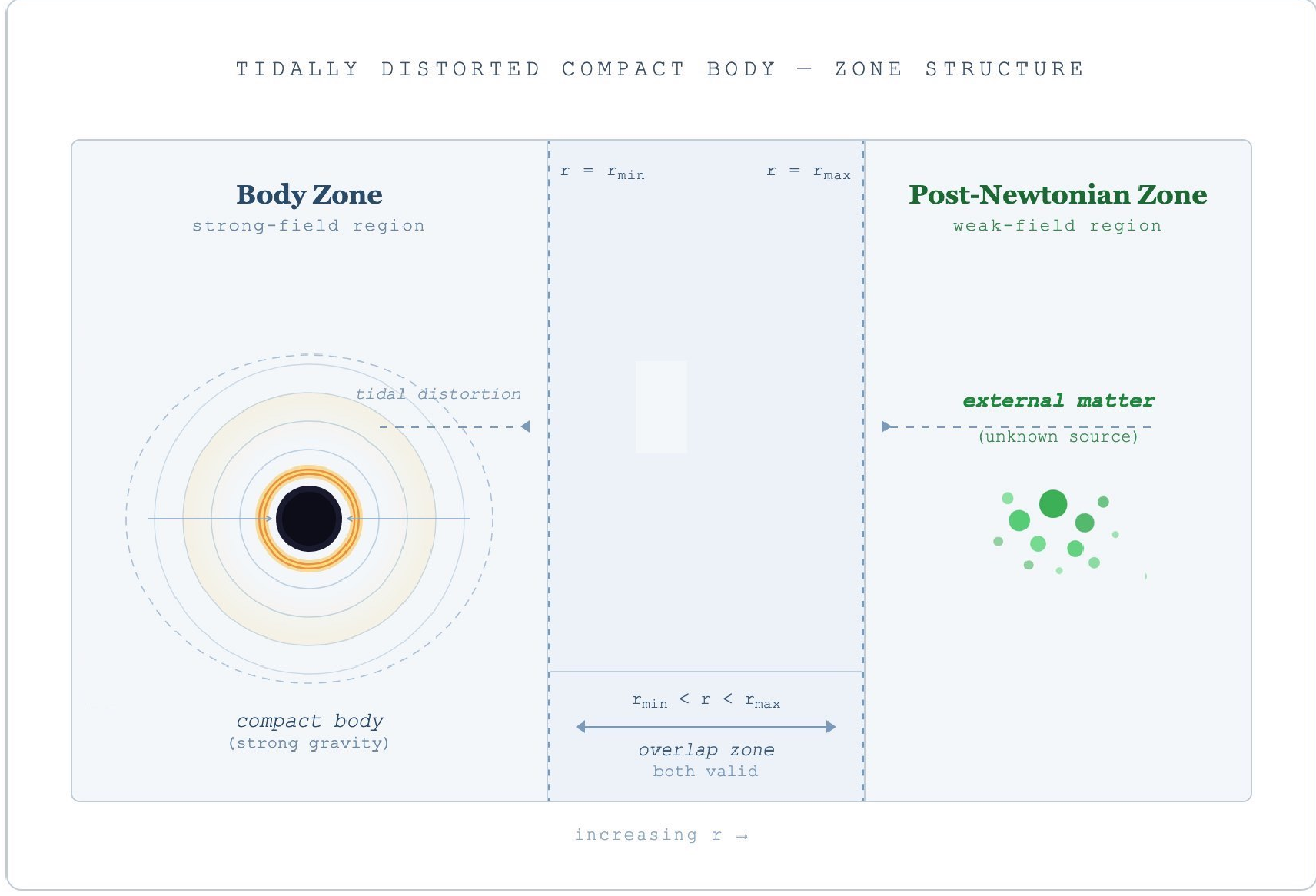 Figure 1: Comparison between the Body Zone (strong gravity), Post-Newtonian Zone (weak gravity), and the Overlap Zone where matching occurs.
The paper highlights Ladder Symmetries. These are operators () that allow researchers to "climb" between multipole orders. Starting from a horizon-regular solution at , one can Generate all higher- regular solutions. Because these generated solutions are pure polynomials, they contain no decaying "tail" at infinity, proving that the Love numbers must be zero.
Results & Insights: The Kerr Twist
When spinning black holes (Kerr) are introduced, the story becomes "Imaginary." While the real part (conservative Love numbers) still vanishes, rotation induces a dissipative response.
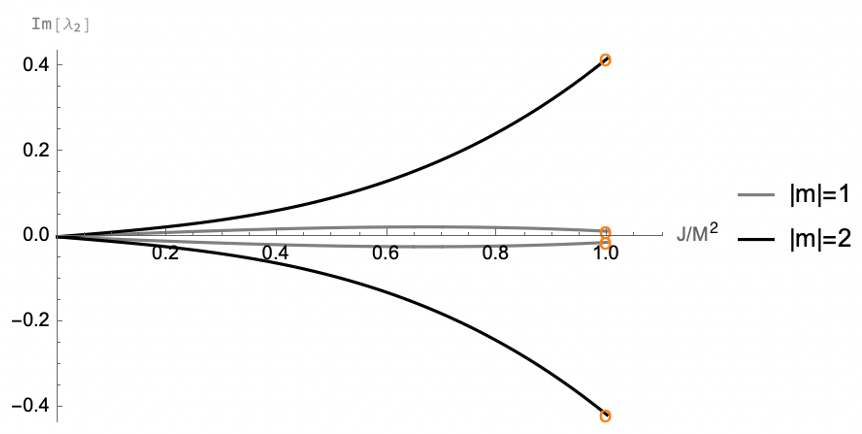 Figure 2: Static dissipative response for Kerr black holes. Note how the "tidal heating" grows with the dimensionless spin .
Key Findings:
- Neutron Stars: Love numbers vary drastically with the EoS, entering the waveform at 5PN order.
- Kerr Black Holes: Rotation shifts the frequency . This means even a static companion can cause "tidal heating" because the black hole is rotating relative to the field.
- Renormalization: At second order in frequency (), Love numbers are no longer zero and exhibit "logarithmic running," similar to couplings in particle physics.
Deep Insight: Why the Vanishing Matters
The vanishing of black hole Love numbers is a naturalness problem. The review explains that this is likely protected by an SL(2,R) "Love Symmetry" present in the near-horizon geometry.
If we ever detect a non-zero static Love number for a massive compact object, it means one of several revolutionary things:
- The object is not a black hole (perhaps a "Boson Star" or "Gravastar").
- General Relativity is wrong at high curvatures.
- The black hole is "wearing a wig" of dark matter or an accretion disk.
Conclusion
Love numbers have evolved from a niche topic in geodynamics to a cornerstone of Gravitational Wave Astronomy. By combining the rigor of EFT with the elegance of hidden symmetries, this paper provides the definitive map for navigating the landscape of compact object deformability. As the Einstein Telescope and LISA come online, we will finally be able to "measure the Love" and see if black holes are as rigid as Einstein predicted.