
Beyond GPS: Protecting Children Through BLE-Based Social Context Analysis
BLE-Based Children’s Social Behavior Analysis System for Crime Prevention
The paper introduces an IoT-based system designed for children's crime prevention through social behavior analysis using Bluetooth Low Energy (BLE) and tri-axial accelerometers. By logging proximity IDs and motion data, the system identifies "alone periods" and activity patterns (walking vs. stationary) to help parents monitor potential kidnapping risks.
TL;DR
Researchers from the University of Tsukuba have developed a low-power, IoT-based wearable system specifically for children's safety. Unlike battery-draining GPS trackers, this system uses Bluetooth Low Energy (BLE) to log social interactions and Accelerometers to detect behavior. It effectively identifies "alone periods"—the highest risk windows for kidnapping—while maintaining a small form factor and long battery life.
Context: The Limitations of Position-Only Tracking
In Japan, statistics show that the majority of child abductions occur when children are solitary. While the industry has gravitated toward "GPS Locators," these devices face a Catch-22: high-frequency tracking provides safety but kills the battery in under two days, while low-frequency tracking misses critical incidents. More importantly, GPS tells you where a child is, but not if they are vulnerable.
The authors' insight is simple yet profound: Safety is a social state, not just a coordinate. A child walking through a park with five friends is at much lower risk than a child walking the same path alone.
Methodology: Fusing Social Proximity with Physical Activity
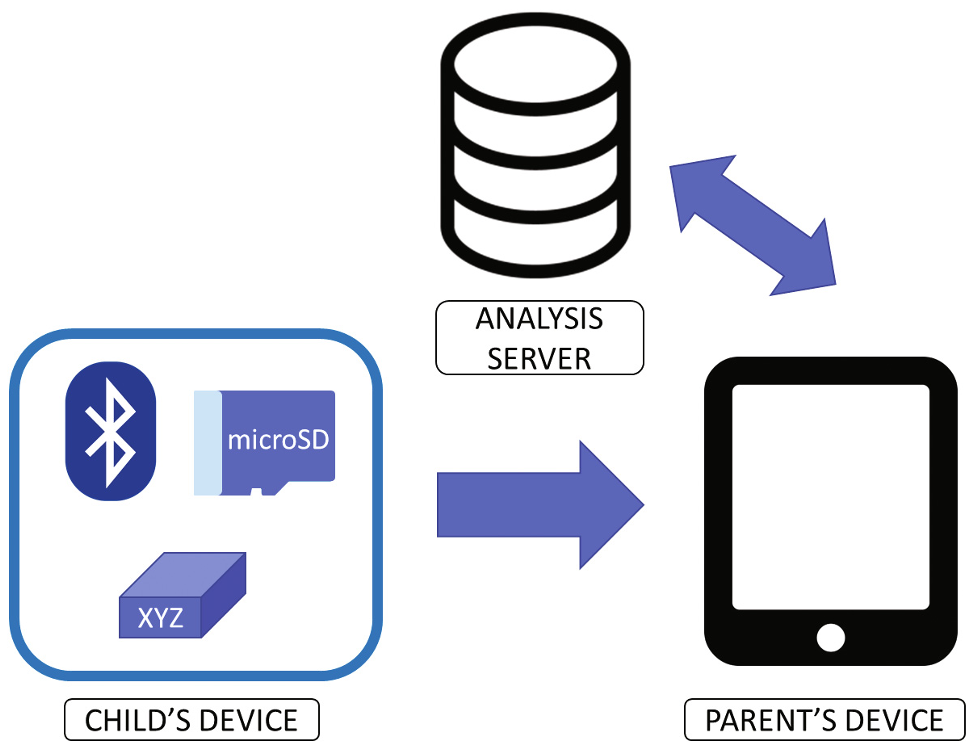
The system architecture is divided into three components: the Child's Device, the Parent's App, and the Analysis Server.
1. The Hardware Design
The prototype (4.8 x 4.5 x 1.4 cm) is designed to be tucked into a school bag. It features:
- BLE Radio: Continuously broadcasts a unique ID and scans for nearby IDs.
- 3D Accelerometer: Captures physical movement signatures.
- Local Storage: Uses an SD card to bypass the need for constant, power-hungry cellular uploads.
2. Behavioral Estimation Scenarios
The system operates in two distinct modes:
- Single Device Scenario: When no friends are detected, the accelerometer logs determine if the child is moving (walking/running) or stationary. A "walking alone" state triggers the highest alert level for parental review.
- Multiple Device Scenario: When peer IDs are detected, the system validates that the child is in a social group, reducing the "perceived risk" even if they are in transit.
Experimental Validation
The researchers conducted two phases of testing. A preliminary test with 24 university students proved that BLE logs can accurately reconstruct a user's day (e.g., detecting lunch breaks or group study sessions).
A second, more technical experiment focused on the hardware's accuracy. By comparing the Analysis Server's output with manual "ground truth" notes kept by participants, the authors demonstrated that the BLE proximity detection was nearly flawless.
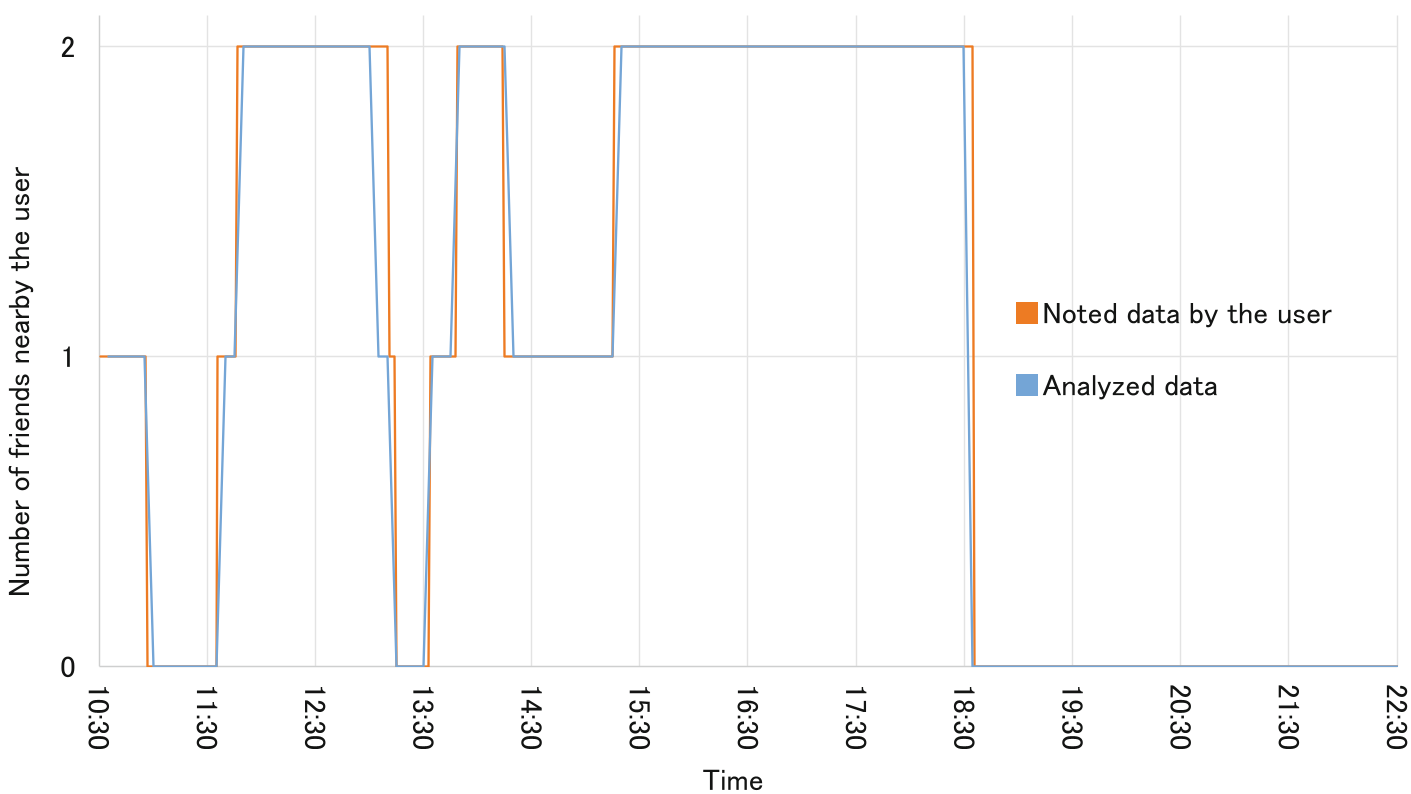 Fig: The high correlation between recorded friend presence and the system's automated detection.
Furthermore, by overlaying acceleration data on social logs, the system characterized sessions like:
- 10:50 - 11:30: High acceleration + Alone = Walking alone (High Risk).
- 16:30 - 17:30: Low acceleration + Peers = Group study (Low Risk).
The "Glance" and "Detail" Visualization
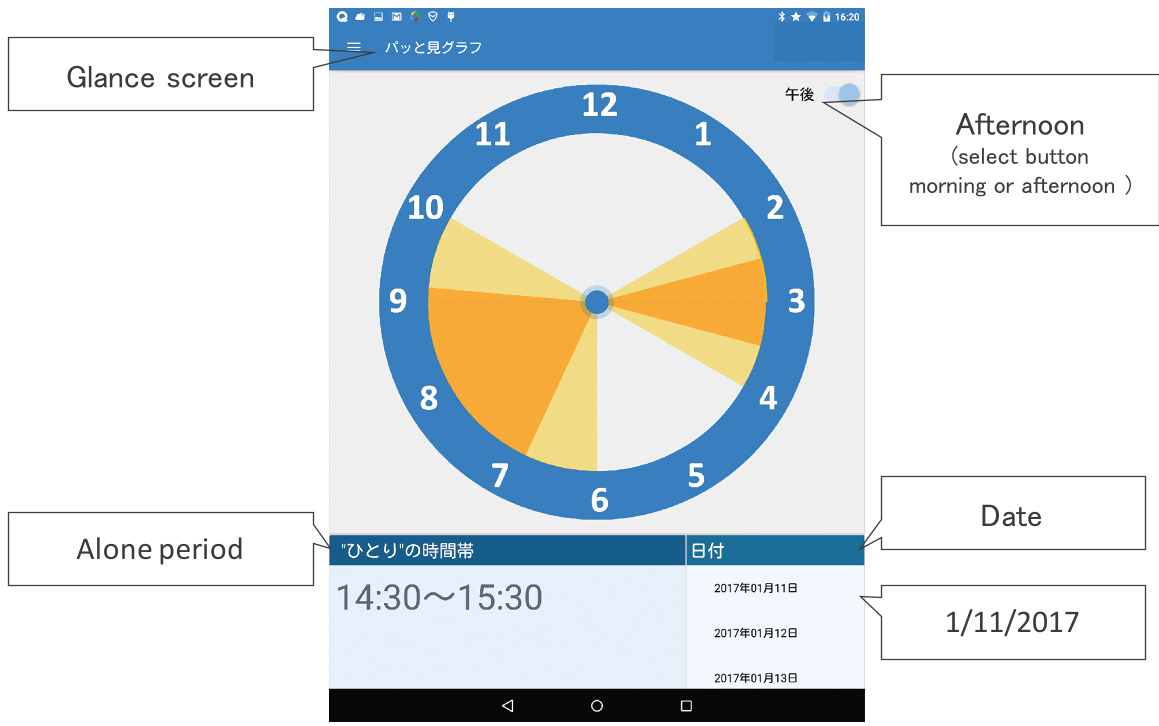
To make this data actionable for busy parents, the mobile app provides two views:
- Glance Screen: A color-coded hourly breakdown of alone periods.
- Detail Screen: A granular look at how many friends were present at any given minute.
Critical Insight & Future Outlook
This research shifts the paradigm of "Crime Prevention" from active surveillance to Social Analysis.
Limitations: Currently, data must be manually transferred via SD card. For a real-world product, a background Wi-Fi or BLE synching mechanism to the parent's phone (upon returning home) is essential.
The Takeaway: By focusing on "Alone Time" rather than "Continuous Lat/Long," we can create safer environments for children using existing, low-cost IoT technologies. Future iterations that refine activity recognition algorithms (e.g., distinguishing between a car ride and a run) could make this an indispensable tool for urban child safety.