
Breaking the Noise Barrier: Tensor-Based FHE for Complex Real-Number Arithmetic
16703_Blend Arithmetic Operations on Tensor-Based Fully Homomorphic Encryption Over Real Numbers.
This paper introduces a novel Tensor-Based Fully Homomorphic Encryption (FHE) scheme designed to support blend arithmetic operations (simultaneous addition and multiplication) over real numbers. Utilizing Kronecker product (KP) laws and a Divide-and-Conquer (DaC) strategy, the method achieves a noise-free encryption status, distinguishing it from traditional lattice-based FHE.
TL;DR
Keke Gai and Meikang Qiu have introduced a breakthrough in Fully Homomorphic Encryption (FHE) that moves away from the "noise-heavy" lattice-based traditions. By treating encryption through the lens of Tensor Theory and Kronecker Products, they have developed a model capable of performing "blended" arithmetic (mixed addition and multiplication) on encrypted real numbers without the cumulative noise that typically plagues ciphertexts.
Motivation: The Efficiency vs. Security Paradox
In the era of IoT and Cloud Computing, data owners often lose control over their information once it reaches a remote server. While FHE has long been promised as the "holy grail" of privacy—allowing servers to process data without seeing it—the implementation has been thwarted by technical obstacles:
- Noise Accumulation: Traditional methods (like Gentry’s) generate "noise" with every operation. Too much noise makes the data undecryptable, necessitating a heavy process called "bootstrapping."
- Arithmetic Rigidity: Most current FHE schemes struggle with complex, mixed-operation polynomials (Blend Operations) on floating-point or real numbers.
The authors' insight is to treat encryption as a matrix transformation using tensor laws, where the structural properties of Kronecker products allow mathematical operations to be mirrored in an encrypted latent space without adding error.
Methodology: The Core Mechanism
The proposed solution, dubbed O-FHE (Optimized FHE), relies on three pillars:
1. The Blend Evaluation (BE) Algorithm
To handle complex equations, the BE algorithm uses a Divide-and-Conquer (DaC) approach. It expands any given polynomial into a simplified set of Basic Terms (BT) and Advance Terms (AT). This "parentheses-stripping" ensures that the cloud only ever has to handle standardized additions and multiplications.
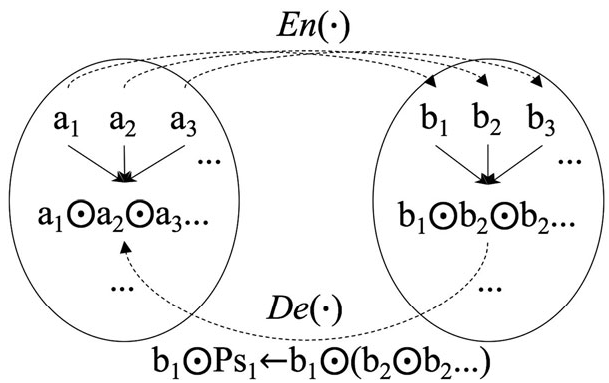
2. Kronecker Product (KP) Transformation
The encryption function is defined as , where is the plaintext and is an encryption matrix. Because of the properties of KPs, multiplying two ciphertexts corresponds to the KP of the underlying plaintexts and their respective matrices.
3. Inverse-Matrix Decryption (IM-HAD & IM-HMD)
Rather than relying on the computationally expensive "Inverse Kronecker" operations, the authors use Inverse Matrices. This optimization allows the data owner to recover the plaintext result by simply applying the inverse of the combined encryption matrices used during the cloud's computation.
Experiments: Real-World Performance
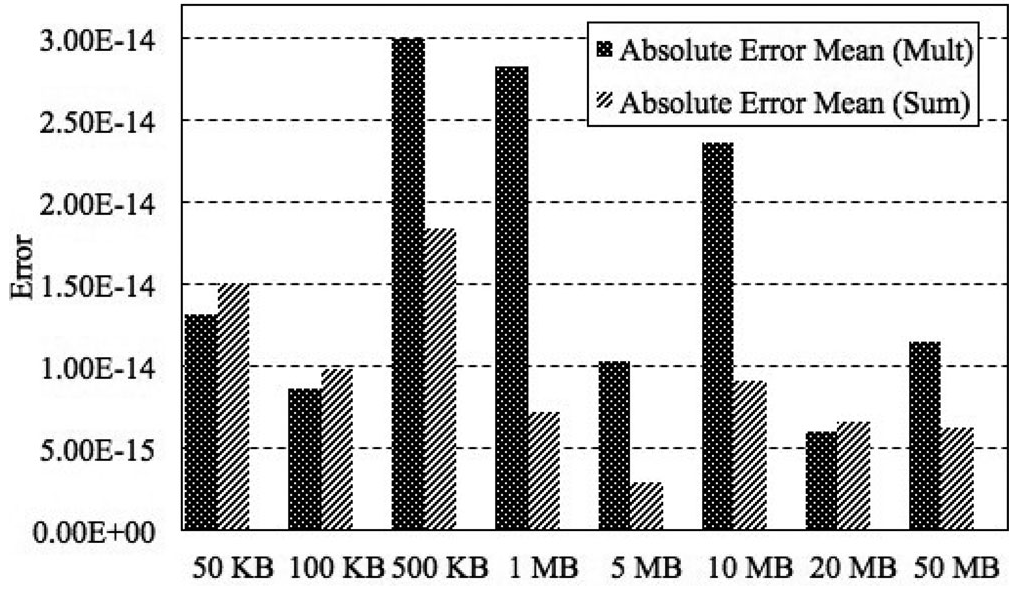
The authors tested their model across various data settings (50KB to 50MB) using MATLAB simulations.
Accuracy and Noise
Unlike lattice-based FHE, which shows increasing error as operations continue, this tensor model is noise-free. The absolute errors remained below , which is effectively bitwise rounding error rather than cryptographic noise.
Complexity Benchmarks
In a head-to-head comparison with established schemes (Gentry, Dijk et al., Brakerski), the tensor-based O-FHE stands out as the only noise-free solution with highly competitive ciphertext expansion rates and secret key complexity ().
| Scheme | Public Key | Secret Key | Noise-Free |
|---|---|---|---|
| O-FHE (Ours) | N/A | O(n⁴) | Yes |
| Gentry [8] | O(n⁷) | O(n³) | No |
| Brakerski [13] | O(n² log² q) | O(n log q) | No |
Critical Insights & Conclusion
The true value of this work lies in its Inductive Bias. By leveraging Matrix Algebra instead of Ideal Lattices, the authors bypass the bootstrapping bottleneck entirely.
Limitations: While highly efficient for linear and polynomial operations, the model still requires the data owner to track the "computation relationship" (the structure of the operations performed) to successfully decrypt. This implies a more synchronized interaction between the client and the cloud compared to traditional "set-and-forget" FHE.
Future Outlook: This approach opens the door for high-speed, privacy-preserving financial modeling and IoT sensor data fusion where real-time performance is critical.