
Blind Chance: Redefining Trust-Based Friend Discovery in Mobile Networks
Blind Chance: On Potential Trust Friends Query in Mobile Social Networks
This paper introduces the Potential-Trust-Friends (PTF) query for Mobile Social Networks (MSNS), aiming to identify the top-k nearby users who satisfy specific keyword demands while maintaining high trust levels. The authors propose a multi-faceted trust scoring model and the CUHR index structure to handle dynamic updates and efficient retrieval.
TL;DR
Finding a trustworthy stranger nearby for a quick task—like sharing a taxi or seeking emergency help—is a complex problem. This paper proposes the Potential-Trust-Friends (PTF) Query, a system that ranks users based on spatial proximity, keyword matching, and a robust trust model. By utilizing a hybrid CUHR index, the system balances the need for real-time location updates with deep historical data analysis.
Background & Positioning
In the landscape of Location-Based Social Networks (LBSN), we have seen plenty of "check-in" apps, but few handle the "stranger trust" problem effectively. Most existing systems either monitor your existing friends or find nearby users based solely on distance. This work carves out a niche in Trust-Aware Spatio-Textual Retrieval, moving beyond simple proximity to include social, interest, and profile-based trust.
The Core Challenge: Why Trust is Hard to Rank
Trust isn't a single number; it's a composite of behavior. The authors identify three gaps in current SOTA methods:
- Social Closeness: Do we share mutual friends?
- Interest Similarity: Do our check-in histories suggest we frequent the same types of places?
- Profile Similarity: Are our demographic or personal attributes aligned?
Processing these factors for thousands of moving users in real-time creates a massive computational bottleneck, necessitating a specialized indexing approach.
Methodology: The CUHR Index & CanGV Framework
To solve the latency problem, the paper introduces the Current Users-Historical Records (CUHR) index. This structure effectively bifurcates the workload:
- CU Index (Memory): A grid-based index for "where are you right now?" It uses a hash table for O(1) user lookups and rapid location updates.
- HR Index (Disk): An adaptive multi-level grid storing "where have you been?" This uses a Grid-Inverted File (GIF) to link keywords to specific spatial cells.
Architecture Overview
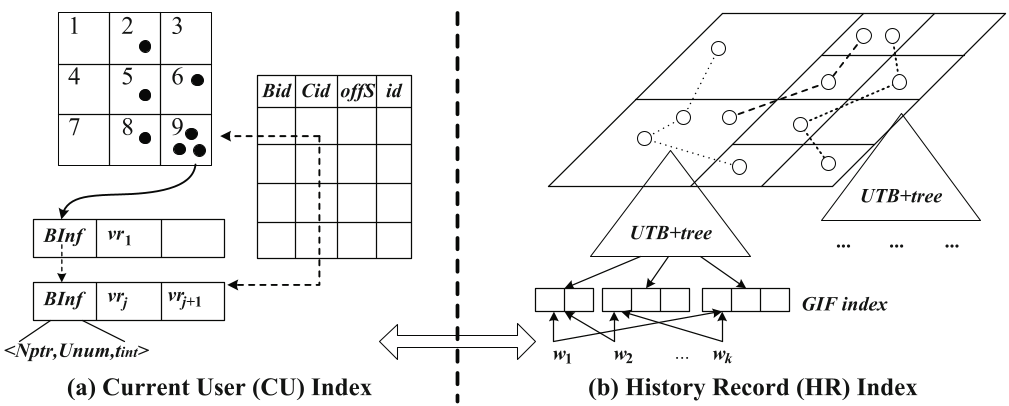
The CanGV (Candidate Generation-and-Verification) algorithm works by:
- Generation: Parallel heaps track the top-k candidates for location, text similarity, and trust.
- Verification: Using an aggregate scoring function, the system calculates an upper bound (
UppB) for partially matching users to prune those who cannot possibly break into the top-k, saving expensive I/O operations.
Experiments & Performance
The researchers used the Gowalla dataset, a gold standard for LBSN research, containing over 6 million check-ins.
Key Findings:
- Accuracy: The baseline "CUFinder" (which only looks at current data) had an accuracy ratio of less than 30% compared to CanGV. This proves that historical data is essential for finding truly "relevant" matches.
- Scalability: While the CanGV response time increases with k, it remains performant even as the number of users grows.
- Update Efficiency: The adaptive grid in HR outperformed the IR-tree in maintenance overhead, making it better suited for the "high-churn" environment of mobile apps.
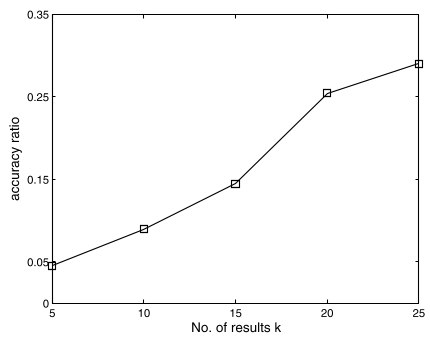 Fig: Trade-off between k-value and response time.
Critical Insight & Future Outlook
The genius of this paper lies in the Trust Scoring Model (Equation 6). By combining Social Closeness, Interest Similarity, and Profile Similarity, the system creates a multi-dimensional "safety score" for potential interactions.
Limitations: The model assumes users are willing to share their full check-in history, which raises significant privacy concerns in today’s regulatory environment (GDPR/CCPA). Future work would likely need to incorporate Differential Privacy or Federated Learning to calculate these trust scores without exposing raw historical trajectory data.
Conclusion
"Blind Chance" successfully turns the accidental proximity of mobile users into meaningful, trust-based connections. For developers of social apps or sharing-economy platforms, the CUHR index provides a blueprint for building high-performance discovery engines that don't sacrifice depth for speed.