
Blind Men and The Elephant: Unifying Pairwise Preferences into Global Rankings
Blind Men and The Elephant: Thurstonian Pairwise Preference for Ranking in Crowdsourcing
This paper introduces Thurstonian Pairwise Preference (TPP), a novel generative model designed to infer ground-truth rankings from crowdsourced pairwise annotations. TPP tackles the scalability and reliability issues of collecting full ranked lists by aggregating simpler pairwise comparisons while accounting for worker expertise and query difficulty.
TL;DR
Inferring a perfect ranked list (like search engine results) from non-expert crowd workers is notoriously difficult. Instead of asking workers to rank everything at once, the Thurstonian Pairwise Preference (TPP) model asks for simple "A vs B" comparisons and uses a sophisticated generative probabilistic framework to reconstruct the "Elephant" (truth) from these "Blind Men" (partial observations), specifically accounting for worker malice and query difficulty.
Problem & Motivation: The Complexity of Ranking
In Information Retrieval (IR), ground-truth rankings are the gold standard. However, asking a crowd worker to rank 30 documents for a single query is a cognitive nightmare. The labeling space is massive, and consensus is rare.
The authors argue that pairwise preferences—comparing just two items—are the atomic, reliable units of human judgment. Yet, aggregating these pairs is hard because:
- Incompleteness: Budget constraints mean we rarely see every possible pair.
- Inconsistency: Workers disagree, and some are "spammers" (random) or "malicious" (intentionally flipping answers).
- Domain Variance: A worker might be an expert in "Sports" but a "Spammer" in "Quantum Physics."
Methodology: The TPP Generative Process
TPP builds on the classic Thurstonian Ranking Model (TRM) but adds layers to handle the nuances of crowdsourcing.
1. Perceived Score Layer
For a query , an item has a ground truth score . A worker perceives a score drawn from a Gaussian distribution centered at the truth, where the variance represents query difficulty.
2. Worker-Aware Layer (The Core Innovation)
TPP introduces a parameter representing worker 's expertise and truthfulness in domain .
- Expert: Large positive .
- Spammer: near zero.
- Malicious: Negative (predicts the worker will intentionally flip the preference).
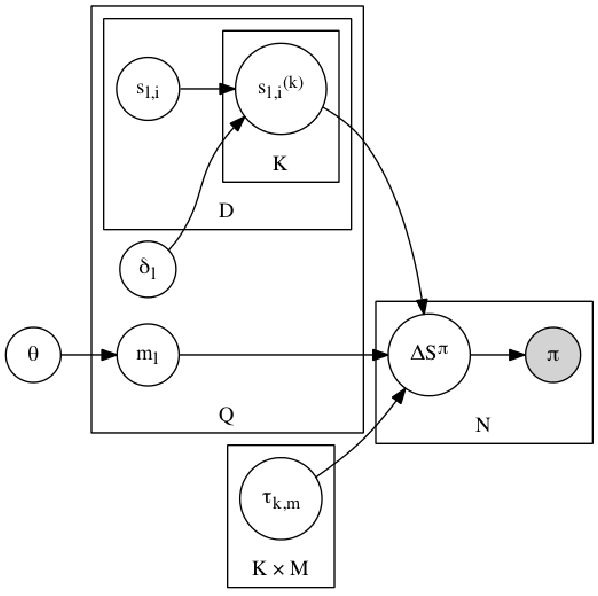 In the plate notation, the model captures the dependency between query difficulty (), latent domains (), and worker characteristics ().
Inference via E-M and Gibbs Sampling
Because the perceived scores and domains are latent variables, the authors use an Expectation-Maximization (E-M) algorithm. To handle the mathematical intractability of the posterior, they implement a Blocked Gibbs Sampler. This allows the model to iteratively "guess" the worker's quality, the query's domain, and the document's true score until they converge.
Experiments & Results
The authors validated TPP against CrowdBT (a Bradley-Terry extension) and BordaCount.
Robustness to Malicious Workers
In synthetic "DEMO 3" scenarios where 30% of workers were malicious, TPP's error (Kendall’s tau) was significantly lower than competitors. It effectively "flipped" the malicious inputs back to their intended meaning by identifying a negative .
Real-World Performance
On the MQ2008-agg dataset, TPP consistently achieved higher NDCG (Normalized Discounted Cumulative Gain) scores. Even with only 20% of the possible pairs (SR=0.2), TPP outperformed standard rank aggregation methods that had access to full lists.
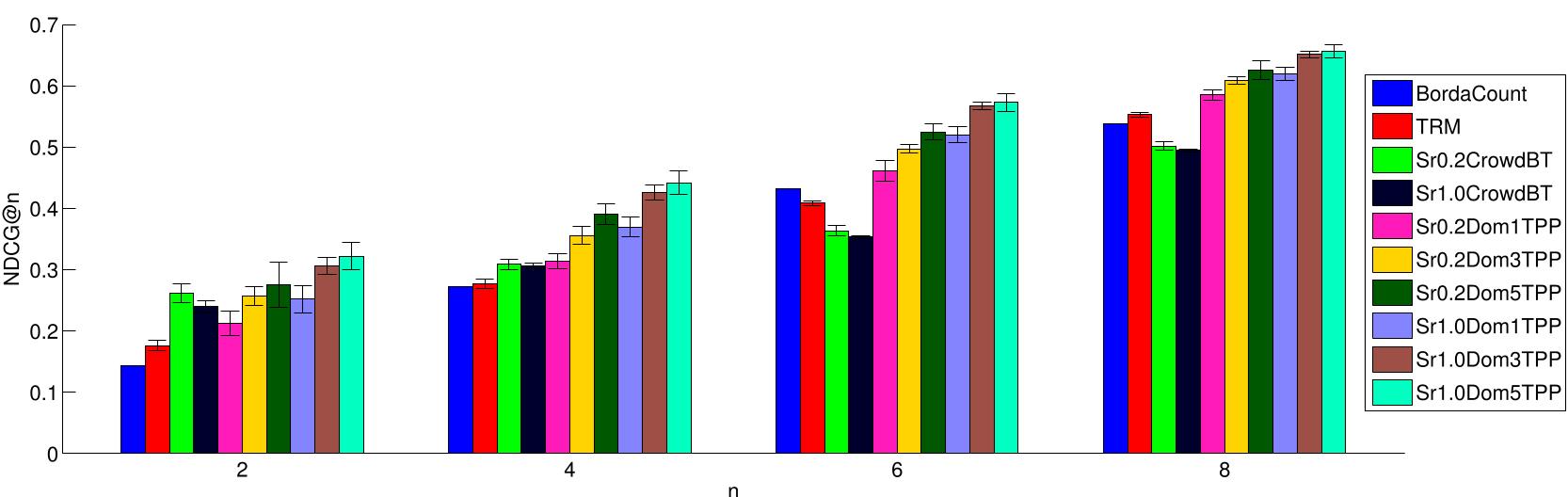 Experimental results showing TPP (with 5 domains) leads the pack in ranking quality across various NDCG depths.
Critical Insight & Conclusion
The "Thurstonian" approach is powerful because it treats the difference in document utility as a continuous latent space. By modeling Query Difficulty and Worker Expertise as separate variance/scale parameters, TPP doesn't just average the crowd's noise—it filters it.
Future Outlook: As we move towards RLHF (Reinforcement Learning from Human Feedback) for LLMs, models like TPP that can identify domain-specific experts amidst a sea of inconsistent labels will be crucial for training the next generation of AI.
Limitations
- Computational Cost: The Gibbs Sampling can be slow for very large query sets.
- Cold Start: Estimating requires a minimum number of judgments per worker per domain.