
Blind Participation in a Visual World: How SNS Accessibility Shapes Social Connection
How Blind People Interact with Visual Content on Social Networking Services
This paper explores how blind individuals interact with visual content on Social Networking Services (SNSs). Through a mixed-methods approach (11 interviews and 60 surveys), the authors identify the motivations, accessibility hurdles, and creative workarounds used by blind users to engage with media-heavy platforms like Facebook, Twitter, and LinkedIn.
TL;DR
Social Networking Services (SNSs) are increasingly dominated by images, but how do those who cannot see them participate? This research dives into the "creative workarounds" blind users employ to navigate Facebook and Twitter. It reveals that while blind users share the same social motivations as sighted peers, they operate in a state of information asymmetry, relying on digital "detective work" to understand the visual world around them.
The Problem: The Visual Wall
In the early days of the web, text was king. Today, the "visual turn" in social media—driven by infinite feeds of photos, memes, and stickers—has built a digital wall for the blind.
The researchers found that existing accessibility standards (like WCAG) are often bypassed in the rush to release new features. Blind users aren't just missing "alt-text"; they are missing the social context of visual interactions. When a friend posts a selfie and everyone comments "You look great!", a blind user might know who is in the photo via tags, but they cannot judge the aesthetics or the "vibe" that triggered the reaction.
Methodology: Listening to the Users
The team utilized a two-pronged qualitative approach:
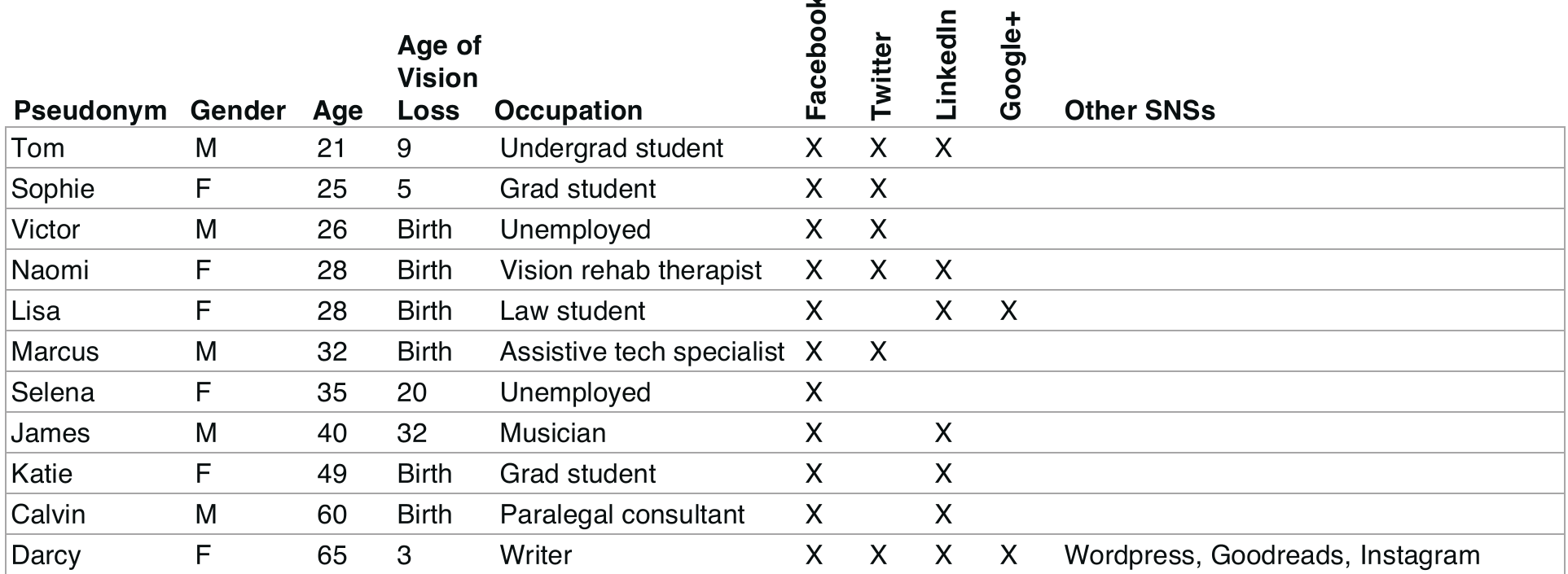
- Survey (n=60): Captured high-level patterns of SNS usage across platforms like Facebook (100% usage), LinkedIn (60%), and Twitter (60%).
- Interviews (n=11): Provided deep dives into the emotional and technical strategies of "power users" with little to no functional vision.
Methodology & Core Insights: The "Social Detective"
The most fascinating discovery is how blind users act as "detectives." To interpret a photo without a description, they triangulate data:
- Geo-tags: "If they are tagged in Mexico, this must be a vacation photo."
- Comments: By reading what others wrote (e.g., "Nice haircut!"), they infer the content.
- The "Safe Like": One participant noted that if a photo has over 100 likes, it is "safe" to like it even without knowing what it is, as a way of maintaining the social bond.
Creative Workarounds
Participants frequently used the mobile version (m.facebook.com) on a desktop browser. Why? Because it is leaner, lacks the "clutter" of the main site, and is more predictable for screen readers like JAWS or VoiceOver. However, this comes at a cost: a "discounted" experience with fewer features.
Results: Facing the Social Stakes
Posting a photo is a high-stakes social act for a blind person. The fear of posting a blurry, off-center, or "unattractive" image is a major deterrent.
- Trust Delegation: Blind users often wait for a sighted "trusted partner" (spouse or close friend) to help them select and edit photos before posting.
- Self-Censorship: Many avoid certain apps entirely (like Instagram or Google+) because the "cost" of navigating the interface—only to find unreadable content—is too high.
Critical Analysis & Conclusion
The Long Journey Ahead
The paper argues that we must move beyond the "separate-but-equal" approach of text-only versions. While AI (OCR) and computer vision are starting to help (e.g., Facebook’s automatic alt-text), they often miss the emotional nuance.
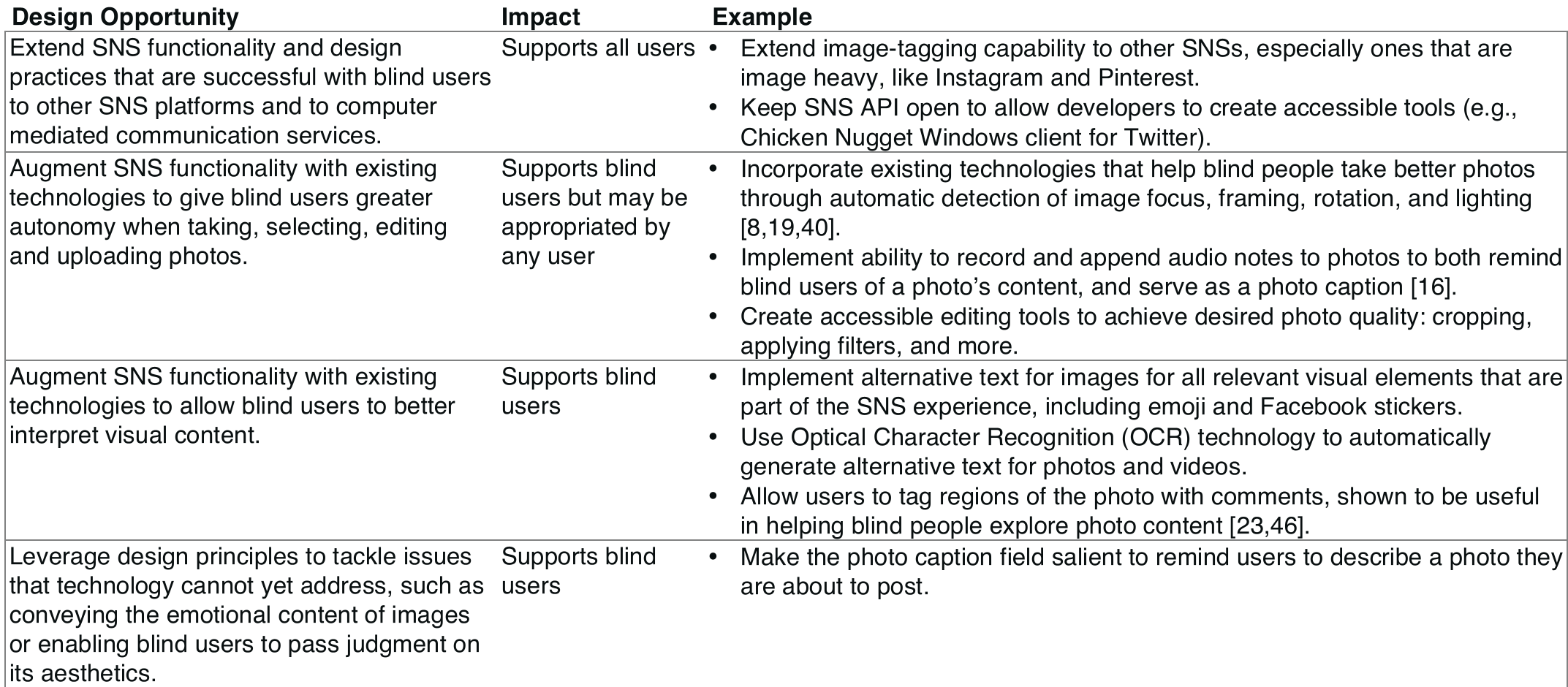
Key Design Implications:
- Autonomy Tools: Integrating photo-aiming assistants (haptic feedback) directly into SNS apps.
- Social Reminders: Making the caption field highly salient to remind sighted users that "alt-text" is a social courtesy, not just a technical requirement.
- Unified Experience: Moving toward a single, universally accessible interface rather than specialized "accessible" versions that eventually lag behind in features.
Final Takeaway: Accessibility on social media isn't just about reading a screen; it’s about social symmetry. When we design for the blind, we aren't just fixing a bug; we are ensuring that the digital town square remains open to everyone.