
Unmixing the Malicious: Using Blind Source Separation for Accurate Malware Classification
POSTER: Blind Separation of Benign and Malicious Events to Enable Accurate Malware Family Classification
The paper introduces a novel framework for malware family classification that utilizes Independent Component Analysis (ICA) to decouple malicious network signals from benign background noise. By treating network traffic as a multivariate signal, the authors achieve high-accuracy labeling using a Blind Source Separation (BSS) approach before feeding "clean" features into a Random Forest classifier.
TL;DR
In the world of network security, malware rarely operates in a vacuum. Its communication is often buried under a mountain of legitimate background traffic—a phenomenon sometimes weaponized via "behavior poisoning." This paper introduces a clever fix: using Independent Component Analysis (ICA) to "blindly" separate malicious signals from benign noise, boosting classification accuracy to over 98% for specific malware families like Shady RAT.
The "Cocktail Party Problem" in Network Security
Modern malware classification typically relies on dynamic analysis—observing what a virus does rather than what it looks like. However, when we monitor an infected host, we don't just see the malware's heartbeats; we also see OS updates, web browsing, and background services.
The authors argue that existing ML models fail because they attempt to learn from "mixed" features. If a malware family's signature is a specific frequency of HTTP POST requests, but the user is also browsing a heavy site, the resulting feature vector is distorted. This is fundamentally a version of the Cocktail Party Problem: how do you hear one voice in a crowded room?
Methodology: ICA as the Ultimate Filter
The core insight of this paper is treating network traffic features (n-grams of network events) as signals that can be decomposed.
1. Feature Representation
The authors convert PCAP traces into "words" representing network events (e.g., an outbound UDP packet to port 53 becomes A0A2A5). They then generate n-grams (sequences of 1 to 5 events) to capture the temporal behavior of both malware and background noise.
2. The ICA Decomposer
The system assumes that malware traffic () and background traffic () are statistically independent and non-Gaussian. Using FastICA, the framework calculates an "unmixing matrix" to recover the latent malware distribution from the observed mixed traffic.
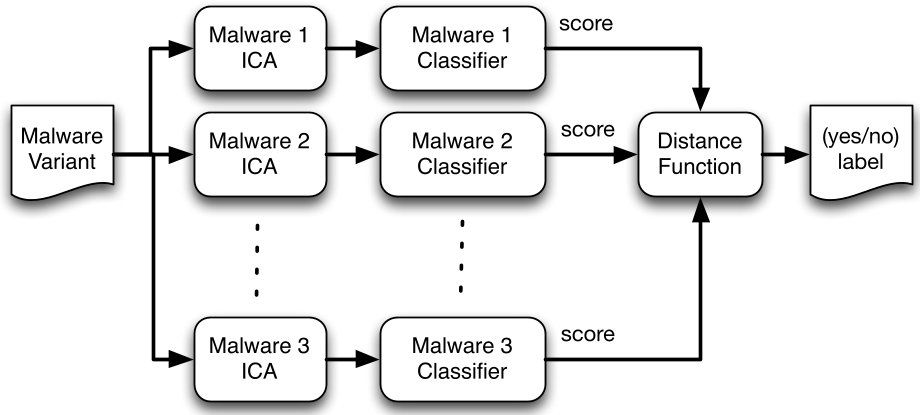 Figure 1: The two-stage labeling process: Signal decomposition followed by Random Forest classification.
3. Classification
Once the signal is "cleaned," it is fed into a Random Forest classifier. Because the classifier now sees the "pure" malware signature, the decision boundaries become much clearer.
Does it actually work?
Experimental results on the Darkness (DDoS focused) and Shady RAT (targeted APT) families show a remarkable recovery of the original signal.
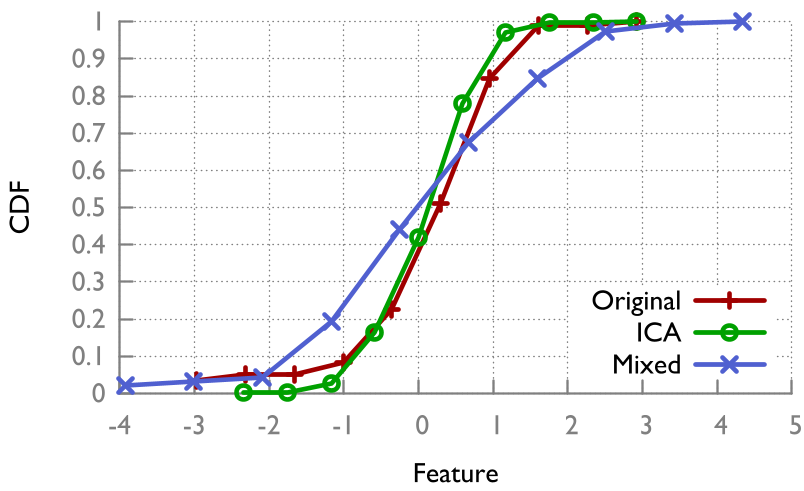 Figure 2: Note how the 'ICA' distribution (Red) almost perfectly recovers the 'Original' malware distribution (Blue) from the distorted 'Mixed' signal (Green).
Performance Metrics:
| Malware Family | Accuracy | Precision | F1 Score |
|---|---|---|---|
| Darkness | 94.3% | 97.1% | 0.924 |
| Shady RAT | 98.1% | 98.3% | 0.976 |
The system significantly outperforms previous methods that didn't account for background noise, especially in complex environments where the background traffic is volatile.
Critical Insight: The Gaussian Limitation
As a PhD-level analysis, it is important to note the ICA assumptions. ICA relies on the "Non-normality" (non-Gaussianity) of the signals. The authors correctly identified that while many natural phenomena are Gaussian, malware network bursts and specific application protocols usually aren't.
However, if a sophisticated attacker were to shape their traffic to follow a strictly Normal (Gaussian) distribution, or if their behavior was strictly dependent on the host's background traffic (e.g., only triggering when the user browses a certain site), the ICA decomposition would theoretically fail.
Conclusion & Future Outlook
This paper effectively bridges the gap between digital signal processing and cybersecurity. By moving away from "black-box" ML that attempts to learn noise, and moving toward a "clean-then-classify" architecture, the authors provide a template for more resilient IDS (Intrusion Detection Systems).
Future Directions:
- Extending this to encrypted traffic where n-gram analysis might be limited to metadata like packet sizes and timing.
- Implementing a "skipping factor" in n-grams to handle jitter and packet loss more gracefully.