
Blind Spots: Why Your Best Friends Might Be Missing from Your Social Feed
Blind Spots: Unveiling users' true willingness in online social networks
This paper introduces the "Blind Spot" problem in Online Social Networks (OSNs) and proposes a novel detection scheme. It identifies "Blind Spots" — undervalued contacts who are important in the physical world but lack sufficient online interaction data — by contradicting explicit interaction history with implicit social circle inferences.
TL;DR
Social algorithms often ignore the people you care about most simply because you talk to them in the "real world" instead of clicking "Like" on their posts. This paper identifies this phenomenon as the Blind Spot problem. By combining interaction history (explicit) with social circle clustering (implicit), the authors provide a way to "detect the silence" and bubble up high-value content that traditional algorithms miss.
The Motivation: The Fallacy of Explicit Interaction
Most modern social platforms—from Facebook’s EdgeRank to Twitter’s relevance scores—operate on a simple assumption: Interaction implies interest.
However, this creates a massive technical bias. If you work in the same office as a colleague or live with a partner, you likely discuss their news face-to-face. Because you don't "interact" with their digital profile, the algorithm assumes they are irrelevant. These are Blind Spots: contacts with high physical-world importance but low online visibility.
Methodology: Detecting Contradictions
The researchers propose a dual-track system to identify these hidden gems.
1. Explicit Willingness (The "What you Do")
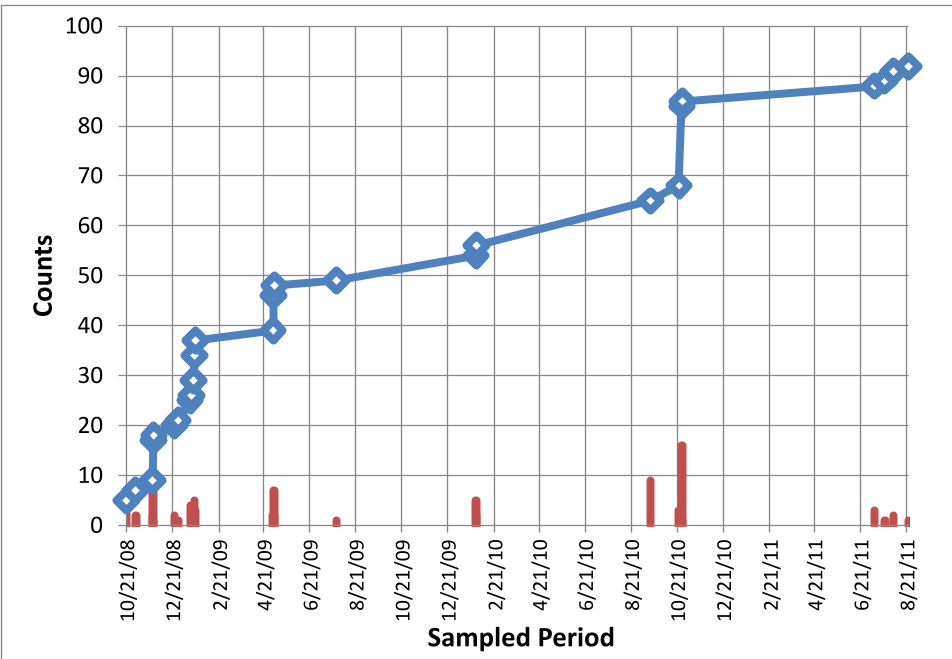
Instead of just counting "likes," the authors use Inflection Points. These are periods of high-frequency interaction. They calculate a willingness score () by looking at the amplitude of these peaks and how recently they occurred.
2. Implicit Inference (The "Who you Know")
Since explicit data is sparse, the system looks at the Social Space. By mapping contacts based on mutual friends and using K-means clustering, the algorithm automatically groups users into "Social Circles" (e.g., family, high school friends, coworkers).
3. The Conflict Detection
The breakthrough logic is simple: People in the same social circle should generally have similar importance to the user. If a user is in a "High Importance" circle (like "Close Friends") but has a very low explicit interaction score, the system flags them as a Blind Spot.
Experiments and Results
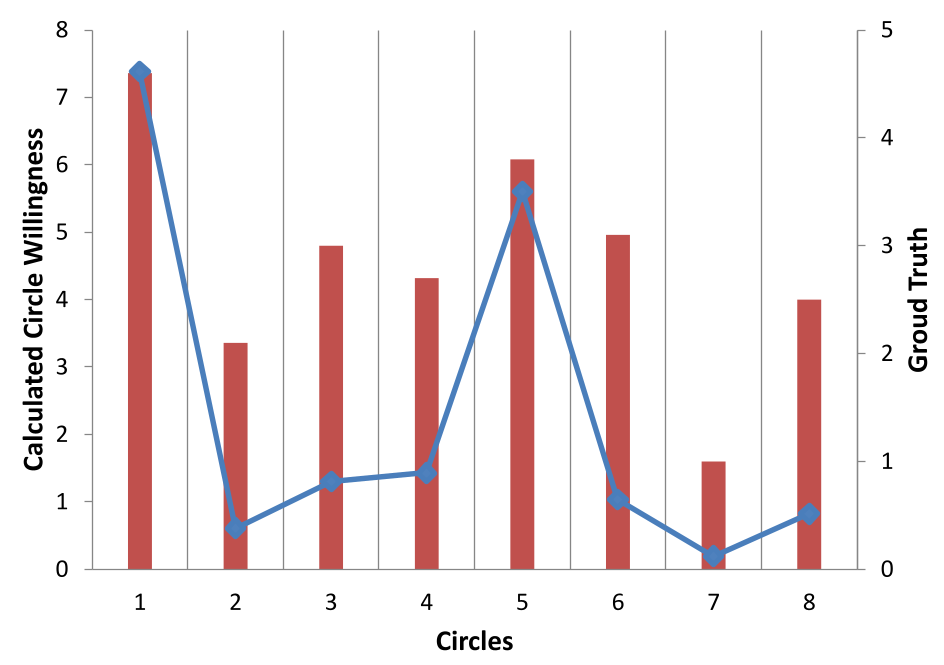
The authors tested this on Renren.com (often called the Facebook of China). By analyzing 8 distinct social circles, they found that:
- Willingness Stability: Within a circle, users generally shared very similar interaction patterns (Volatility Ratio < 20%), confirming that circles are a reliable anchor for importance.
- Finding the Missing: In "hot" circles (circles with high overall interaction), the system reliably found users who were personally rated as "very important" (ground truth ~4.5/5) despite having low digital engagement.
Critical Insights & Future Outlook
The "Blind Spot" problem is a quintessential example of the Cyber-Physical Gap.
Strengths: This method doesn't require users to manually create "Close Friend" lists—a task most users find tedious. It effectively uses the structure of the network to correct for missing behavior.
Limitations: The study is currently limited by its reliance on mutual friends as the primary clustering index. In extremely sparse networks where even mutual friend data is hidden, this approach might struggle.
The Takeaway: For the next generation of AI-driven social feeds, the goal isn't just to track what a user does, but to understand the context of what they aren't doing. By leveraging social circles, we can finally bridge the gap between our digital footprints and our real-world relationships.