
Blindfolded Random Forests: Solving the Multi-Owner Privacy Puzzle in MLaaS
Blindfolded Evaluation of Random Forests with Multi-Key Homomorphic Encryption.
This paper introduces a privacy-preserving protocol for evaluating Random Forests in an outsourced multi-owner setting using Multi-Key Homomorphic Encryption (MKHE). The core method combines BGV-based somewhat homomorphic encryption with a novel secure comparison (SecComp) and counting (SecCount) protocol to achieve non-interactive, collaborative classification.
TL;DR
Researchers have developed a new framework that allows multiple organizations (like different hospitals) to outsource their encrypted Random Forest models to a cloud provider. The cloud can then process a client's encrypted query against all these models and return an aggregated result—all without the cloud, the owners, or the client ever seeing each other's raw data. By introducing a non-interactive comparison protocol (SecComp), they've slashed communication rounds and boosted speed by up to 7x.
Context: The Multi-Party Bottleneck
In the world of Privacy-Preserving Machine Learning (PPML), Decision Trees are a "bread and butter" algorithm. However, moving from a single-server model to a collaborative, outsourced environment has historically been a nightmare.
Previous SOTA methods (like DGK-based protocols) suffered from two fatal flaws:
- Interactivity: The server had to ask the client for help every time it reached a decision node ("Is this value greater than that one?").
- Key Management: They weren't designed for "Multi-Key" scenarios. If three different clinics provide models, standard HE requires complex workarounds that either leak intermediate results or explode in computational cost.
Methodology: The "Blindfolded" Architecture
The authors tackle these issues through three major technical innovations:
1. Non-Interactive SecComp
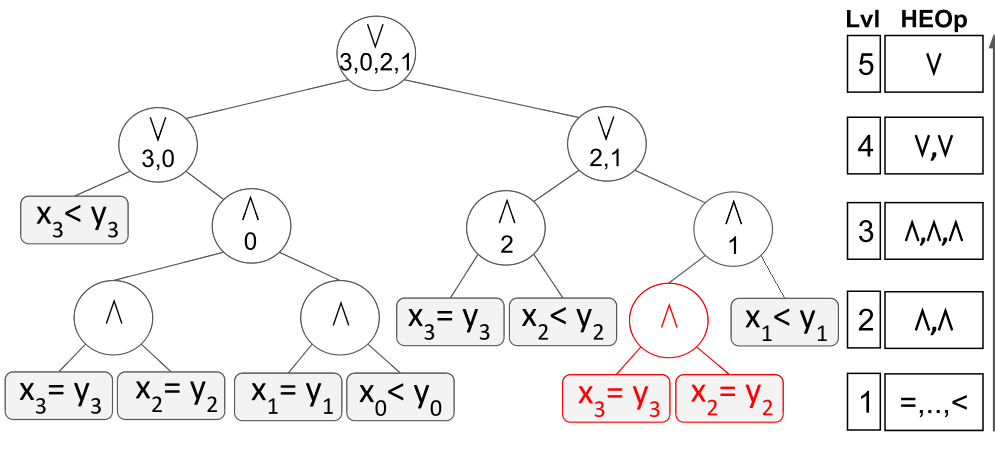
Instead of generating intermediate values that require decryption, the new SecComp protocol computes a boolean circuit homomorphically to produce a single encrypted bit.
- The Intuition: By translating comparison logic into a binary evaluation tree, the evaluator can process levels in parallel.
- The Benefit: It eliminates the "back-and-forth" between the cloud and the client, reducing round complexity to a constant.
2. Hybrid & Multi-Key HE (MKHE)
Standard MKHE ciphertexts grow linearly with the number of keys. To fix this, the authors used a Threshold HE + MKHE hybrid. Model owners create a single joint "Threshold" key for their models. At evaluation time, the cloud only has to handle two keys: the Client's and the Owners' Joint Key.
- Efficiency Hack: They use AES to encrypt data during transit and then "homomorphically decrypt" it into BGV ciphertexts once it reaches the cloud, significantly saving bandwidth.
3. Secure Counting (SecCount)
Ensemble methods like Random Forests require a "majority vote." The paper introduces SecCount, which matches encrypted classification results against a pool of unique labels and sums them using encrypted binary full-adders. This allows for multi-class classification rather than just binary outputs.
Performance Benchmarks
The team tested their prototype on real-world UCI datasets (Heart Disease, Breast Cancer).
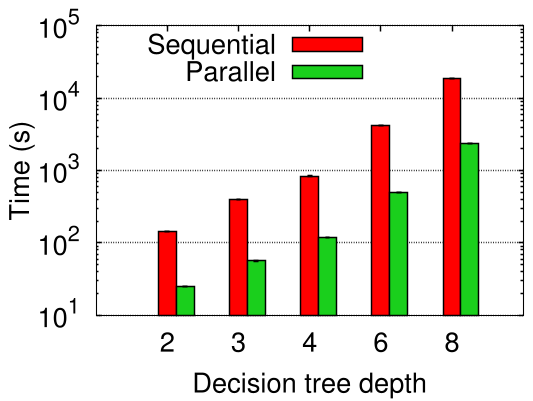
- Scalability: In a Random Forest with 15 trees, parallel evaluation reduced processing time from ~6532 seconds to ~1420 seconds (HD dataset).
- Optimization Comparison: Their "in-pairs" polynomial evaluation outperformed standard sequential multiplication by nearly 12x as tree depth increased.
Critical Insight: Why This Matters
The real breakthrough here isn't just "faster encryption." It's the structural shift from a synchronous, interactive task to an asynchronous, parallelizable one. By removing the client from the "decision loop," the protocol becomes robust against timing attacks and network latency—the two biggest killers of real-world secure computation.
Limitations & Future Work
While the speedup is impressive, 1400 seconds for an inference task is still "offline" speed. The authors suggest moving toward CKKS (Approximate Number HE) to handle floating-point numbers, which could further optimize the mathematical operations required for higher-dimensional feature vectors.
Conclusion
This research moves us closer to a "Blindfolded" Cloud—a world where sensitive data can be computed on freely without ever being exposed, bridging the gap between rigorous data privacy (GDPR/HIPAA) and the power of collaborative AI.