
Block-Based Partitioning: Rethinking Graph Distribution for Random Walks
A Block-Based Edge Partitioning for Random Walks Algorithms over Large Social Graphs
This paper introduces a specialized block-based edge partitioning strategy for Fully Multiple Random Walks (FMRWs) on large-scale social graphs. The method utilizes a vertex-cut approach labeled "block-partitioning" which leverages graph topological properties and local communities to outperform generic partitioning methods like GraphX and PowerGraph.
TL;DR
Existing graph partitioning strategies are often "blind" to the specific algorithms running on them. This paper proposes a topology-aware edge partitioning method designed specifically for Random Walks. By identifying local "communities" (blocks) and keeping them together, the authors achieved up to an 84% reduction in communication traffic and slashed execution times by more than half compared to industry standards like GraphX.
The Motivation: Why Generic Partitioning Fails
Large social networks are notorious for their power-law degree distribution—a few "celebrity" nodes have millions of connections, while most have few.
- Edge-cut (Vertex Partitioning): Fails because cutting a high-degree node's edges across partitions creates massive imbalance.
- Vertex-cut (Edge Partitioning): Popularized by PowerGraph and GraphX, this divides edges. However, their strategies (Hashing or Greedy) are generic. They don't account for the fact that in algorithms like Personalized PageRank or FMRW, a walker tends to stay within a local cluster.
The authors argue that if we don't consider this Local Access Pattern (LAP), we move data across the network unnecessarily.
Methodology: Mining Communities via Seeds
The core innovation is building Blocks—tightly knit edge clusters—before distributing them to servers.
1. Seed Selection & Connectivity
Instead of random assignment, the system picks "Seeds" (central nodes). For every edge , it calculates a Connectivity Score based on path reachability. The intuition is: if a random walk starting at a seed is likely to hit this edge, the edge belongs in that seed's block.
2. The Scaling Secret: Split & Merge
Since blocks are based on topology, they aren't naturally even in size. The authors introduce:
- Block Split: High-density communities are subdivided using sub-seeds.
- Block Merge: Small, isolated fragments are combined to meet the minimum server workload requirements.
Experimental Evidence: Crushing the Baselines
The authors integrated their logic into Spark GraphX and tested it against standard hash-based and greedy methods.
The VRF Metric
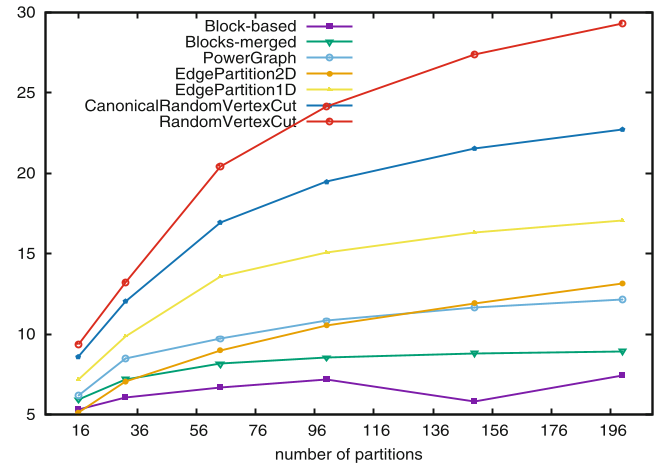
The Vertex Replication Factor (VRF) measures how many times a vertex must be "mirrored" across servers. A lower VRF means less synchronization. As shown below, the block-based approach achieves a significantly lower VRF than both PowerGraph (Greedy) and GraphX (Random).
Real-World Performance
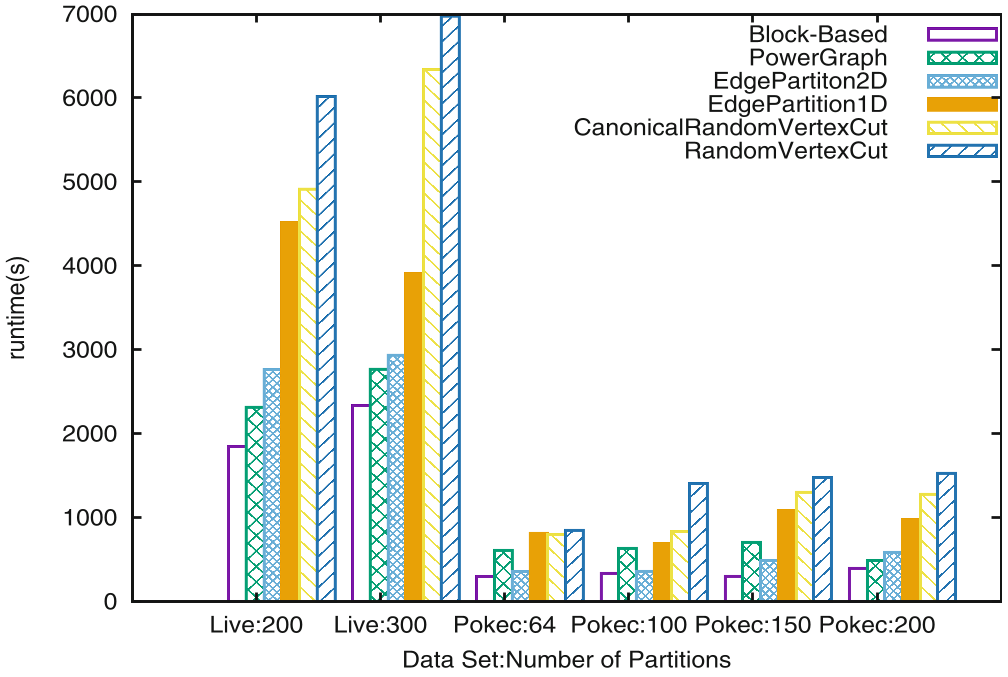
When running Fully Multiple Random Walks (FMRWs), the results were even more dramatic. While the VRF was 4x lower than Random-Vertex-Cut, the actual message count dropped by over 80%. This proves their hypothesis: random walks stay local, and by keeping those localities on the same server, network I/O is virtually eliminated.
Critical Insight: Beyond Static Graphs
One of the most impressive features of this work is its handling of dynamic graphs. Because edge assignment is based on connectivity vectors, when a new "friendship" (edge) is added to a social network, the system can calculate its score and assign it to the correct block incrementally without reshuffling the entire graph.
Conclusion & Future Work
This paper shifts the paradigm from "how to balance the graph" to "how to balance the computation". By aligning the data layout with the movement of random walkers, the authors have provided a blueprint for high-performance social graph analytics. Future improvements might involve more sophisticated seed selection to handle the 5-10% of "outlier" nodes that live on the periphery of the social web.
Key Takeaway: If your graph algorithm has a "Local Access Pattern," stop using Hash Partitioning. Look at your topology, find your communities, and let the walkers stay home.