
Decentralized Social Privacy: High-Efficiency ACL via Ethereum Smart Contracts
Blockchain-based access control management for Decentralized Online Social Networks
The paper introduces a manageable and auditable access control framework for Decentralized Online Social Networks (DOSNs) leveraging the Ethereum blockchain. By utilizing Access Control Lists (ACL) within smart contracts, it provides a trustworthy mechanism to manage privacy policies while ensuring context-aware (time and location) data protection.
Executive Summary
TL;DR: This paper tackles the "privacy vs. decentralization" paradox in Online Social Networks. By implementing an Access Control List (ACL) framework directly on the Ethereum blockchain, the authors provide an auditable, user-driven system that manages permissions without relying on a central provider. The core breakthrough is a multi-contract architecture that outperforms contemporary Attribute-Based models by over 4.5x in gas efficiency.
Strategic Position: This work moves beyond the "Blockchain as storage" trope and positions the ledger as an immutable Policy Enforcement Point (PEP). It is a refinement of DOSN theory, focusing on the practical cost-utility trade-offs of on-chain governance.
Problem & Motivation: The Churn and Transparency Gap
Existing Decentralized Online Social Networks (DOSNs) like Diaspora or Mastodon have moved away from central silos but struggle with node churn—if the peer holding your "privacy settings" goes offline, your data becomes either inaccessible or unprotected.
Conversely, early blockchain social networks (like Steemit) often store data publicly on the ledger, which is a privacy nightmare. The researchers identified a need for a system where:
- Ownership is absolute: Users (Resource Owners) define who sees what.
- Policies are persistent: Access rules aren't lost when a node drops.
- Audits are possible: Malicious behavior is recorded and punished automatically.
Methodology: The Smart Contract Ecosystem
The framework moves away from the "One-Size-Fits-All" contract. Instead, it utilizes a modular 4-part system to manage the lifecycle of a social interaction:
- Access Control Contract (ACC): The heart of the system. It stores the ACL (Subject, Resource, Action, Location, Time).
- Reputation & Inspector Contracts: These act as the "DeFi-Equivalent" of a credit score, tracking repeated access violations or location spoofing to punish malicious actors via "Timeouts."
- Registrar Contract (RegC): A discovery service that allows trusted nodes to find a user's specific policy logic.
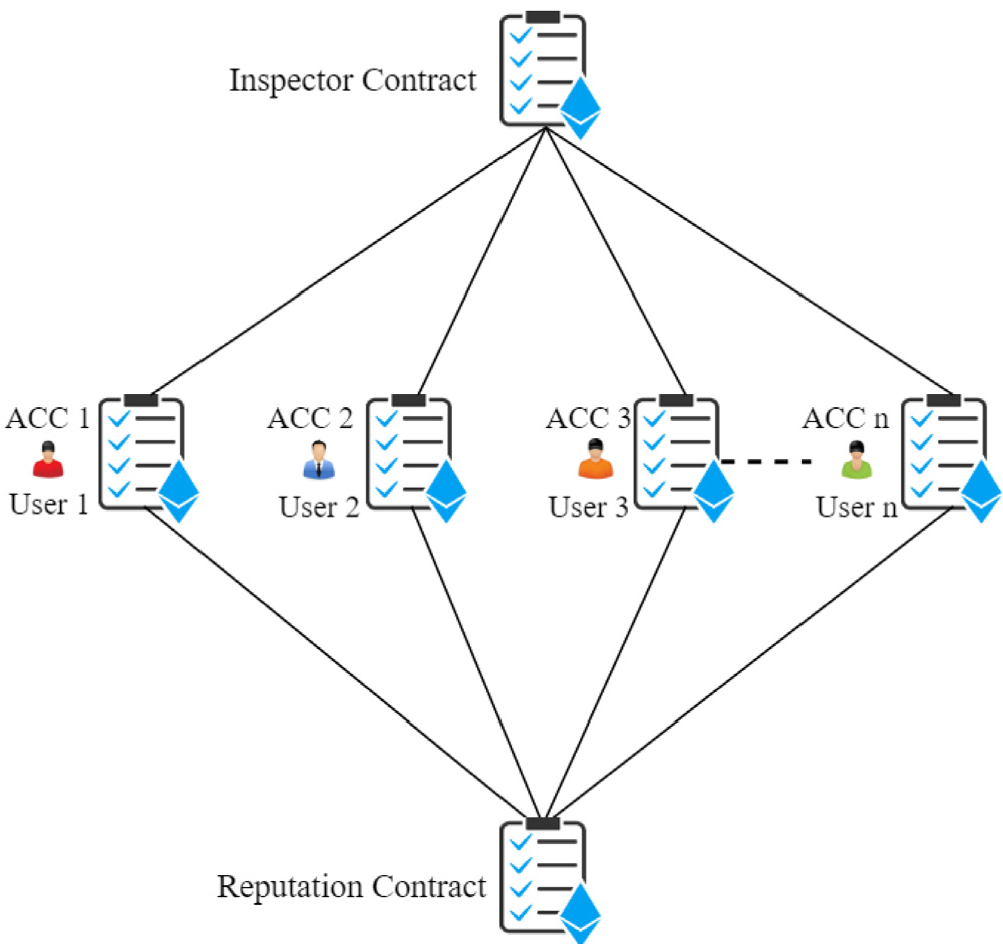
The Secret Sauce: Context-Awareness Unlike simple "Yes/No" permissions, this model includes Location and Time Range fields. The ACC interacts with an Oracle to verify if a user's physical presence matches the policy, preventing "remote" data breaches.
Experiments & Results: Efficiency is King
The researchers deployed their contracts on the Rinkeby Ethereum Testnet. In the world of blockchain, complexity equals cost (Gas).
Key Metrics:
- ACL Evaluation Cost: 61,648 Gas ($0.0117 USD at time of study).
- ABAC (Competitor) Cost: ~280,000 Gas.
- Scalability: The system supports batching, allowing a Resource Owner to grant permissions to 14 friends in a single transaction.
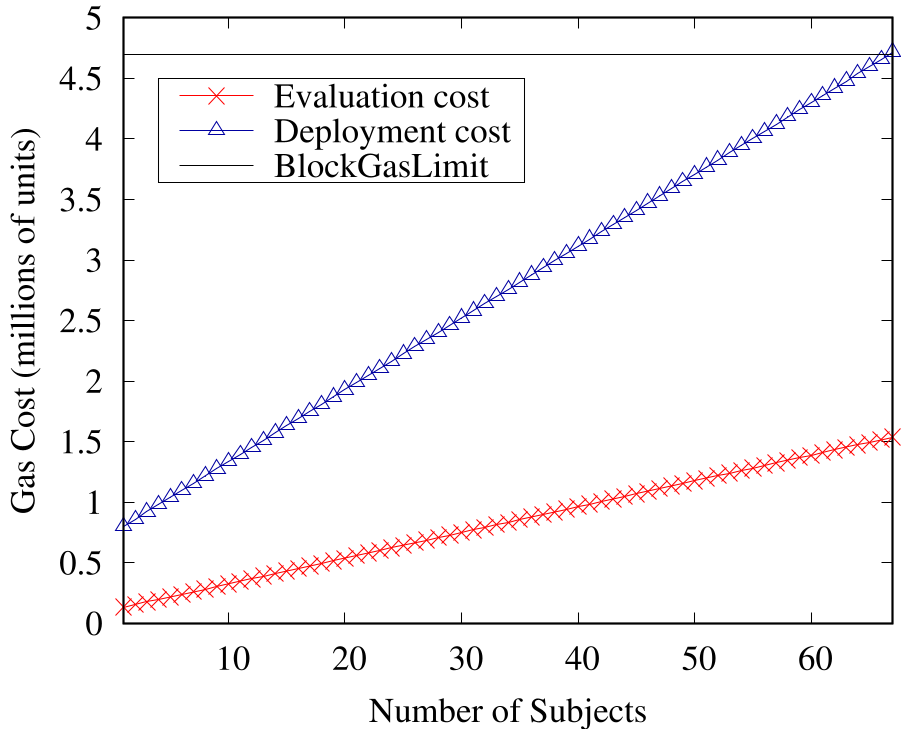
The Reputation Contract proved remarkably robust, capable of processing ratings for 66 subjects simultaneously before hitting the Ethereum BlockGasLimit.
Critical Analysis & Conclusion
Takeaway
The paper successfully demonstrates that on-chain ACLs are a viable path for DOSNs. By formalizing "misbehavior" (like recurrent spam requests) into a codified Reputation Score, social networks can finally automate trust without a "Big Brother" moderator.
Limitations
- The Oracle Problem: The reliance on an external Oracle for location data introduces a point of trust that contradicts pure decentralization.
- The 14-Subject Ceiling: The limitation to 14 subjects per transaction suggests that for "Public" or "Large Group" posts, this model might require off-chain aggregation or Layer-2 scaling solutions (like Arbitrum or ZK-Rollups) to be truly practical for millions of users.
Future Outlook
This framework lays the groundwork for "Programmatic Socializing," where privacy isn't just a setting, but a smart contract that evolves based on the behavior of your social circle.