
Blockchain meets SIoT: Re-Engineering Trust through Social Geometry and Information Entropy
Blockchain-based Trust Management in Social Internet of Things
This paper proposes a decentralized trust management system for the Social Internet of Things (SIoT) by integrating Ethereum blockchain with Edge/Fog computing. The core methodology combines multi-dimensional trust metrics—reputation, cooperativeness, and community interest—with information entropy to achieve a secure and scalable SOTA trust evaluation framework.
TL;DR
The Social Internet of Things (SIoT) envisions a world where devices aren't just connected; they have "friends" and "communities." However, managing trust in these autonomous networks is a nightmare of centralized vulnerabilities and malicious feedback. This paper introduces a Blockchain-based Trust Management System that uses Information Entropy to filter out lies and Social Metrics to verify relationships, successfully detecting nearly 100% of malicious actors in simulated environments.
Background: The Shift from IoT to SIoT
We are moving beyond simple sensor-to-cloud connections. In SIoT, devices establish relationships based on their owners' social circles. While this adds a layer of "human" logic to device interactions, it also opens the door to social-based attacks. Centralized clouds are no longer sufficient—they are targets for "Storage Attacks" and lack the transparency needed for global trust.
The Core Insight: Why Entropy Matters
The most significant challenge in trust management is the Bad-Mouthing Attack (lying to ruin a node's reputation). The authors' "secret sauce" is the application of Information Entropy.
Instead of assigning static weights to feedback (which attackers can easily game), the system calculates the "disorder" of a node's feedback. If a node provides consistently useful and high-quality data, its weight in the global reputation calculation increases. This dynamic weighting makes the cost of a successful attack prohibitively high for adversaries.
Methodology: The Three Pillars of Trust
The framework evaluates trust as a three-dimensional tuple:
- Reputation (): A blend of direct experience and indirect feedback (Entropy-weighted).
- Cooperativeness (): Using Jaccard Similarity to see if two devices share the same "friends" in the network.
- Community-Interest (): Evaluating if the edge nodes (Fog nodes) they belong to have established business or social relationships.
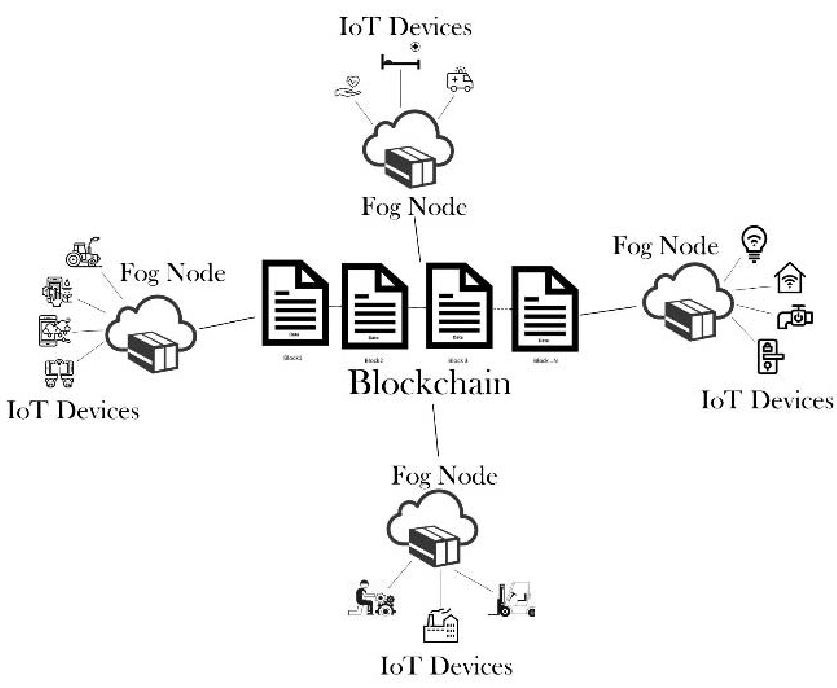 Figure 1: The decentralized architecture leveraging Ethereum Smart Contracts at the Fog layer.
Experimental Validation
The authors implemented a proof-of-concept using Solidity on a private Ethereum blockchain. They tested the system against varying percentages of malicious nodes (up to 30%).
Key Findings:
- Convergence: With a reputation threshold of 0.8, the system effectively neutralized malicious nodes after approximately 1,000 transactions.
- The Power of Indirect Knowledge: One of the most interesting findings was that relying more on Indirect Experience (80%) actually led to faster convergence than focusing on direct interaction. This proves that in a blockchain environment, the "collective wisdom" of the network, when filtered through entropy, is more reliable than individual experience.
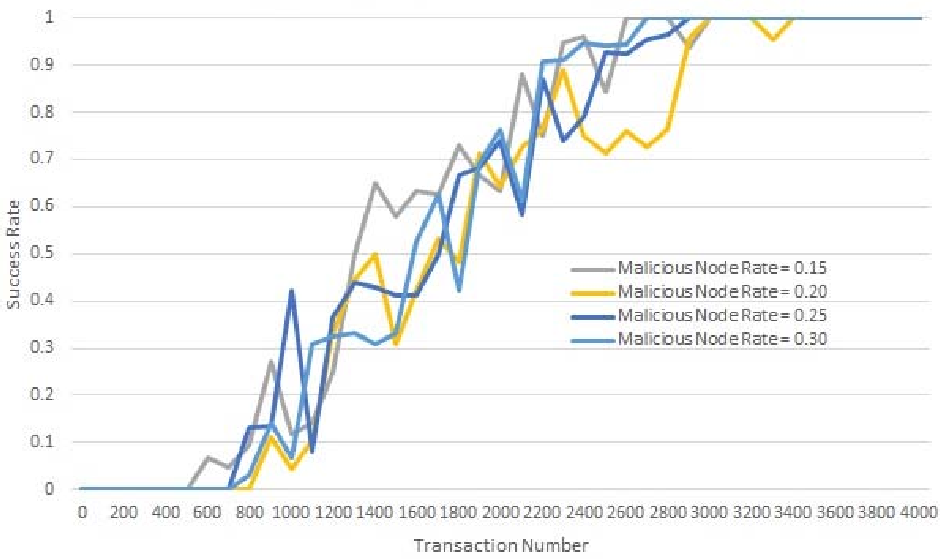 Figure 2: Success rate of malicious node detection over time with varying trust thresholds.
Critical Analysis & Conclusion
This paper successfully bridges the gap between social network theory and distributed ledger technology. By moving the computation to Fog nodes, they solve the latency issues typically associated with blockchain.
Takeaway for the Industry: The future of IoT security isn't just better encryption; it’s about social context. If a device wants to access your data, the system shouldn't just ask "Does it have the key?", but "Who are its friends, and what is its reputation in the community?"
Limitations: While robust, the system requires nodes to pay transaction costs (gas) to prevent DoS attacks. In low-power IoT scenarios, the economic model of who pays for trust evaluations needs further refinement to ensure sustainability.